| Weight | 1 lbs |
|---|---|
| Dimensions | 9 × 5 × 2 in |
| host | mouse |
| isotype | IgG2a |
| clonality | monoclonal |
| concentration | concentrate, predilute |
| applications | IHC |
| reactivity | human |
| available size | 0.1 mL, 0.5 mL, 1 mL concentrated, 7 mL prediluted |

mouse anti-Tyrosinase monoclonal antibody (T311) 6398
Price range: $160.00 through $528.00
Antibody summary
- Mouse monoclonal to Tyrosinase
- Suitable for: Immunohistochemistry (formalin-fixed, paraffin-embedded tissues)
- Reacts with: Human
- Isotype:IgG2a
- Control: Melanoma
- Visualization: Cytoplasmic
- 0.1, 0.5, 1.0 mL concentrated, 7 mL prediluted
mouse anti-Tyrosinase monoclonal antibody T311 6398
| target relevance |
|---|
| Homo sapiens TYR Tyrosinase |
| Protein names Tyrosinase |
| Alternative names LB24-AB, Monophenol monooxygenase, SK29-AB, Tumor rejection antigen AB |
| Gene names TYR |
| Protein family Belongs to the tyrosinase family |
| Function This is a copper-containing oxidase that functions in the formation of pigments such as melanins and other polyphenolic compounds. Catalyzes the initial and rate limiting step in the cascade of reactions leading to melanin production from tyrosine (By similarity). In addition to hydroxylating tyrosine to DOPA (3,4-dihydroxyphenylalanine), also catalyzes the oxidation of DOPA to DOPA-quinone, and possibly the oxidation of DHI (5,6-dihydroxyindole) to indole-5,6 quinone (PubMed:28661582) |
| Catalytic activity 2 L-dopa + O2 = 2 L-dopaquinone + 2 H2O L-tyrosine + O2 = L-dopaquinone + H2O 2 5,6-dihydroxyindole-2-carboxylate + O2 = 2 indole-5,6-quinone-2-carboxylate + 2 H2O |
| Subcellular location Melanosome membrane, Melanosome |
| Structure Forms an OPN3-dependent complex with DCT in response to blue light in melanocytes |
| Post-translational modification Glycosylated |
| Involvement in disease Albinism, oculocutaneous, 1A An autosomal recessive disorder in which the biosynthesis of melanin pigment is absent in skin, hair, and eyes. It is characterized by complete lack of tyrosinase activity due to production of an inactive enzyme. Patients present with a life-long absence of melanin pigment after birth, and manifest increased sensitivity to ultraviolet radiation with predisposition to skin cancer. Visual anomalies include decreased acuity, nystagmus, strabismus and photophobia. Albinism, oculocutaneous, 1B An autosomal recessive disorder in which the biosynthesis of melanin pigment is reduced in skin, hair, and eyes. It is characterized by partial lack of tyrosinase activity. Patients have white hair at birth that rapidly turns yellow or blond. They manifest the development of minimal-to-moderate amounts of cutaneous and ocular pigment. Some patients may have with white hair in the warmer areas (scalp and axilla) and progressively darker hair in the cooler areas (extremities). This variant phenotype is due to a loss of tyrosinase activity above 35-37 degrees C. |
| Keywords 3D-structure, Albinism, Alternative splicing, Copper, Deafness, Disease variant, Glycoprotein, Melanin biosynthesis, Membrane, Metal-binding, Monooxygenase, Oxidoreductase, Proteomics identification, Reference proteome, Signal, Transmembrane, Transmembrane helix, Tumor antigen, Waardenburg syndrome |
| Sequence MLLAVLYCLLWSFQTSAGHFPRACVSSKNLMEKECCPPWSGDRSPCGQLSGRGSCQNILL SNAPLGPQFPFTGVDDRESWPSVFYNRTCQCSGNFMGFNCGNCKFGFWGPNCTERRLLVR RNIFDLSAPEKDKFFAYLTLAKHTISSDYVIPIGTYGQMKNGSTPMFNDINIYDLFVWMH YYVSMDALLGGSEIWRDIDFAHEAPAFLPWHRLFLLRWEQEIQKLTGDENFTIPYWDWRD AEKCDICTDEYMGGQHPTNPNLLSPASFFSSWQIVCSRLEEYNSHQSLCNGTPEGPLRRN PGNHDKSRTPRLPSSADVEFCLSLTQYESGSMDKAANFSFRNTLEGFASPLTGIADASQS SMHNALHIYMNGTMSQVQGSANDPIFLLHHAFVDSIFEQWLRRHRPLQEVYPEANAPIGH NRESYMVPFIPLYRNGDFFISSKDLGYDYSYLQDSDPDSFQDYIKSYLEQASRIWSWLLG AAMVGAVLTALLAGLVSLLCRHKRKQLPEEKQPLLMEKEDYHSLYQSHL |
| UniProt accession: P14679 |
Data
 |
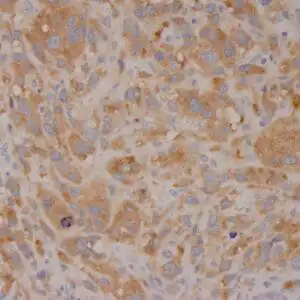
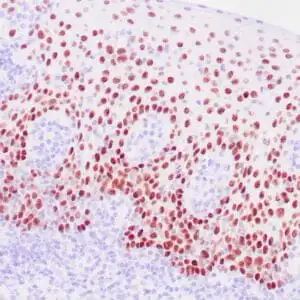
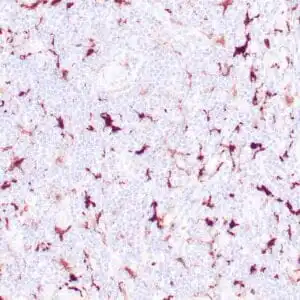
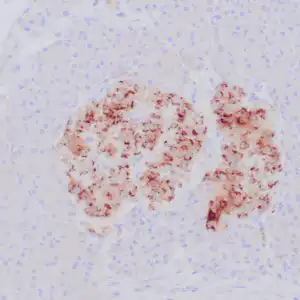
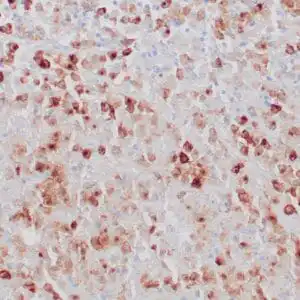
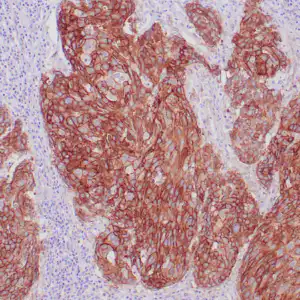
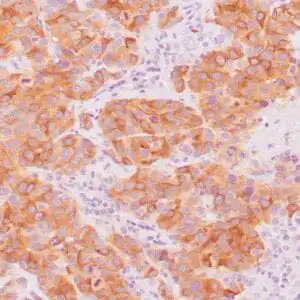
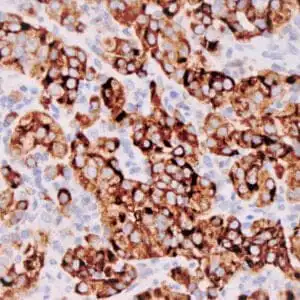
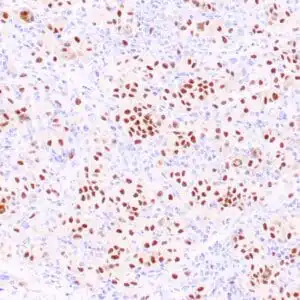
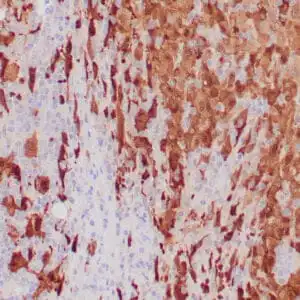
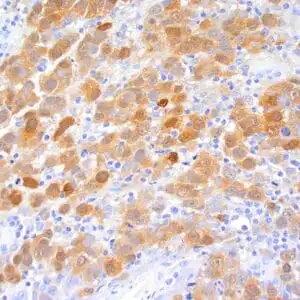
| Human melanoma stained with anti-tyrosinase antibody using peroxidase-conjugate and DAB chromogen. Note the cytoplasmic staining of tumor cells. |
FAQ & Publications
Frequently Asked Questions
What applications is the mouse anti-Tyrosinase monoclonal antibody (T311) validated for?
This antibody is validated for immunohistochemistry (IHC) applications on formalin-fixed, paraffin-embedded human tissue samples.
How should the mouse anti-Tyrosinase monoclonal antibody (T311) be stored to maintain its stability?
For short-term storage, keep the antibody at 2-8°C. For long-term storage, it should be kept at -20°C, and freeze/thaw cycles should be avoided to preserve antibody integrity.
Publications
| pmid | title | authors | citation |
|---|---|---|---|
| We haven't added any publications to our database yet. | |||
Published literature highly relevant to the biological target of this product and referencing this antibody or clone are retrieved from the PubMed database provided by the United States National Library of Medicine at the National Institutes of Health.
Protocols
| relevant to this product |
|---|
| IHC |
Documents
| Batch Number | QC File | SDS |
|---|---|---|
| To view batch-specific Safety Datasheets and Quality Certificates associated with your account, please Log In. | ||
Only logged in customers who have purchased this product may leave a review.
Reviews
There are no reviews yet.