| Weight | 1 lbs |
|---|---|
| Dimensions | 9 × 5 × 2 in |
| host | mouse |
| isotype | IgG1 |
| clonality | monoclonal |
| concentration | 1 mg/mL |
| applications | ICC/IF, WB |
| reactivity | SMRT |
| available sizes | 100 µg |

mouse anti-Smrt monoclonal antibody (H7) 7889
$503.00
Antibody summary
- Mouse monoclonal to Smrt
- Suitable for: WB,ICC/IF,IP
- Isotype: IgG1
- 100 µg
mouse anti-Smrt monoclonal antibody (H7) 7889
| antibody |
|---|
| Tested applications WB,ICC/IF,IP |
| Recommended dilutions Immunoblotting and Immunoprecipitation: use at 1-5 ug/mL. Positive control: HBL100 |
| Immunogen A KLH-conjugated synthetic peptide derived from human SMRT corresponding to aa 994-1005 |
| Size and concentration 100µg and lot specific |
| Form liquid |
| Storage Instructions This antibody is stable for at least one (1) year at -20°C. Avoid multiple freeze- thaw cycles. |
| Storage buffer 10 mM PBS, pH 7.4. |
| Purity immunogen affinity purification |
| Clonality monoclonal |
| Isotype IgG1 |
| Compatible secondaries goat anti-mouse IgG, H&L chain specific, peroxidase conjugated polyclonal antibody 5486 goat anti-mouse IgG, H&L chain specific, biotin conjugated, Conjugate polyclonal antibody 2685 goat anti-mouse IgG, H&L chain specific, FITC conjugated polyclonal antibody 7854 goat anti-mouse IgG, H&L chain specific, peroxidase conjugated polyclonal antibody, crossabsorbed 1706 goat anti-mouse IgG, H&L chain specific, biotin conjugated polyclonal antibody, crossabsorbed 1716 goat anti-mouse IgG, H&L chain specific, FITC conjugated polyclonal antibody, crossabsorbed 1721 |
| Isotype control Mouse monocolonal IgG1 - Isotype Control |
| target relevance |
|---|
| Homo sapiens NCOR2 Nuclear receptor corepressor 2 |
| Protein names Nuclear receptor corepressor 2 |
| Alternative names CTG repeat protein 26, SMAP270, Silencing mediator of retinoic acid and thyroid hormone receptor, T3 receptor-associating factor, Thyroid-, retinoic-acid-receptor-associated corepressor |
| Gene names NCOR2 |
| Protein family Belongs to the N-CoR nuclear receptor corepressors family |
| Function Transcriptional corepressor that mediates the transcriptional repression activity of some nuclear receptors by promoting chromatin condensation, thus preventing access of the basal transcription (PubMed:10077563, PubMed:10097068, PubMed:18212045, PubMed:20812024, PubMed:22230954, PubMed:23911289). Acts by recruiting chromatin modifiers, such as histone deacetylases HDAC1, HDAC2 and HDAC3 (PubMed:22230954). Required to activate the histone deacetylase activity of HDAC3 (PubMed:22230954). Involved in the regulation BCL6-dependent of the germinal center (GC) reactions, mainly through the control of the GC B-cells proliferation and survival (PubMed:18212045, PubMed:23911289). Recruited by ZBTB7A to the androgen response elements/ARE on target genes, negatively regulates androgen receptor signaling and androgen-induced cell proliferation (PubMed:20812024) |
| Subcellular location Nucleus |
| Structure Forms a large corepressor complex that contains SIN3A/B and histone deacetylases HDAC1 and HDAC2. This complex associates with the thyroid (TR) and the retinoid acid receptors (RAR) in the absence of ligand, and may stabilize their interaction with TFIIB. Interacts directly with RARA in the absence of ligand; the interaction represses RARA activity. Interacts (isoform SMRT) with HDAC10. Interacts with MINT. Component of the N-Cor repressor complex, at least composed of NCOR1, NCOR2, HDAC3, TBL1X, TBL1R, CORO2A and GPS2 (PubMed:10809664, PubMed:10944117, PubMed:11931768, PubMed:19858209, PubMed:21240272). Interacts with CBFA2T3 and ATXN1L. Interacts with RARB; the interaction is weak and does not repress RARB transactivational activity. Interacts (via 1D-myo-inositol 1,4,5,6-tetrakisphosphate) with HDAC3; promoting the histone deacetylase activity of HDAC3 (PubMed:22230954). Interacts with HDAC7 and C1D. Interacts with NR4A2; this interaction increases in the absence of PITX3. Interacts with BCL6 (via the BTB domain), required for BCL6 transcriptional repressor activity on a subset of target genes. Forms ternary complexes with BCOR and BCL6 on target gene promoters but, on enhancer elements, interacts with BCL6 and HDAC3 to repress proximal gene expression. May interact with DEAF1. Interacts with RXRA. Interacts with MECP2 (By similarity). Interacts with ZBTB7A (PubMed:20812024). Interacts with AR (PubMed:20812024). Interacts with TBL1Y (PubMed:30341416). Interacts with SANBR (via the BTB domain) (By similarity) |
| Keywords 3D-structure, Acetylation, Alternative splicing, Coiled coil, DNA-binding, Isopeptide bond, Methylation, Nucleus, Phosphoprotein, Proteomics identification, Reference proteome, Repeat, Repressor, Transcription, Transcription regulation, Ubl conjugation |
| Sequence MSGSTQPVAQTWRATEPRYPPHSLSYPVQIARTHTDVGLLEYQHHSRDYASHLSPGSIIQ PQRRRPSLLSEFQPGNERSQELHLRPESHSYLPELGKSEMEFIESKRPRLELLPDPLLRP SPLLATGQPAGSEDLTKDRSLTGKLEPVSPPSPPHTDPELELVPPRLSKEELIQNMDRVD REITMVEQQISKLKKKQQQLEEEAAKPPEPEKPVSPPPIESKHRSLVQIIYDENRKKAEA AHRILEGLGPQVELPLYNQPSDTRQYHENIKINQAMRKKLILYFKRRNHARKQWEQKFCQ RYDQLMEAWEKKVERIENNPRRRAKESKVREYYEKQFPEIRKQRELQERMQSRVGQRGSG LSMSAARSEHEVSEIIDGLSEQENLEKQMRQLAVIPPMLYDADQQRIKFINMNGLMADPM KVYKDRQVMNMWSEQEKETFREKFMQHPKNFGLIASFLERKTVAECVLYYYLTKKNENYK SLVRRSYRRRGKSQQQQQQQQQQQQQQQQQPMPRSSQEEKDEKEKEKEAEKEEEKPEVEN DKEDLLKEKTDDTSGEDNDEKEAVASKGRKTANSQGRRKGRITRSMANEANSEEAITPQQ SAELASMELNESSRWTEEEMETAKKGLLEHGRNWSAIARMVGSKTVSQCKNFYFNYKKRQ NLDEILQQHKLKMEKERNARRKKKKAPAAASEEAAFPPVVEDEEMEASGVSGNEEEMVEE AEALHASGNEVPRGECSGPATVNNSSDTESIPSPHTEAAKDTGQNGPKPPATLGADGPPP GPPTPPPEDIPAPTEPTPASEATGAPTPPPAPPSPSAPPPVVPKEEKEEETAAAPPVEEG EEQKPPAAEELAVDTGKAEEPVKSECTEEAEEGPAKGKDAEAAEATAEGALKAEKKEGGS GRATTAKSSGAPQDSDSSATCSADEVDEAEGGDKNRLLSPRPSLLTPTGDPRANASPQKP LDLKQLKQRAAAIPPIQVTKVHEPPREDAAPTKPAPPAPPPPQNLQPESDAPQQPGSSPR GKSRSPAPPADKEAFAAEAQKLPGDPPCWTSGLPFPVPPREVIKASPHAPDPSAFSYAPP GHPLPLGLHDTARPVLPRPPTISNPPPLISSAKHPSVLERQIGAISQGMSVQLHVPYSEH AKAPVGPVTMGLPLPMDPKKLAPFSGVKQEQLSPRGQAGPPESLGVPTAQEASVLRGTAL GSVPGGSITKGIPSTRVPSDSAITYRGSITHGTPADVLYKGTITRIIGEDSPSRLDRGRE DSLPKGHVIYEGKKGHVLSYEGGMSVTQCSKEDGRSSSGPPHETAAPKRTYDMMEGRVGR AISSASIEGLMGRAIPPERHSPHHLKEQHHIRGSITQGIPRSYVEAQEDYLRREAKLLKR EGTPPPPPPSRDLTEAYKTQALGPLKLKPAHEGLVATVKEAGRSIHEIPREELRHTPELP LAPRPLKEGSITQGTPLKYDTGASTTGSKKHDVRSLIGSPGRTFPPVHPLDVMADARALE RACYEESLKSRPGTASSSGGSIARGAPVIVPELGKPRQSPLTYEDHGAPFAGHLPRGSPV TTREPTPRLQEGSLSSSKASQDRKLTSTPREIAKSPHSTVPEHHPHPISPYEHLLRGVSG VDLYRSHIPLAFDPTSIPRGIPLDAAAAYYLPRHLAPNPTYPHLYPPYLIRGYPDTAALE NRQTIINDYITSQQMHHNAATAMAQRADMLRGLSPRESSLALNYAAGPRGIIDLSQVPHL PVLVPPTPGTPATAMDRLAYLPTAPQPFSSRHSSSPLSPGGPTHLTKPTTTSSSERERDR DRERDRDREREKSILTSTTTVEHAPIWRPGTEQSSGSSGGGGGSSSRPASHSHAHQHSPI SPRTQDALQQRPSVLHNTGMKGIITAVEPSTPTVLRSTSTSSPVRPAATFPPATHCPLGG TLDGVYPTLMEPVLLPKEAPRVARPERPRADTGHAFLAKPPARSGLEPASSPSKGSEPRP LVPPVSGHATIARTPAKNLAPHHASPDPPAPPASASDPHREKTQSKPFSIQELELRSLGY HGSSYSPEGVEPVSPVSSPSLTHDKGLPKHLEELDKSHLEGELRPKQPGPVKLGGEAAHL PHLRPLPESQPSSSPLLQTAPGVKGHQRVVTLAQHISEVITQDYTRHHPQQLSAPLPAPL YSFPGASCPVLDLRRPPSDLYLPPPDHGAPARGSPHSEGGKRSPEPNKTSVLGGGEDGIE PVSPPEGMTEPGHSRSAVYPLLYRDGEQTEPSRMGSKSPGNTSQPPAFFSKLTESNSAMV KSKKQEINKKLNTHNRNEPEYNISQPGTEIFNMPAITGTGLMTYRSQAVQEHASTNMGLE AIIRKALMGKYDQWEESPPLSANAFNPLNASASLPAAMPITAADGRSDHTLTSPGGGGKA KVSGRPSSRKAKSPAPGLASGDRPPSVSSVHSEGDCNRRTPLTNRVWEDRPSSAGSTPFP YNPLIMRLQAGVMASPPPPGLPAGSGPLAGPHHAWDEEPKPLLCSQYETLSDSE |
| UniProt accession: Q9Y618 |
Data
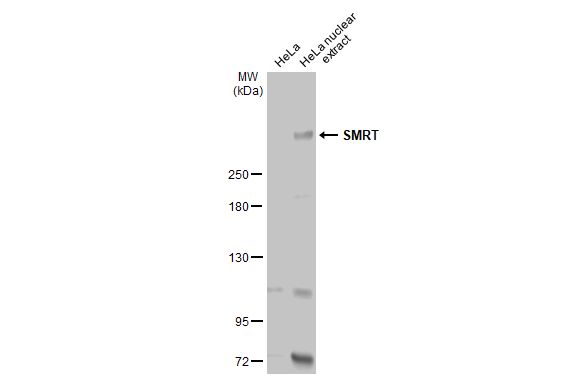 |
| HeLa whole cell and nuclear extracts (30 µg) were separated by 5% SDS-PAGE, and the membrane was blotted with SMRT antibody [1542] (7889) diluted at 1:1000. The HRP-conjugated anti-mouse IgG antibody was used to detect the primary antibody, and the signal was developed with Trident ECL plus-Enhanced. |
FAQ & Publications
Frequently Asked Questions
What applications is the mouse anti-Smrt monoclonal antibody (H7) validated for?
This antibody is validated for Western blotting (WB), immunocytochemistry/immunofluorescence (ICC/IF), and immunoprecipitation (IP) applications.
How should the mouse anti-Smrt monoclonal antibody (H7) be stored to maintain stability?
The antibody should be stored at -20°C and is stable for at least one year under these conditions. It is important to avoid multiple freeze-thaw cycles to preserve antibody integrity.
What is the immunogen used to generate the mouse anti-Smrt monoclonal antibody (H7)?
The immunogen is a KLH-conjugated synthetic peptide derived from human SMRT corresponding to amino acids 994 to 1005.
What is the concentration and size of the mouse anti-Smrt monoclonal antibody (H7) supplied?
The antibody is supplied at a concentration of 1 mg/mL in liquid form, with a size of 100 micrograms per vial.
Is the mouse anti-Smrt monoclonal antibody (H7) compatible with secondary antibodies? If so, which ones?
Yes, it is compatible with goat anti-mouse IgG secondary antibodies including H&L chain specific peroxidase conjugated, biotin conjugated, and FITC conjugated polyclonal antibodies, both standard and cross-adsorbed forms.
Publications
| pmid | title | authors | citation |
|---|---|---|---|
| We haven't added any publications to our database yet. | |||
Published literature highly relevant to the biological target of this product and referencing this antibody or clone are retrieved from the PubMed database provided by the United States National Library of Medicine at the National Institutes of Health.
Protocols
| relevant to this product |
|---|
| Western blot IHC ICC |
Documents
| Batch Number | QC File | SDS |
|---|---|---|
| To view batch-specific Safety Datasheets and Quality Certificates associated with your account, please Log In. | ||
Only logged in customers who have purchased this product may leave a review.


Reviews
There are no reviews yet.