| Weight | 1 lbs |
|---|---|
| Dimensions | 9 × 5 × 2 in |
| host | mouse |
| isotype | IgG1 |
| clonality | monoclonal |
| concentration | 1 mg/mL |
| applications | ICC/IF, WB |
| reactivity | RPA14 |
| available sizes | 100 µg |
mouse anti-RPA14 monoclonal antibody (11.1) 9765
$503.00
Antibody summary
- Mouse monoclonal to RPA14
- Suitable for: WB,IHC-P,IP
- Isotype: IgG1
- 100 µg
mouse anti-RPA14 monoclonal antibody (11.1) 9765
| antibody |
|---|
| Tested applications WB,IHC,IHC,IP |
| Recommended dilutions Immunoblotting, Immunoprecipitation: use at 0.2-1 ug/mL. Positive control: HeLa, Raji, and 3T3 cells and recombinant protein. |
| Immunogen N-terminally 6x-His tagged fusion protein corresponding to full-length human RPA14 expressed in E. coli. |
| Size and concentration 100µg and lot specific |
| Form liquid |
| Storage Instructions This antibody is stable for at least one (1) year at -70°C. Avoid multiple freeze- thaw cycles. |
| Storage buffer PBS, pH 7.4 |
| Purity protein affinity purification |
| Clonality monoclonal |
| Isotype IgG1 |
| Compatible secondaries goat anti-mouse IgG, H&L chain specific, peroxidase conjugated polyclonal antibody 5486 goat anti-mouse IgG, H&L chain specific, biotin conjugated, Conjugate polyclonal antibody 2685 goat anti-mouse IgG, H&L chain specific, FITC conjugated polyclonal antibody 7854 goat anti-mouse IgG, H&L chain specific, peroxidase conjugated polyclonal antibody, crossabsorbed 1706 goat anti-mouse IgG, H&L chain specific, biotin conjugated polyclonal antibody, crossabsorbed 1716 goat anti-mouse IgG, H&L chain specific, FITC conjugated polyclonal antibody, crossabsorbed 1721 |
| Isotype control Mouse monocolonal IgG1 - Isotype Control |
| target relevance |
|---|
| Homo sapiens RPA3 Replication protein A 14 kDa subunit |
| Protein names Replication protein A 14 kDa subunit |
| Alternative names Replication factor A protein 3 |
| Gene names RPA3 |
| Protein family Belongs to the replication factor A protein 3 family |
| Function As part of the heterotrimeric replication protein A complex (RPA/RP-A), binds and stabilizes single-stranded DNA intermediates that form during DNA replication or upon DNA stress. It prevents their reannealing and in parallel, recruits and activates different proteins and complexes involved in DNA metabolism. Thereby, it plays an essential role both in DNA replication and the cellular response to DNA damage (PubMed:17596542, PubMed:9430682). In the cellular response to DNA damage, the RPA complex controls DNA repair and DNA damage checkpoint activation. Through recruitment of ATRIP activates the ATR kinase a master regulator of the DNA damage response (PubMed:24332808). It is required for the recruitment of the DNA double-strand break repair factors RAD51 and RAD52 to chromatin, in response to DNA damage. Also recruits to sites of DNA damage proteins like XPA and XPG that are involved in nucleotide excision repair and is required for this mechanism of DNA repair (PubMed:7697716). Also plays a role in base excision repair (BER), probably through interaction with UNG (PubMed:9765279). RPA stimulates 5'-3' helicase activity of BRIP1/FANCJ (PubMed:17596542). Also recruits SMARCAL1/HARP, which is involved in replication fork restart, to sites of DNA damage. May also play a role in telomere maintenance. RPA3 has its own single-stranded DNA-binding activity and may be responsible for polarity of the binding of the complex to DNA (PubMed:19010961). As part of the alternative replication protein A complex, aRPA, binds single-stranded DNA and probably plays a role in DNA repair. Compared to the RPA2-containing, canonical RPA complex, may not support chromosomal DNA replication and cell cycle progression through S-phase. The aRPA may not promote efficient priming by DNA polymerase alpha but could support DNA synthesis by polymerase delta in presence of PCNA and replication factor C (RFC), the dual incision/excision reaction of nucleotide excision repair and RAD51-dependent strand exchange (PubMed:19996105) |
| Subcellular location Nucleus |
| Structure Component of the canonical replication protein A complex (RPA), a heterotrimer composed of RPA1, RPA2 and RPA3. Also a component of the aRPA, the alternative replication protein A complex, a trimeric complex similar to the replication protein A complex/RPA but where RPA1 and RPA3 are associated with RPA4 instead of RPA2. Interacts with BRIP1/FANCJ via the RPA1 subunit; following DNA damage they colocalize in foci in the nucleus (PubMed:17596542) |
| Post-translational modification Ubiquitinated by RFWD3 at stalled replication forks in response to DNA damage: ubiquitination by RFWD3 does not lead to degradation by the proteasome and promotes removal of the RPA complex from stalled replication forks, promoting homologous recombination (PubMed:26474068) |
| Keywords 3D-structure, Acetylation, DNA damage, DNA recombination, DNA repair, DNA replication, Isopeptide bond, Nucleus, Proteomics identification, Reference proteome, Ubl conjugation |
| Sequence MVDMMDLPRSRINAGMLAQFIDKPVCFVGRLEKIHPTGKMFILSDGEGKNGTIELMEPLD EEISGIVEVVGRVTAKATILCTSYVQFKEDSHPFDLGLYNEAVKIIHDFPQFYPLGIVQH D |
| UniProt accession: P35244 |
Data
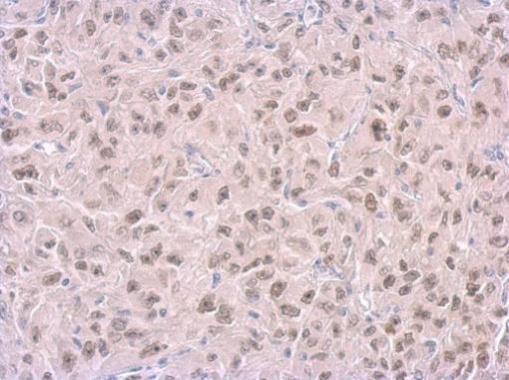 |
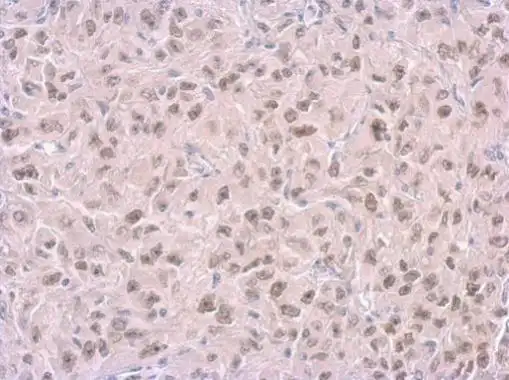
| RPA14 antibody [11.1] detects RPA14 protein at nucleus on Mahlarvu xenograft by immunohistochemical analysis. Sample: Paraffin-embedded Mahlarvu xenograft. RPA14 antibody [11.1] (9765) dilution: 1:200. Antigen Retrieval: Trilogy™ (EDTA based, pH 8.0) buffer, 15min |
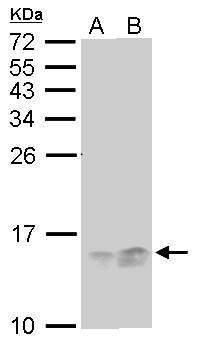 |
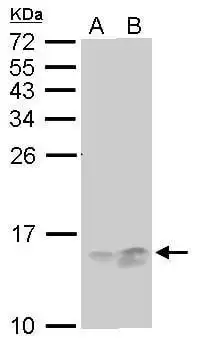
| RPA14 antibody [11.1] detects RPA14 protein by Western blot analysis. A. 30 µg A549 whole cell lysate/extract B. 30 µg MCF-7 whole cell lysate/extract 15 % SDS-PAGE RPA14 antibody [11.1] (9765) dilution: 1:1000 |
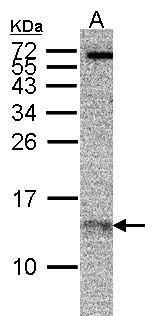 |
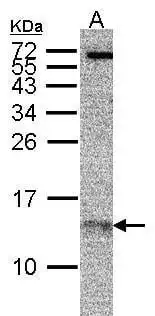
| Sample (30 µg of whole cell lysate) A: MCF7 15% SDS PAGE 9765 diluted at 1:500 |
FAQ & Publications
Frequently Asked Questions
What applications is the mouse anti-RPA14 monoclonal antibody (11.1) validated for?
This antibody is validated for Western blotting (WB), immunohistochemistry on paraffin-embedded sections (IHC-P), immunoprecipitation (IP), and immunocytochemistry/immunofluorescence (ICC/IF). Recommended dilutions are provided for immunoprecipitation at 0.2-1 µg/mL and Western blotting at 1:1000 or 1:500 dilution.
How should the mouse anti-RPA14 monoclonal antibody be stored to maintain stability?
The antibody should be stored at -70°C and is stable for at least one year under these conditions. It is important to avoid multiple freeze-thaw cycles to preserve antibody integrity.
What is the immunogen used to generate the mouse anti-RPA14 monoclonal antibody (11.1)?
The immunogen is a full-length human RPA14 protein expressed in E. coli, fused to an N-terminal 6x-His tag.
Which species does the mouse anti-RPA14 monoclonal antibody specifically react with?
This monoclonal antibody targets the RPA14 protein, specifically reacting with the human RPA14 protein as confirmed by immunohistochemical analysis on Mahlarvu xenograft samples and detection in human cell lines such as A549 and MCF-7.
Publications
| pmid | title | authors | citation |
|---|---|---|---|
| We haven't added any publications to our database yet. | |||
Published literature highly relevant to the biological target of this product and referencing this antibody or clone are retrieved from the PubMed database provided by the United States National Library of Medicine at the National Institutes of Health.
Protocols
| relevant to this product |
|---|
| Western blot IHC |
Documents
| Batch Number | QC File | SDS |
|---|---|---|
| To view batch-specific Safety Datasheets and Quality Certificates associated with your account, please Log In. | ||
Only logged in customers who have purchased this product may leave a review.


Reviews
There are no reviews yet.