| Weight | 1 lbs |
|---|---|
| Dimensions | 9 × 5 × 2 in |
| host | mouse |
| isotype | IgG1 |
| clonality | monoclonal |
| concentration | 1 mg/mL |
| applications | ICC/IF, WB |
| reactivity | p95/Nibrin |
| available sizes | 100 µg |


mouse anti-p95 monoclonal antibody (1D7) 1319
$503.00
Antibody summary
- Mouse monoclonal to p95
- Suitable for: WB,ICC/IF,IP
- Isotype: IgG1
- 100 µg
mouse anti-p95 monoclonal antibody (1D7) 1319
| antibody |
|---|
| Tested applications WB,ICC/IF,IP |
| Recommended dilutions Immunoblotting, Immunoprecipitation:: use at 1-2 ug/mL. In immunoblots, a band of 95 kD is detected. Positive controls: MCF-7, HeLa, or Raji cells. |
| Immunogen Fusion protein containing the complete coding region of human p95/nibrin expressed in E. coli. |
| Size and concentration 100µg and lot specific |
| Form liquid |
| Storage Instructions This antibody is stable for at least one (1) year at -70°C. Avoid multiple freeze- thaw cycles. |
| Storage buffer PBS, pH 7.4. |
| Purity protein affinity purification |
| Clonality monoclonal |
| Isotype IgG1 |
| Compatible secondaries goat anti-mouse IgG, H&L chain specific, peroxidase conjugated polyclonal antibody 5486 goat anti-mouse IgG, H&L chain specific, biotin conjugated, Conjugate polyclonal antibody 2685 goat anti-mouse IgG, H&L chain specific, FITC conjugated polyclonal antibody 7854 goat anti-mouse IgG, H&L chain specific, peroxidase conjugated polyclonal antibody, crossabsorbed 1706 goat anti-mouse IgG, H&L chain specific, biotin conjugated polyclonal antibody, crossabsorbed 1716 goat anti-mouse IgG, H&L chain specific, FITC conjugated polyclonal antibody, crossabsorbed 1721 |
| Isotype control Mouse monocolonal IgG1 - Isotype Control |
| target relevance |
|---|
| Homo sapiens NBN Nibrin |
| Protein names Nibrin |
| Alternative names Cell cycle regulatory protein p95, Nijmegen breakage syndrome protein 1 |
| Gene names NBN |
| Protein family Belongs to the Nibrin family |
| Function Component of the MRN complex, which plays a central role in double-strand break (DSB) repair, DNA recombination, maintenance of telomere integrity and meiosis (PubMed:10888888, PubMed:15616588, PubMed:18411307, PubMed:18583988, PubMed:18678890, PubMed:19759395, PubMed:23115235, PubMed:28216226, PubMed:28867292, PubMed:9705271). The MRN complex is involved in the repair of DNA double-strand breaks (DSBs) via homologous recombination (HR), an error-free mechanism which primarily occurs during S and G2 phases (PubMed:19759395, PubMed:28867292, PubMed:9705271). The complex (1) mediates the end resection of damaged DNA, which generates proper single-stranded DNA, a key initial steps in HR, and is (2) required for the recruitment of other repair factors and efficient activation of ATM and ATR upon DNA damage (PubMed:19759395, PubMed:9705271). The MRN complex possesses single-strand endonuclease activity and double-strand-specific 3'-5' exonuclease activity, which are provided by MRE11, to initiate end resection, which is required for single-strand invasion and recombination (PubMed:19759395, PubMed:28867292, PubMed:9705271). Within the MRN complex, NBN acts as a protein-protein adapter, which specifically recognizes and binds phosphorylated proteins, promoting their recruitment to DNA damage sites (PubMed:12419185, PubMed:15616588, PubMed:18411307, PubMed:18582474, PubMed:18583988, PubMed:18678890, PubMed:19759395, PubMed:19804756, PubMed:23762398, PubMed:24534091, PubMed:27814491, PubMed:27889449, PubMed:33836577). Recruits MRE11 and RAD50 components of the MRN complex to DSBs in response to DNA damage (PubMed:12419185, PubMed:18411307, PubMed:18583988, PubMed:18678890, PubMed:24534091, PubMed:26438602). Promotes the recruitment of PI3/PI4-kinase family members ATM, ATR, and probably DNA-PKcs to the DNA damage sites, activating their functions (PubMed:15064416, PubMed:15616588, PubMed:15790808, PubMed:16622404, PubMed:22464731, PubMed:30952868, PubMed:35076389). Mediates the recruitment of phosphorylated RBBP8/CtIP to DSBs, leading to cooperation between the MRN complex and RBBP8/CtIP to initiate end resection (PubMed:19759395, PubMed:27814491, PubMed:27889449, PubMed:33836577). RBBP8/CtIP specifically promotes the endonuclease activity of the MRN complex to clear DNA ends containing protein adducts (PubMed:27814491, PubMed:27889449, PubMed:30787182, PubMed:33836577). The MRN complex is also required for the processing of R-loops (PubMed:31537797). NBN also functions in telomere length maintenance via its interaction with TERF2: interaction with TERF2 during G1 phase preventing recruitment of DCLRE1B/Apollo to telomeres (PubMed:10888888, PubMed:28216226). NBN also promotes DNA repair choice at dysfunctional telomeres: NBN phosphorylation by CDK2 promotes non-homologous end joining repair at telomeres, while unphosphorylated NBN promotes microhomology-mediated end-joining (MMEJ) repair (PubMed:28216226). Enhances AKT1 phosphorylation possibly by association with the mTORC2 complex (PubMed:23762398) |
| Subcellular location Nucleus, Chromosome, Nucleus, PML body, Chromosome, telomere |
| Structure (Microbial infection) Interacts with herpes simplex virus 1 protein UL12 |
| Post-translational modification Phosphorylated by ATM in response of ionizing radiation, and such phosphorylation is responsible intra-S phase checkpoint control and telomere maintenance (PubMed:10766245, PubMed:10802669, PubMed:10839544, PubMed:10839545). Phosphorylated at Ser-432 by CDK2 in S/G2 phases abolishes interaction with TERF2, enabling DCLRE1B/Apollo recruitment to telomeres (PubMed:28216226). Phosphorylation at Ser-432 in response to dysfunctional telomeres promotes non-homologous end joining repair at telomeres, while dephosphorylation by PPP1CA promotes microhomology-mediated end-joining (MMEJ) repair (PubMed:28216226) Ubiquitinated at Lys-435 via 'Lys-6'-linked ubiquitin chains by RNF8, promoting NBN recruitment to DNA double-strand breaks (DSBs) (PubMed:23115235). Ubiquitinated at Lys-686 and Lys-689 via 'Lys-63'-linked ubiquitin chains by PELI1: ubiquitination takes place following PELI1 phosphorylation and promotes ATM activation and DNA repair (PubMed:30952868). Ubiquitinated at Lys-735 via 'Lys-63'-linked ubiquitin chains by the SCF(SKP2) complex: ubiquitination takes place following SKP2 phosphorylation and promotes ATM activation and DNA repair (PubMed:22464731) Lactylation at Lys-388 by KAT5 in response to DNA damage promotes recruitment of the MRN complex to DNA damage sites (PubMed:38961290). Delactylated by HDAC3 (PubMed:38961290) |
| Involvement in disease Nijmegen breakage syndrome A disorder characterized by chromosomal instability, radiation sensitivity, microcephaly, growth retardation, immunodeficiency and predisposition to cancer, particularly to lymphoid malignancies. Breast cancer A common malignancy originating from breast epithelial tissue. Breast neoplasms can be distinguished by their histologic pattern. Invasive ductal carcinoma is by far the most common type. Breast cancer is etiologically and genetically heterogeneous. Important genetic factors have been indicated by familial occurrence and bilateral involvement. Mutations at more than one locus can be involved in different families or even in the same case. Aplastic anemia A form of anemia in which the bone marrow fails to produce adequate numbers of peripheral blood elements. It is characterized by peripheral pancytopenia and marrow hypoplasia. |
| Keywords 3D-structure, Cell cycle, Chromosome, Direct protein sequencing, Disease variant, DNA damage, DNA repair, Host-virus interaction, Isopeptide bond, Meiosis, Nucleus, Phosphoprotein, Proteomics identification, Reference proteome, Telomere, Ubl conjugation |
| Sequence MWKLLPAAGPAGGEPYRLLTGVEYVVGRKNCAILIENDQSISRNHAVLTANFSVTNLSQT DEIPVLTLKDNSKYGTFVNEEKMQNGFSRTLKSGDGITFGVFGSKFRIEYEPLVACSSCL DVSGKTALNQAILQLGGFTVNNWTEECTHLVMVSVKVTIKTICALICGRPIVKPEYFTEF LKAVESKKQPPQIESFYPPLDEPSIGSKNVDLSGRQERKQIFKGKTFIFLNAKQHKKLSS AVVFGGGEARLITEENEEEHNFFLAPGTCVVDTGITNSQTLIPDCQKKWIQSIMDMLQRQ GLRPIPEAEIGLAVIFMTTKNYCDPQGHPSTGLKTTTPGPSLSQGVSVDEKLMPSAPVNT TTYVADTESEQADTWDLSERPKEIKVSKMEQKFRMLSQDAPTVKESCKTSSNNNSMVSNT LAKMRIPNYQLSPTKLPSINKSKDRASQQQQTNSIRNYFQPSTKKRERDEENQEMSSCKS ARIETSCSLLEQTQPATPSLWKNKEQHLSENEPVDTNSDNNLFTDTDLKSIVKNSASKSH AAEKLRSNKKREMDDVAIEDEVLEQLFKDTKPELEIDVKVQKQEEDVNVRKRPRMDIETN DTFSDEAVPESSKISQENEIGKKRELKEDSLWSAKEISNNDKLQDDSEMLPKKLLLTEFR SLVIKNSTSRNPSGINDDYGQLKNFKKFKKVTYPGAGKLPHIIGGSDLIAHHARKNTELE EWLRQEMEVQNQHAKEESLADDLFRYNPYLKRRR |
| UniProt accession: O60934 |
Data
 |
| Sample (30 µg of whole cell lysate) A: HepG2 7.5% SDS PAGE 1319 diluted at 1:1000 The HRP-conjugated anti-mouse IgG antibody was used to detect the primary antibody. |
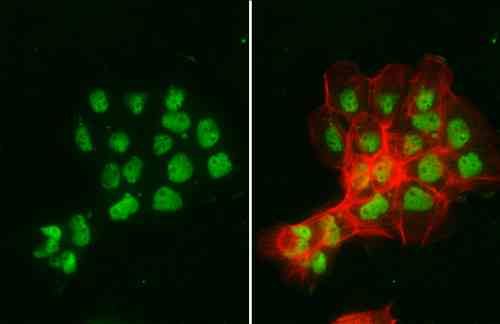 |
| NBS1 antibody [1D7] detects NBS1 protein at nucleus by immunofluorescent analysis.Sample: A431 cells were fixed in 4% paraformaldehyde at RT for 15 min.Green: NBS1 stained by NBS1 antibody [1D7] (1319) diluted at 1:500.Red: phalloidin, a cytoskeleton marker, diluted at 1:200. |
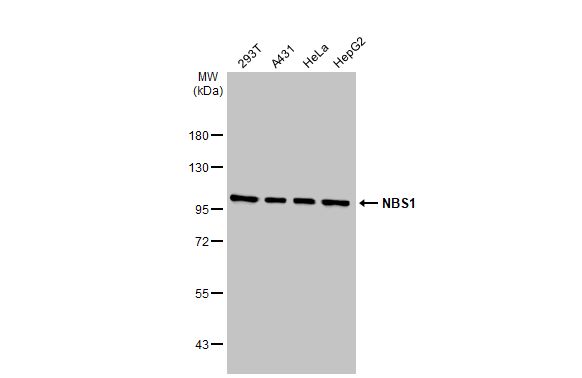 |
| Various whole cell extracts (30 µg) were separated by 7.5% SDS-PAGE, and the membrane was blotted with NBS1 antibody [1D7] (1319) diluted at 1:500. The HRP-conjugated anti-mouse IgG antibody was used to detect the primary antibody. |
FAQ & Publications
Frequently Asked Questions
What applications is the mouse anti-p95 monoclonal antibody (1D7) validated for?
This antibody has been tested and is suitable for Western Blotting (WB), Immunocytochemistry/Immunofluorescence (ICC/IF), and Immunoprecipitation (IP) applications.
How should the mouse anti-p95 monoclonal antibody (1D7) be stored to maintain stability?
The antibody should be stored at -70°C and is stable for at least one year under these conditions. It is important to avoid multiple freeze-thaw cycles to preserve antibody integrity.
What is the recommended concentration and dilution for using this antibody in immunoprecipitation and immunoblotting?
For immunoprecipitation, the antibody is recommended to be used at 1-2 µg/mL. In immunoblotting, it detects a band at 95 kDa corresponding to the p95/Nibrin protein.
What is the immunogen used to generate the mouse anti-p95 monoclonal antibody (1D7)?
The immunogen is a fusion protein containing the complete coding region of human p95/Nibrin, expressed in Escherichia coli.
Which secondary antibodies are compatible for detection with this mouse anti-p95 monoclonal antibody?
Compatible secondary antibodies include goat anti-mouse IgG H&L chain specific antibodies conjugated with peroxidase, biotin, or FITC, available both as standard and cross-absorbed polyclonal antibodies.
Publications
| pmid | title | authors | citation |
|---|---|---|---|
| We haven't added any publications to our database yet. | |||
Published literature highly relevant to the biological target of this product and referencing this antibody or clone are retrieved from the PubMed database provided by the United States National Library of Medicine at the National Institutes of Health.
Protocols
| relevant to this product |
|---|
| Western blot IHC ICC |
Documents
| Batch Number | QC File | SDS |
|---|---|---|
| To view batch-specific Safety Datasheets and Quality Certificates associated with your account, please Log In. | ||
Only logged in customers who have purchased this product may leave a review.


Reviews
There are no reviews yet.