| Weight | 1 lbs |
|---|---|
| Dimensions | 9 × 5 × 2 in |
| host | mouse |
| isotype | IgG1 |
| clonality | monoclonal |
| concentration | 1 mg/mL |
| applications | ICC/IF, WB |
| reactivity | Measles Phosphoprotein |
| available sizes | 100 µg |
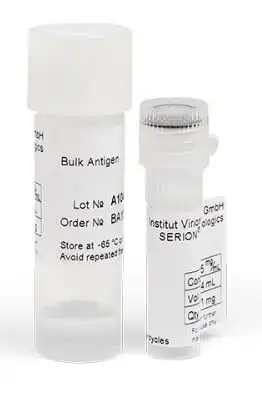
mouse anti-Measles Phosphoprotein monoclonal antibody (9H4) 3804
$520.00
Antibody summary
- Mouse monoclonal to Measles Phosphoprotein
- Suitable for: WB,ICC,ELISA
- Isotype: IgG1
- 100 µg
mouse anti-Measles Phosphoprotein monoclonal antibody (9H4) 3804
| antibody |
|---|
| Tested applications WB,ICC/IF,ELISA |
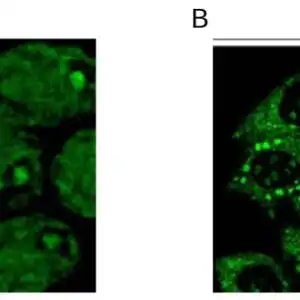
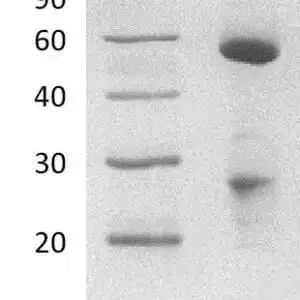
| Recommended dilutions ELISA: use at 0.1-1.0ug/ml Immunoblotting: User should use at 1-5ug/ml. A band of ~70kDa is detected Immunocytochemistry: use at 2- 10ug/ml on virus-infected cells. These are recommended concentrations. End user should determine optimal concentrations for the |
| Immunogen Recombinant Measles virus phosphoprotein. |
| Size and concentration 100µg and |
| Form lyophilized |
| Storage Instructions This product is stable for at least one (1) year at -20°C to -70°C. Reconstituted product should be stored in appropriate aliquots to avoid repeated freeze-thaw cycles. |
| Storage buffer Lyophilized, 0.1M Tris, 0.1M glycine, 2% sucrose |
| Purity protein affinity purification |
| Clonality monoclonal |
| Isotype IgG1 |
| Compatible secondaries goat anti-mouse IgG, H&L chain specific, peroxidase conjugated polyclonal antibody 5486 goat anti-mouse IgG, H&L chain specific, biotin conjugated, Conjugate polyclonal antibody 2685 goat anti-mouse IgG, H&L chain specific, FITC conjugated polyclonal antibody 7854 goat anti-mouse IgG, H&L chain specific, peroxidase conjugated polyclonal antibody, crossabsorbed 1706 goat anti-mouse IgG, H&L chain specific, biotin conjugated polyclonal antibody, crossabsorbed 1716 goat anti-mouse IgG, H&L chain specific, FITC conjugated polyclonal antibody, crossabsorbed 1721 |
| Isotype control Mouse monocolonal IgG1 - Isotype Control |
| target relevance |
|---|
| Measles virus (strain Edmonston-AIK-C vaccine) P/V Phosphoprotein |
| Protein names Phosphoprotein |
| Gene names P/V |
| Protein family Belongs to the morbillivirus P protein family |
| Function Essential cofactor of the RNA polymerase L that plays a central role in the transcription and replication by forming the polymerase complex with RNA polymerase L and recruiting L to the genomic N-RNA template for RNA synthesis (By similarity). Also plays a central role in the encapsidation of nascent RNA chains by forming the encapsidation complex with the nucleocapsid protein N (N-P complex). Acts as a chaperone for newly synthesized free N protein, so-called N0, allowing encapsidation of nascent RNA chains during replication (By similarity). The nucleoprotein protein N prevents excessive phosphorylation of P, which leads to down-regulation of viral transcription/ replication. Participates, together with N, in the formation of viral factories (viroplasms), which are large inclusions in the host cytoplasm where replication takes place (By similarity) |
| Structure Homotetramer (By similarity). Interacts (via multimerization domain and XD domain) with polymerase L; this interaction forms the polymerase L-P complex (By similarity). Interacts (via N-terminus) with N0 (via Ncore); this interaction allows P to chaperon N0 to avoid N polymerization and non-specific RNA binding before encapsidation (By similarity). Interacts (via C-terminus) with N-RNA template (via Ntail); this interaction maintains the P/L complex anchored to the nucleocapsid template during the sequential transcription (By similarity). Interacts (via C-terminus) with protein C; this interaction allows C to associate with the ribonucleocapsid and regulate the polymerase activity (By similarity) |
| Post-translational modification Phosphorylation on serines by host CK2 is necessary for the formation of viral factories |
| Keywords 3D-structure, Phosphoprotein, RNA editing, Viral RNA replication |
| Sequence MAEEQARHVKNGLECIRALKAEPIGSLAIEEAMAAWSEISDNPGQERATCREEKAGSSGL SKPCLSAIGSTEGGAPRIRGQGPGESDDDAETLGIPPRNLQASSTGLQCYYVYDHSGEAV KGIQDADSIMVQSGLDGDSTLSGGDNESENSDVDIGEPDTEGYAITDRGSAPISMGFRAS DVETAEGGEIHELLRLQSRGNNFPKLGKTLNVPPPPDPGRASTSGTPIKKGTERRLASFG TEIASLLTGGATQCARKSPSEPSGPGAPAGNVPEYVSNAALIQEWTPESGTTISPRSQNN EEGGDYYDDELFSDVQDIKTALAKIHEDNQKIISKLESLLLLKGEVESIKKQINRQNISI STLEGHLSSIMIAIPGLGKDPNDPTADVEINPDLKPIIGRDSGRALAEVLKKPVASRQLQ GMTNGRTSSRGQLLKEFQPKPIGKKMSSAVGFVPDTGPASRSVIRSIIKSSRLEEDRKRY LMTLLDDIKGANDLAKFHQMLMKIIMK |
| UniProt accession: P35974 |
Data
| No results found |
FAQ & Publications
Frequently Asked Questions
What applications has the mouse anti-Measles Phosphoprotein monoclonal antibody (9H4) been validated for?
This monoclonal antibody has been tested and is suitable for Western blotting (WB), immunocytochemistry/immunofluorescence (ICC/IF), and ELISA applications.
How should the mouse anti-Measles Phosphoprotein antibody be stored to maintain stability?
The antibody is stable for at least one year when stored lyophilized at temperatures between -20°C and -70°C. After reconstitution, it should be aliquoted appropriately to avoid repeated freeze-thaw cycles.
What is the recommended concentration range for using this antibody in ELISA and immunocytochemistry?
For ELISA, the recommended concentration is 0.1 to 1.0 µg/mL. For immunocytochemistry on virus-infected cells, use the antibody at 2 to 10 µg/mL. Users should optimize concentrations based on their specific experimental conditions.
What is the immunogen used to generate the mouse anti-Measles Phosphoprotein monoclonal antibody (9H4)?
The immunogen used is recombinant Measles virus phosphoprotein, ensuring specificity for the target protein.
Publications
| pmid | title | authors | citation |
|---|---|---|---|
| We haven't added any publications to our database yet. | |||
Published literature highly relevant to the biological target of this product and referencing this antibody or clone are retrieved from the PubMed database provided by the United States National Library of Medicine at the National Institutes of Health.
Protocols
| relevant to this product |
|---|
| Western blot IHC ICC |
Documents
| Batch Number | QC File | SDS |
|---|---|---|
| To view batch-specific Safety Datasheets and Quality Certificates associated with your account, please Log In. | ||
Only logged in customers who have purchased this product may leave a review.


Reviews
There are no reviews yet.