| Weight | 1 lbs |
|---|---|
| Dimensions | 9 × 5 × 2 in |
| host | mouse |
| isotype | IgG1 |
| clonality | monoclonal |
| concentration | 1 mg/mL |
| applications | ICC/IF, WB |
| reactivity | Measles Nucleoprotein |
| available sizes | 100 µg |

mouse anti-Measles Nucleoprotein monoclonal antibody (2F3) 5089
$520.00
Antibody summary
- Mouse monoclonal to Measles Nucleoprotein
- Suitable for: WB,ICC,ELISA
- Isotype: IgG1
- 100 µg
mouse anti-Measles Nucleoprotein monoclonal antibody (2F3) 5089
| antibody |
|---|
| Tested applications WB,ICC/IF,ELISA |
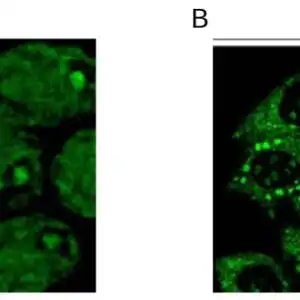
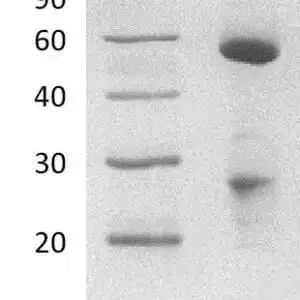
| Recommended dilutions ELISA: use at 0.1-1.0ug/ml Immunoblotting: User should use at 1-5ug/ml. A band of ~60kDa is detected Immunocytochemistry: use at 2- 10ug/ml on virus-infected cells. These are recommended concentrations. End user should determine optimal concentrations for the |
| Immunogen Recombinant Measles virus nucleoprotein. |
| Size and concentration 100µg and |
| Form lyophilized |
| Storage Instructions This product is stable for at least one (1) year at -20°C to -70°C. Reconstituted product should be stored in appropriate aliquots to avoid repeated freeze-thaw cycles. |
| Storage buffer Lyophilized, 0.1M Tris, 0.1M glycine, 2% sucrose |
| Purity protein affinity purification |
| Clonality monoclonal |
| Isotype IgG1 |
| Compatible secondaries goat anti-mouse IgG, H&L chain specific, peroxidase conjugated polyclonal antibody 5486 goat anti-mouse IgG, H&L chain specific, biotin conjugated, Conjugate polyclonal antibody 2685 goat anti-mouse IgG, H&L chain specific, FITC conjugated polyclonal antibody 7854 goat anti-mouse IgG, H&L chain specific, peroxidase conjugated polyclonal antibody, crossabsorbed 1706 goat anti-mouse IgG, H&L chain specific, biotin conjugated polyclonal antibody, crossabsorbed 1716 goat anti-mouse IgG, H&L chain specific, FITC conjugated polyclonal antibody, crossabsorbed 1721 |
| Isotype control Mouse monocolonal IgG1 - Isotype Control |
| target relevance |
|---|
| Measles virus (strain Edmonston B) N Nucleoprotein |
| Protein names Nucleoprotein |
| Alternative names Nucleocapsid protein |
| Gene names N |
| Protein family Belongs to the paramyxoviruses nucleocapsid family |
| Function Forms the helical nucleocapsid (NC) in a ratio of 1 N per 6 ribonucleotides, protecting the genome from nucleases (By similarity). The nucleocapsid (NC) has a helical structure with either 12.35 or 11.64 N per turn, approximately 20 nm in diameter, with a hollow central cavity approximately 5 nm in diameter (By similarity). The encapsidated genomic RNA serves as template for transcription and replication; encapsidation by N is coupled to RNA synthesis (By similarity). Forms the encapsidation complex with the phosphoprotein protein P (PubMed:26719278). Before encapsidation, the newly synthesized free N protein, so-called N0, is chaperoned by P (By similarity). Participates, together with P, in the formation of viral factories (viroplasms), which are large inclusions in the host cytoplasm where replication takes place (By similarity). N is released in the blood following lysis of measles infected cells, it interacts then with human FCGR2B on immune cells, inducing apoptosis and blocking inflammatory immune response (PubMed:15914856) |
| Subcellular location Virion, Host cytoplasm, Host nucleus |
| Structure Homomultimer; forms the nucleocapsid (By similarity). Binds to viral genomic RNA (By similarity). N0 interacts (via Ncore) with the phosphoprotein (via N-terminus); this interaction allows P to chaperon N0 to avoid N polymerization and non-specific RNA binding before encapsidation (PubMed:26719278). Interacts (via the Ntail) as N-RNA template with the phosphoprotein (via C-terminus XD); this interaction maintains the P/L complex anchored to the nucleocapsid template during the sequential transcription (By similarity). Interacts with the phosphoprotein; this interaction leads to the formation of membraneless organelles that function as viral replication factories (By similarity). Interacts (via Ncore) with human FCGR2B protein (PubMed:15914856). Interacts (via Ntail) with a protein on human thymic epithelial cells, termed Nucleoprotein Receptor (NR); this interaction induces growth arrest (PubMed:15914856, PubMed:14557619). Interacts with human PPIA/CYPA and PPIB/CYPB (By similarity) |
| Post-translational modification Phosphorylation at Thr-279 is required for the formation of the nucleocapsid |
| Keywords 3D-structure, Capsid protein, Helical capsid protein, Host cytoplasm, Host nucleus, Host-virus interaction, Phosphoprotein, Ribonucleoprotein, RNA-binding, Viral nucleoprotein, Virion |
| Sequence MATLLRSLALFKRNKDKPPITSGSGGAIRGIKHIIIVPIPGDSSITTRSRLLDRLVRLIG NPDVSGPKLTGALIGILSLFVESPGQLIQRITDDPDVSIRLLEVVQSDQSQSGLTFASRG TNMEDEADQYFSHDDPISSDQSRFGWFENKEISDIEVQDPEGFNMILGTILAQIWVLLAK AVTAPDTAADSELRRWIKYTQQRRVVGEFRLERKWLDVVRNRIAEDLSLRRFMVALILDI KRTPGNKPRIAEMICDIDTYIVEAGLASFILTIKFGIETMYPALGLHEFAGELSTLESLM NLYQQMGETAPYMVILENSIQNKFSAGSYPLLWSYAMGVGVELENSMGGLNFGRSYFDPA YFRLGQEMVRRSAGKVSSTLASELGITAEDARLVSEIAMHTTEDKISRAVGPRQAQVSFL HGDQSENELPRLGGKEDRRVKQSRGEARESYRETGPSRASDARAAHLPTGTPLDIDTASE SSQDPQDSRRSADALLRLQAMAGISEEQGSDTDTPIVYNDRNLLD |
| UniProt accession: P0DXN6 |
Data
| No results found |
FAQ & Publications
Frequently Asked Questions
What applications is the mouse anti-Measles Nucleoprotein monoclonal antibody (2F3) validated for?
This antibody is validated for Western blot (WB), immunocytochemistry/immunofluorescence (ICC/IF), and ELISA applications.
How should the mouse anti-Measles Nucleoprotein monoclonal antibody (2F3) be stored to maintain stability?
The lyophilized antibody should be stored at -20°C to -70°C and is stable for at least one year under these conditions. After reconstitution, it should be aliquoted appropriately to avoid repeated freeze-thaw cycles.
Publications
| pmid | title | authors | citation |
|---|---|---|---|
| We haven't added any publications to our database yet. | |||
Published literature highly relevant to the biological target of this product and referencing this antibody or clone are retrieved from the PubMed database provided by the United States National Library of Medicine at the National Institutes of Health.
Protocols
| relevant to this product |
|---|
| Western blot IHC ICC |
Documents
| Batch Number | QC File | SDS |
|---|---|---|
| To view batch-specific Safety Datasheets and Quality Certificates associated with your account, please Log In. | ||
Only logged in customers who have purchased this product may leave a review.


Reviews
There are no reviews yet.