| Weight | 1 lbs |
|---|---|
| Dimensions | 9 × 5 × 2 in |
| host | mouse |
| isotype | IgG1 |
| clonality | monoclonal |
| concentration | 1 mg/mL |
| applications | ICC/IF, WB |
| reactivity | Heme Oxygenase-1 |
| available sizes | 100 µg |


mouse anti-Heme Oxygenase-1 monoclonal antibody (GTS-1) 2852
$509.00
Antibody summary
- Mouse monoclonal to Heme Oxygenase-1
- Suitable for: ELISA
- Isotype: IgG1
- 100 µg
mouse anti-Heme Oxygenase-1 monoclonal antibody (GTS-1) 2852
| antibody |
|---|
| Tested applications ELISA |
| Recommended dilutions Immunoblotting: use at 5-10ug/mL. A band of ~33kDa is detected. Immunohistochemistry: use at 5-10ug/mL on human frozen or paraffin-embedded tissue. Antigen retrieval with 0.4ug/mL Proteinase K. These are recommended concentrations. Endusers should determine optimal concentra |
| Immunogen Microsomal fraction of transformed mouse T-cell transfected with rat heme oxygenase- 1 (WR19LrHO-1). |
| Size and concentration 100µg and |
| Form lyophilized |
| Storage Instructions Stock solution of 2mg/ml should be stored for one (1) year at -20°C in appropriate aliquots to avoid multiple freeze-thaw cycles or at 4°C for 6 months with the addition of 0.1% sodium a |
| Storage buffer PBS, pH 7.4, 1% BSA., lyophilized. |
| Purity immunogen affinity purification |
| Clonality monoclonal |
| Isotype IgG1 |
| Compatible secondaries goat anti-mouse IgG, H&L chain specific, peroxidase conjugated polyclonal antibody 5486 goat anti-mouse IgG, H&L chain specific, biotin conjugated, Conjugate polyclonal antibody 2685 goat anti-mouse IgG, H&L chain specific, FITC conjugated polyclonal antibody 7854 goat anti-mouse IgG, H&L chain specific, peroxidase conjugated polyclonal antibody, crossabsorbed 1706 goat anti-mouse IgG, H&L chain specific, biotin conjugated polyclonal antibody, crossabsorbed 1716 goat anti-mouse IgG, H&L chain specific, FITC conjugated polyclonal antibody, crossabsorbed 1721 |
| Isotype control Mouse monocolonal IgG1 - Isotype Control |
| target relevance |
|---|
| Homo sapiens HMOX1 Heme oxygenase 1 |
| Protein names Heme oxygenase 1 |
| Gene names HMOX1 |
| Protein family Belongs to the heme oxygenase family |
| Function Catalyzes the oxidative cleavage of heme at the alpha-methene bridge carbon, released as carbon monoxide (CO), to generate biliverdin IXalpha, while releasing the central heme iron chelate as ferrous iron (PubMed:11121422, PubMed:19556236, PubMed:7703255). Affords protection against programmed cell death and this cytoprotective effect relies on its ability to catabolize free heme and prevent it from sensitizing cells to undergo apoptosis (PubMed:20055707) |
| Catalytic activity heme b + 3 reduced [NADPH--hemoprotein reductase] + 3 O2 = biliverdin IXalpha + CO + Fe(2+) + 3 oxidized [NADPH--hemoprotein reductase] + 3 H2O + H(+) |
| Subcellular location Endoplasmic reticulum membrane |
| Structure Homodimer and higher order homooligomer (PubMed:19556236). Oligomerization is crucial for its stability and function in the endoplasmic reticulum (PubMed:19556236). Interacts with FLVCR2; this interaction is potentiated in the presence of heme |
| Post-translational modification A soluble form arises by proteolytic removal of the membrane anchor |
| Involvement in disease Heme oxygenase 1 deficiency A disease characterized by impaired stress hematopoiesis, resulting in marked erythrocyte fragmentation and intravascular hemolysis, coagulation abnormalities, endothelial damage, and iron deposition in renal and hepatic tissues. Clinical features include persistent hemolytic anemia, asplenia, nephritis, generalized erythematous rash, growth retardation and hepatomegaly. |
| Keywords 3D-structure, Apoptosis, Endoplasmic reticulum, Heme, Host-virus interaction, Iron, Membrane, Metal-binding, Oxidoreductase, Phosphoprotein, Proteomics identification, Reference proteome, Transmembrane, Transmembrane helix |
| Sequence MERPQPDSMPQDLSEALKEATKEVHTQAENAEFMRNFQKGQVTRDGFKLVMASLYHIYVA LEEEIERNKESPVFAPVYFPEELHRKAALEQDLAFWYGPRWQEVIPYTPAMQRYVKRLHE VGRTEPELLVAHAYTRYLGDLSGGQVLKKIAQKALDLPSSGEGLAFFTFPNIASATKFKQ LYRSRMNSLEMTPAVRQRVIEEAKTAFLLNIQLFEELQELLTHDTKDQSPSRAPGLRQRA SNKVQDSAPVETPRGKPPLNTRSQAPLLRWVLTLSFLVATVAVGLYAM |
| UniProt accession: P09601 |
Data
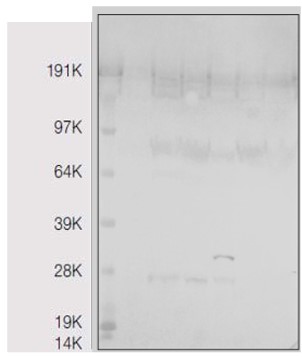 |
| Immunoblotting: use at 5-10ug/ml. A band of ~33kDa is detected. Detection of rat HO-1 with #2852 at 5ug/ml. |
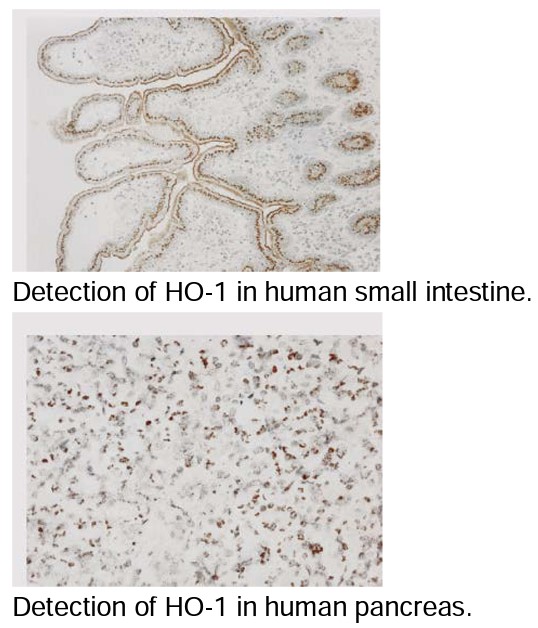 |
| Immunohistochemistry: use at 5-10ug/ml on human frozen or paraffin-embedded tissue. Antigen retrieval with 0.4ug/ml Proteinase K. |
FAQ & Publications
Frequently Asked Questions
What are the recommended applications and dilutions for the mouse anti-Heme Oxygenase-1 monoclonal antibody (GTS-1) 2852?
This antibody is suitable for ELISA, immunocytochemistry/immunofluorescence (ICC/IF), and Western blotting (WB). For immunoblotting, use at 5-10 µg/mL, which detects a band of approximately 33 kDa. For immunohistochemistry on human frozen or paraffin-embedded tissue, use at 5-10 µg/mL with antigen retrieval using 0.4 µg/mL Proteinase K. These are recommended starting concentrations; end users should determine the optimal concentration for their specific application.
How should the mouse anti-Heme Oxygenase-1 monoclonal antibody (GTS-1) 2852 be stored to maintain stability?
The stock solution at 2 mg/mL should be stored at -20°C in appropriate aliquots to avoid multiple freeze-thaw cycles for up to one year. Alternatively, it can be stored at 4°C for up to six months with the addition of 0.1% sodium azide. The lyophilized antibody is supplied in PBS, pH 7.4, with 1% BSA.
What is the immunogen used to generate the mouse anti-Heme Oxygenase-1 monoclonal antibody (GTS-1) 2852?
The immunogen is the microsomal fraction of transformed mouse T-cells transfected with rat heme oxygenase-1 (WR19LrHO-1).
Publications
| pmid | title | authors | citation |
|---|---|---|---|
| We haven't added any publications to our database yet. | |||
Published literature highly relevant to the biological target of this product and referencing this antibody or clone are retrieved from the PubMed database provided by the United States National Library of Medicine at the National Institutes of Health.
Protocols
| relevant to this product |
|---|
| ELISA |
Documents
| Batch Number | QC File | SDS |
|---|---|---|
| To view batch-specific Safety Datasheets and Quality Certificates associated with your account, please Log In. | ||
Only logged in customers who have purchased this product may leave a review.


Reviews
There are no reviews yet.