| Weight | 1 lbs |
|---|---|
| Dimensions | 9 × 5 × 2 in |
| host | mouse |
| isotype | IgG1 |
| clonality | monoclonal |
| concentration | 1 mg/mL |
| applications | ICC/IF, WB |
| reactivity | Glutathione-S-Transferase (GST) |
| available sizes | 100 µg |


mouse anti-GST monoclonal antibody (3G10) 4677
$503.00
Antibody summary
- Mouse monoclonal to GST
- Suitable for: WB,IP
- Isotype: IgG1
- 100 µg
mouse anti-GST monoclonal antibody (3G10) 4677
| antibody |
|---|
| Tested applications WB,IP |
| Recommended dilutions Immunoblotting: use at 0.2-2ug/mL. These are recommended concentrations. Endusers should determine optimal concentrations for their applications. |
| Immunogen GST protein of Schistosoma japonicum expressed in E. coli. |
| Size and concentration 100µg and 1 mg/mL |
| Form liquid |
| Storage Instructions This antibody is stable for at least one (1) year at -20°C. |
| Storage buffer PBS, pH 7.4. |
| Purity protein affinity purification |
| Clonality monoclonal |
| Isotype IgG1 |
| Compatible secondaries goat anti-mouse IgG, H&L chain specific, peroxidase conjugated polyclonal antibody 5486 goat anti-mouse IgG, H&L chain specific, biotin conjugated, Conjugate polyclonal antibody 2685 goat anti-mouse IgG, H&L chain specific, FITC conjugated polyclonal antibody 7854 goat anti-mouse IgG, H&L chain specific, peroxidase conjugated polyclonal antibody, crossabsorbed 1706 goat anti-mouse IgG, H&L chain specific, biotin conjugated polyclonal antibody, crossabsorbed 1716 goat anti-mouse IgG, H&L chain specific, FITC conjugated polyclonal antibody, crossabsorbed 1721 |
| Isotype control Mouse monocolonal IgG1 - Isotype Control |
| target relevance |
|---|
| Schistosoma japonicum GST28 Glutathione S-transferase class-mu 28 kDa isozyme |
| Protein names Glutathione S-transferase class-mu 28 kDa isozyme |
| Alternative names Sj28 antigen, Sj28GST |
| Protein family Belongs to the GST superfamily. Mu family |
| Function Conjugation of reduced glutathione to a wide number of exogenous and endogenous hydrophobic electrophiles |
| Catalytic activity RX + glutathione = an S-substituted glutathione + a halide anion + H(+) |
| Structure Homodimer |
| Keywords Transferase |
| Sequence VKLIYFNGRGRAEPIRMILVAAGVEFEDERIEFQDWPKIKPTIPGGRLPIVKITDKRGDV KTMSESLAIARFIARKHNMMGDTDDEYYIIEKMIGQVEDVESEYHKTLIKPPEEKEKISK EILNGKVPILLQAICETLKESTGNLTVGDKVTLADVVLIASIDHITDLDKEFLTGKYPEI HKHRKHLLATSPKLAKYLSERHATAF |
| UniProt accession: P26624 |
Data
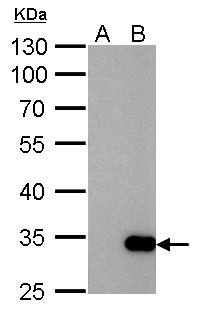 |
| GST tag antibody [3G10] detects GST tag protein by Western blot analysis. A. Non-induced cell lysate from E. coli expressing GST-tagged proteins B. IPTG-induced cell lysate from E. coli expressing GST-tagged proteins 10 % SDS-PAGE GST tag antibody [3G10] (4677) dilution: 1:10000 |
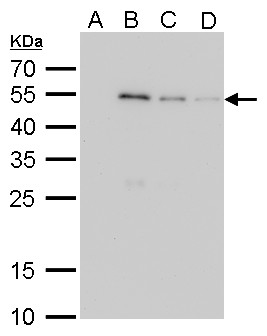 |
| GST tag antibody [3G10] detects GST tag protein by Western blot analysis. A. 2 µg His-recombinant protein B. 2 µg GST-recombinant protein C. 1 µg GST-recombinant protein D. 0.5 µg GST-recombinant protein 10 % SDS-PAGE GST tag antibody [3G10] (4677) dilution: 1:5000 |
FAQ & Publications
Frequently Asked Questions
What applications has the mouse anti-GST monoclonal antibody (3G10) been validated for?
This antibody has been tested and is suitable for Western blot (WB) and immunoprecipitation (IP) applications.
How should the mouse anti-GST monoclonal antibody (3G10) be stored to maintain stability?
The antibody is stable for at least one year when stored at -20°C in its supplied storage buffer, which is PBS at pH 7.4.
What is the recommended working concentration range for immunoblotting with this antibody?
For immunoblotting applications, the recommended antibody dilution is between 0.2 and 2 µg/mL, though users should optimize the concentration for their specific experiments.
What is the immunogen used to generate the mouse anti-GST monoclonal antibody (3G10)?
The immunogen is the GST protein from Schistosoma japonicum expressed in Escherichia coli.
Publications
| pmid | title | authors | citation |
|---|---|---|---|
| We haven't added any publications to our database yet. | |||
Published literature highly relevant to the biological target of this product and referencing this antibody or clone are retrieved from the PubMed database provided by the United States National Library of Medicine at the National Institutes of Health.
Protocols
| relevant to this product |
|---|
| Western blot |
Documents
| Batch Number | QC File | SDS |
|---|---|---|
| To view batch-specific Safety Datasheets and Quality Certificates associated with your account, please Log In. | ||
Only logged in customers who have purchased this product may leave a review.


Reviews
There are no reviews yet.