| Weight | 1 lbs |
|---|---|
| Dimensions | 9 × 5 × 2 in |
| host | mouse |
| isotype | IgG1 |
| clonality | monoclonal |
| concentration | 1 mg/mL |
| applications | ICC/IF, WB |
| reactivity | Fen-1 |
| available sizes | 100 µg |


mouse anti-Fen-1 monoclonal antibody (4E7) 3657
$503.00
Antibody summary
- Mouse monoclonal to Fen-1
- Suitable for: WB,ICC/IF,IP
- Isotype: IgG1
- 100 µg
mouse anti-Fen-1 monoclonal antibody (4E7) 3657
| antibody |
|---|
| Tested applications WB,ICC/IF,IP |
| Recommended dilutions Immunoblotting: use at 1-5 ug/mL. Positive controls: MCF-7 cells and recombinant fusion protein. |
| Immunogen Recombinant human FEN-1 protein (aa 1-380) purified from baculovirus-infected Sf-9 cells. |
| Size and concentration 100µg and lot specific |
| Form liquid |
| Storage Instructions This antibody is stable for at least one (1) year at -20°C. Avoid multiple freeze- thaw cycles. |
| Storage buffer 10 mM PBS, pH 7.4. |
| Purity immunogen affinity purification |
| Clonality monoclonal |
| Isotype IgG1 |
| Compatible secondaries goat anti-mouse IgG, H&L chain specific, peroxidase conjugated polyclonal antibody 5486 goat anti-mouse IgG, H&L chain specific, biotin conjugated, Conjugate polyclonal antibody 2685 goat anti-mouse IgG, H&L chain specific, FITC conjugated polyclonal antibody 7854 goat anti-mouse IgG, H&L chain specific, peroxidase conjugated polyclonal antibody, crossabsorbed 1706 goat anti-mouse IgG, H&L chain specific, biotin conjugated polyclonal antibody, crossabsorbed 1716 goat anti-mouse IgG, H&L chain specific, FITC conjugated polyclonal antibody, crossabsorbed 1721 |
| Isotype control Mouse monocolonal IgG1 - Isotype Control |
| target relevance |
|---|
| Homo sapiens FEN1 Flap endonuclease 1 |
| Protein names Flap endonuclease 1 |
| Alternative names DNase IV, Flap structure-specific endonuclease 1, Maturation factor 1 |
| Gene names FEN1 |
| Protein family Belongs to the XPG/RAD2 endonuclease family. FEN1 subfamily |
| Function Structure-specific nuclease with 5'-flap endonuclease and 5'-3' exonuclease activities involved in DNA replication and repair. During DNA replication, cleaves the 5'-overhanging flap structure that is generated by displacement synthesis when DNA polymerase encounters the 5'-end of a downstream Okazaki fragment. It enters the flap from the 5'-end and then tracks to cleave the flap base, leaving a nick for ligation. Also involved in the long patch base excision repair (LP-BER) pathway, by cleaving within the apurinic/apyrimidinic (AP) site-terminated flap. Acts as a genome stabilization factor that prevents flaps from equilibrating into structures that lead to duplications and deletions. Also possesses 5'-3' exonuclease activity on nicked or gapped double-stranded DNA, and exhibits RNase H activity. Also involved in replication and repair of rDNA and in repairing mitochondrial DNA |
| Subcellular location Mitochondrion |
| Structure Interacts with PCNA (PubMed:11430825, PubMed:15616578, PubMed:26760506, PubMed:9305916). Three molecules of FEN1 bind to one PCNA trimer with each molecule binding to one PCNA monomer (PubMed:15616578). PCNA stimulates the nuclease activity without altering cleavage specificity (PubMed:15616578). The C-terminal domain binds EP300; can bind simultaneously to both PCNA and EP300 (PubMed:11430825). Interacts with DDX11; this interaction is direct and increases flap endonuclease activity of FEN1 (PubMed:18499658). Interacts with WDR4; regulating its endonuclease activity (PubMed:26751069). Interacts with POLB (PubMed:19336415, PubMed:26760506) |
| Post-translational modification Acetylated by EP300. Acetylation inhibits both endonuclease and exonuclease activity. Acetylation also reduces DNA-binding activity but does not affect interaction with PCNA or EP300 Phosphorylation upon DNA damage induces relocalization to the nuclear plasma. Phosphorylation at Ser-187 by CDK2 occurs during late S-phase and results in dissociation from PCNA Methylation at Arg-192 by PRMT5 impedes Ser-187 phosphorylation and increases interaction with PCNA |
| Keywords 3D-structure, Acetylation, Alternative initiation, Direct protein sequencing, DNA damage, DNA repair, DNA replication, Endonuclease, Exonuclease, Hydrolase, Magnesium, Metal-binding, Methylation, Mitochondrion, Nuclease, Nucleus, Phosphoprotein, Proteomics identification, Reference proteome |
| Sequence MGIQGLAKLIADVAPSAIRENDIKSYFGRKVAIDASMSIYQFLIAVRQGGDVLQNEEGET TSHLMGMFYRTIRMMENGIKPVYVFDGKPPQLKSGELAKRSERRAEAEKQLQQAQAAGAE QEVEKFTKRLVKVTKQHNDECKHLLSLMGIPYLDAPSEAEASCAALVKAGKVYAAATEDM DCLTFGSPVLMRHLTASEAKKLPIQEFHLSRILQELGLNQEQFVDLCILLGSDYCESIRG IGPKRAVDLIQKHKSIEEIVRRLDPNKYPVPENWLHKEAHQLFLEPEVLDPESVELKWSE PNEEELIKFMCGEKQFSEERIRSGVKRLSKSRQGSTQGRLDDFFKVTGSLSSAKRKEPEP KGSTKKKAKTGAAGKFKRGK |
| UniProt accession: P39748 |
Data
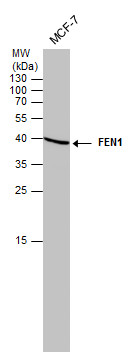 |
| Whole cell extract (30 µg) was separated by 12% SDS-PAGE, and the membrane was blotted with FEN1 antibody (3657) diluted at 1:500. The HRP-conjugated anti-mouse IgG antibody was used to detect the primary antibody. |
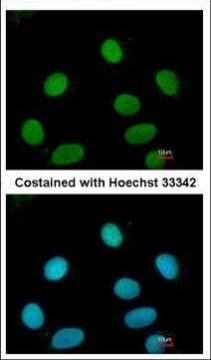 |
| Immunofluorescence analysis of paraformaldehyde-fixed MCF7, using FEN1 [4E7](3657) antibody at 1:200 dilution. |
FAQ & Publications
Frequently Asked Questions
What experimental applications is the mouse anti-Fen-1 monoclonal antibody (4E7) validated for?
This antibody is validated for use in Western blotting (WB), immunocytochemistry/immunofluorescence (ICC/IF), and immunoprecipitation (IP) applications.
How should the mouse anti-Fen-1 monoclonal antibody (4E7) be stored to maintain stability?
The antibody should be stored at -20°C and is stable for at least one year under these conditions. It is important to avoid multiple freeze-thaw cycles to preserve antibody integrity.
Publications
| pmid | title | authors | citation |
|---|---|---|---|
| We haven't added any publications to our database yet. | |||
Published literature highly relevant to the biological target of this product and referencing this antibody or clone are retrieved from the PubMed database provided by the United States National Library of Medicine at the National Institutes of Health.
Protocols
| relevant to this product |
|---|
| Western blot IHC ICC |
Documents
| Batch Number | QC File | SDS |
|---|---|---|
| To view batch-specific Safety Datasheets and Quality Certificates associated with your account, please Log In. | ||
Only logged in customers who have purchased this product may leave a review.


Reviews
There are no reviews yet.