| Weight | 1 lbs |
|---|---|
| Dimensions | 9 × 5 × 2 in |
| host | mouse |
| isotype | IgG1 |
| clonality | monoclonal |
| concentration | 1 mg/mL |
| applications | ICC/IF, WB |
| reactivity | DNA Polymeraseδ |
| available sizes | 100 µg |


mouse anti-DNA Polymerase δ monoclonal antibody (6196) 1586
$503.00
Antibody summary
- Mouse monoclonal to DNA Polymerase δ
- Suitable for: WB,IHC-P
- Isotype: IgG1
- 100 µg
mouse anti-DNA Polymerase δ monoclonal antibody (6196) 1586
| antibody |
|---|
| Tested applications WB,IHC,IHC |
| Recommended dilutions Immunoblotting: use at a 1:500-1:3,000 dilution. A band of ~124kDa is detected. Detection of DNA polymerase delta in HeLa cell lysate with #13910 diluted 1:1,000 IHC: use at a dilution of 1:200 with antigen retrieval: citrate buffer, pH 6.0, 15 minutes. Detection of DNA polymerase delta in p |
| Immunogen Recombinant protein corresponding to aa 1-140 of the large subunit of human DNA polymerase delta |
| Size and concentration 100µg and lot specific |
| Form liquid |
| Storage Instructions This product is stable for at least one (1) year if stored at -20°C. Store product in appropriate aliquots to avoid multiple freeze-thaw cycles. |
| Storage buffer PBS, pH 7.2. |
| Purity protein affinity purification |
| Clonality monoclonal |
| Isotype IgG1 |
| Compatible secondaries goat anti-mouse IgG, H&L chain specific, peroxidase conjugated polyclonal antibody 5486 goat anti-mouse IgG, H&L chain specific, biotin conjugated, Conjugate polyclonal antibody 2685 goat anti-mouse IgG, H&L chain specific, FITC conjugated polyclonal antibody 7854 goat anti-mouse IgG, H&L chain specific, peroxidase conjugated polyclonal antibody, crossabsorbed 1706 goat anti-mouse IgG, H&L chain specific, biotin conjugated polyclonal antibody, crossabsorbed 1716 goat anti-mouse IgG, H&L chain specific, FITC conjugated polyclonal antibody, crossabsorbed 1721 |
| Isotype control Mouse monocolonal IgG1 - Isotype Control |
| target relevance |
|---|
| Homo sapiens POLD1 DNA polymerase delta catalytic subunit |
| Protein names DNA polymerase delta catalytic subunit |
| Alternative names 3'-5' exodeoxyribonuclease, DNA polymerase subunit delta p125 |
| Gene names POLD1 |
| Protein family Belongs to the DNA polymerase type-B family |
| Function As the catalytic component of the trimeric (Pol-delta3 complex) and tetrameric DNA polymerase delta complexes (Pol-delta4 complex), plays a crucial role in high fidelity genome replication, including in lagging strand synthesis, and repair (PubMed:16510448, PubMed:19074196, PubMed:20334433, PubMed:24022480, PubMed:24035200, PubMed:31449058). Exhibits both DNA polymerase and 3'- to 5'-exonuclease activities (PubMed:16510448, PubMed:19074196, PubMed:20334433, PubMed:24022480, PubMed:24035200). Requires the presence of accessory proteins POLD2, POLD3 and POLD4 for full activity. Depending upon the absence (Pol-delta3) or the presence of POLD4 (Pol-delta4), displays differences in catalytic activity. Most notably, expresses higher proofreading activity in the context of Pol-delta3 compared with that of Pol-delta4 (PubMed:19074196, PubMed:20334433). Although both Pol-delta3 and Pol-delta4 process Okazaki fragments in vitro, Pol-delta3 may be better suited to fulfill this task, exhibiting near-absence of strand displacement activity compared to Pol-delta4 and stalling on encounter with the 5'-blocking oligonucleotides. Pol-delta3 idling process may avoid the formation of a gap, while maintaining a nick that can be readily ligated (PubMed:24035200). Along with DNA polymerase kappa, DNA polymerase delta carries out approximately half of nucleotide excision repair (NER) synthesis following UV irradiation (PubMed:20227374). Under conditions of DNA replication stress, in the presence of POLD3 and POLD4, may catalyze the repair of broken replication forks through break-induced replication (BIR) (PubMed:24310611). Involved in the translesion synthesis (TLS) of templates carrying O6-methylguanine, 8oxoG or abasic sites (PubMed:19074196, PubMed:24191025) |
| Catalytic activity DNA(n) + a 2'-deoxyribonucleoside 5'-triphosphate = DNA(n+1) + diphosphate |
| Subcellular location Nucleus |
| Structure Component of the tetrameric DNA polymerase delta complex (Pol-delta4), which consists of POLD1/p125, POLD2/p50, POLD3/p66/p68 and POLD4/p12, with POLD1 bearing both DNA polymerase and 3' to 5' proofreading exonuclease activities (PubMed:11595739, PubMed:12522211, PubMed:17317665, PubMed:22801543, PubMed:31449058, PubMed:31629014). Within Pol-delta4, directly interacts with POLD2 and POLD4 (PubMed:11328591, PubMed:12403614, PubMed:16510448). Following genotoxic stress by DNA-damaging agents, such as ultraviolet light and methyl methanesulfonate, or by replication stress induced by treatment with hydroxyurea or aphidicolin, Pol-delta4 is converted into a trimeric form of the complex (Pol-delta3) by POLD4 degradation. Pol-delta3 is the major form at S phase replication sites and DNA damage sites (PubMed:17317665, PubMed:22801543). POLD1 displays different catalytic properties depending upon the complex it is found in (PubMed:17317665). It exhibits higher proofreading activity and fidelity than Pol-delta4, making it particularly well suited to respond to DNA damage (PubMed:19074196, PubMed:20334433). Directly interacts with PCNA, as do POLD3 and POLD4; this interaction stimulates Pol-delta4 polymerase activity (PubMed:11328591, PubMed:12403614, PubMed:12522211, PubMed:16510448, PubMed:24022480, PubMed:24939902). As POLD2 and POLD4, directly interacts with WRNIP1; this interaction stimulates DNA polymerase delta-mediated DNA synthesis, independently of the presence of PCNA. This stimulation may be due predominantly to an increase of initiation frequency and also to increased processivity (PubMed:15670210). Also observed as a dimeric complex with POLD2 (Pol-delta2 complex). Pol-delta2 is relatively insensitive to the PCNA stimulation (2-5-fold) compared to Pol-delta4 that is stimulated by over 50-fold (PubMed:12403614). The DNA polymerase delta complex interacts with POLDIP2; this interaction is probably mediated through direct binding to POLD2 (PubMed:12522211). Interacts with CIAO1 (PubMed:23891004). Interacts with POLDIP2 (PubMed:24191025). Interacts with RFC1 (PubMed:31629014) |
| Involvement in disease Colorectal cancer 10 A complex disease characterized by malignant lesions arising from the inner wall of the large intestine (the colon) and the rectum. Genetic alterations are often associated with progression from premalignant lesion (adenoma) to invasive adenocarcinoma. Risk factors for cancer of the colon and rectum include colon polyps, long-standing ulcerative colitis, and genetic family history. Mandibular hypoplasia, deafness, progeroid features, and lipodystrophy syndrome An autosomal dominant systemic disorder characterized by prominent loss of subcutaneous fat, metabolic abnormalities including insulin resistance and diabetes mellitus, sclerodermatous skin, and a facial appearance characterized by mandibular hypoplasia. Sensorineural deafness occurs late in the first or second decades of life. Immunodeficiency 120 An autosomal recessive immunologic disorder manifesting in early childhood with recurrent upper and lower respiratory tract infections, lymphopenia, and hypogammaglobulinemia. Affected individuals may also develop persistent viral infections, particularly of the herpes family. Additional variable features include hearing loss, speech delay, short stature, and mildly impaired intellectual development. |
| Keywords 3D-structure, 4Fe-4S, Disease variant, DNA damage, DNA excision, DNA repair, DNA replication, DNA-binding, DNA-directed DNA polymerase, Exonuclease, Hydrolase, Iron, Iron-sulfur, Isopeptide bond, Metal-binding, Methylation, Nuclease, Nucleotidyltransferase, Nucleus, Proteomics identification, Reference proteome, Transferase, Ubl conjugation, Zinc, Zinc-finger |
| Sequence MDGKRRPGPGPGVPPKRARGGLWDDDDAPRPSQFEEDLALMEEMEAEHRLQEQEEEELQS VLEGVADGQVPPSAIDPRWLRPTPPALDPQTEPLIFQQLEIDHYVGPAQPVPGGPPPSRG SVPVLRAFGVTDEGFSVCCHIHGFAPYFYTPAPPGFGPEHMGDLQRELNLAISRDSRGGR ELTGPAVLAVELCSRESMFGYHGHGPSPFLRITVALPRLVAPARRLLEQGIRVAGLGTPS FAPYEANVDFEIRFMVDTDIVGCNWLELPAGKYALRLKEKATQCQLEADVLWSDVVSHPP EGPWQRIAPLRVLSFDIECAGRKGIFPEPERDPVIQICSLGLRWGEPEPFLRLALTLRPC APILGAKVQSYEKEEDLLQAWSTFIRIMDPDVITGYNIQNFDLPYLISRAQTLKVQTFPF LGRVAGLCSNIRDSSFQSKQTGRRDTKVVSMVGRVQMDMLQVLLREYKLRSYTLNAVSFH FLGEQKEDVQHSIITDLQNGNDQTRRRLAVYCLKDAYLPLRLLERLMVLVNAVEMARVTG VPLSYLLSRGQQVKVVSQLLRQAMHEGLLMPVVKSEGGEDYTGATVIEPLKGYYDVPIAT LDFSSLYPSIMMAHNLCYTTLLRPGTAQKLGLTEDQFIRTPTGDEFVKTSVRKGLLPQIL ENLLSARKRAKAELAKETDPLRRQVLDGRQLALKVSANSVYGFTGAQVGKLPCLEISQSV TGFGRQMIEKTKQLVESKYTVENGYSTSAKVVYGDTDSVMCRFGVSSVAEAMALGREAAD WVSGHFPSPIRLEFEKVYFPYLLISKKRYAGLLFSSRPDAHDRMDCKGLEAVRRDNCPLV ANLVTASLRRLLIDRDPEGAVAHAQDVISDLLCNRIDISQLVITKELTRAASDYAGKQAH VELAERMRKRDPGSAPSLGDRVPYVIISAAKGVAAYMKSEDPLFVLEHSLPIDTQYYLEQ QLAKPLLRIFEPILGEGRAEAVLLRGDHTRCKTVLTGKVGGLLAFAKRRNCCIGCRTVLS HQGAVCEFCQPRESELYQKEVSHLNALEERFSRLWTQCQRCQGSLHEDVICTSRDCPIFY MRKKVRKDLEDQEQLLRRFGPPGPEAW |
| UniProt accession: P28340 |
Data
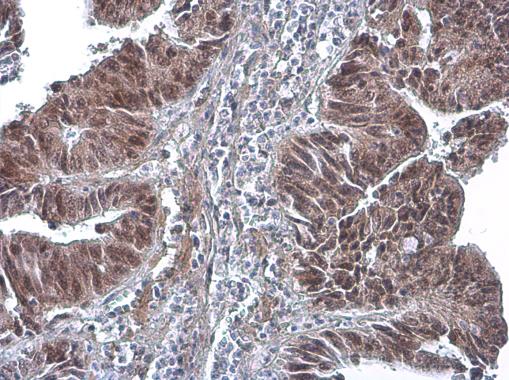 |
| DNA polymerase delta antibody [6196] detects DNA polymerase delta protein at cytoplasm and nucleus by immunohistochemical analysis.Sample: Paraffin-embedded human colon cancer.DNA polymerase delta stained by DNA polymerase delta antibody [6196] (1586) diluted at 1:200. Antigen Retrieval: Citrate buffer, pH 6.0, 15 min |
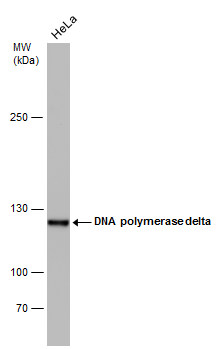 |
| Whole cell extract (30 µg) was separated by 5% SDS-PAGE, and the membrane was blotted with DNA polymerase delta antibody [6196] (1586) diluted at 1:1000. |
FAQ & Publications
Frequently Asked Questions
What applications has the mouse anti-DNA Polymerase δ monoclonal antibody (6196) been validated for?
This monoclonal antibody has been validated for use in Western blotting (WB) and immunohistochemistry on paraffin-embedded sections (IHC-P). Recommended dilutions are 1:500-1:3,000 for immunoblotting and 1:200 for IHC with antigen retrieval.
How should the antibody be stored to maintain its stability?
The antibody is stable for at least one year when stored at -20°C. It is recommended to aliquot the product appropriately to avoid repeated freeze-thaw cycles.
What is the host species and clonality of this antibody?
This antibody is a mouse monoclonal antibody of the IgG1 isotype.
What is the immunogen used to generate this mouse anti-DNA Polymerase δ antibody?
The immunogen is a recombinant protein corresponding to amino acids 1-140 of the large subunit of human DNA polymerase delta.
Publications
| pmid | title | authors | citation |
|---|---|---|---|
| We haven't added any publications to our database yet. | |||
Published literature highly relevant to the biological target of this product and referencing this antibody or clone are retrieved from the PubMed database provided by the United States National Library of Medicine at the National Institutes of Health.
Protocols
| relevant to this product |
|---|
| Western blot IHC |
Documents
| Batch Number | QC File | SDS |
|---|---|---|
| To view batch-specific Safety Datasheets and Quality Certificates associated with your account, please Log In. | ||
Only logged in customers who have purchased this product may leave a review.


Reviews
There are no reviews yet.