| Weight | 1 lbs |
|---|---|
| Dimensions | 9 × 5 × 2 in |
| host | mouse |
| isotype | IgG1 |
| clonality | monoclonal |
| concentration | 1 mg/mL |
| applications | ICC/IF, WB |
| reactivity | Collagen Vα-1 Chain N-propeptide-NC2 domain |
| available sizes | 100 µg |

mouse anti-Collagen V α-1 Chain (NC2 domain) monoclonal antibody (18G5) 9077
$520.00
Antibody summary
- Mouse monoclonal to Collagen V α-1 Chain (NC2 domain)
- Suitable for: WB,IHC
- Isotype: IgG1
- 100 µg
mouse anti-Collagen V α-1 Chain (NC2 domain) monoclonal antibody (18G5) 9077
| antibody |
|---|
| Tested applications WB,IHC,IHC |
| Recommended dilutions Immunoblotting: use at 1-5ug/mL. Immunohistochemistry: Formalin-fixed, paraffin-embedded tissue, heat-induced antigen retrieval. Use at 1-10ug/mL. These are recommended concentrations. Enduser should determine optimal concentrations for their applications. |
| Immunogen Recombinant human collagen V alpha-1 chain N fragment. |
| Size and concentration 100µg and |
| Form lyophilized |
| Storage Instructions This product is stable for at least one (1) year at -20°C to -70°C. Reconstituted product should be stored in appropriate aliquots to avoid repeated freeze-thaw cycles. |
| Storage buffer Lyophilized, 0.1M Tris, 0.1M glycine, 2% sucrose |
| Purity protein affinity purification |
| Clonality monoclonal |
| Isotype IgG1 |
| Compatible secondaries goat anti-mouse IgG, H&L chain specific, peroxidase conjugated polyclonal antibody 5486 goat anti-mouse IgG, H&L chain specific, biotin conjugated, Conjugate polyclonal antibody 2685 goat anti-mouse IgG, H&L chain specific, FITC conjugated polyclonal antibody 7854 goat anti-mouse IgG, H&L chain specific, peroxidase conjugated polyclonal antibody, crossabsorbed 1706 goat anti-mouse IgG, H&L chain specific, biotin conjugated polyclonal antibody, crossabsorbed 1716 goat anti-mouse IgG, H&L chain specific, FITC conjugated polyclonal antibody, crossabsorbed 1721 |
| Isotype control Mouse monocolonal IgG1 - Isotype Control |
| target relevance |
|---|
| Homo sapiens COL5A1 Collagen alpha-1(V) chain |
| Protein names Collagen alpha-1(V) chain |
| Gene names COL5A1 |
| Protein family Belongs to the fibrillar collagen family |
| Function Type V collagen is a member of group I collagen (fibrillar forming collagen). It is a minor connective tissue component of nearly ubiquitous distribution. Type V collagen binds to DNA, heparan sulfate, thrombospondin, heparin, and insulin |
| Subcellular location Secreted, extracellular space, extracellular matrix |
| Structure Trimers of two alpha 1(V) and one alpha 2(V) chains in most tissues and trimers of one alpha 1(V), one alpha 2(V), and one alpha 3(V) chains in placenta. Interacts with CSPG4 |
| Post-translational modification Prolines at the third position of the tripeptide repeating unit (G-X-Y) are hydroxylated in some or all of the chains Sulfated on 40% of tyrosines |
| Involvement in disease Ehlers-Danlos syndrome, classic type, 1 A form of Ehlers-Danlos syndrome, a group of connective tissue disorders characterized by skin hyperextensibility, articular hypermobility, and tissue fragility. The main features of classic Ehlers-Danlos syndrome are joint hypermobility and dislocation, and fragile, bruisable skin. EDSCL1 inheritance is autosomal dominant. Fibromuscular dysplasia, multifocal An autosomal dominant vascular disorder with incomplete penetrance, characterized by fibrous tissue and webs developing in the artery wall and leading to multiple arterial stenoses. Patients with multifocal fibromuscular dysplasia can develop arterial tortuosity, macroaneurysms, and dissections. Arterial rupture may occur. |
| Keywords 3D-structure, Alternative splicing, Calcium, Collagen, Direct protein sequencing, Disease variant, Disulfide bond, Ehlers-Danlos syndrome, Extracellular matrix, Heparin-binding, Hydroxylation, Metal-binding, Proteomics identification, Reference proteome, Repeat, Secreted, Signal, Sulfation |
| Sequence MDVHTRWKARSALRPGAPLLPPLLLLLLWAPPPSRAAQPADLLKVLDFHNLPDGITKTTG FCATRRSSKGPDVAYRVTKDAQLSAPTKQLYPASAFPEDFSILTTVKAKKGSQAFLVSIY NEQGIQQIGLELGRSPVFLYEDHTGKPGPEDYPLFRGINLSDGKWHRIALSVHKKNVTLI LDCKKKTTKFLDRSDHPMIDINGIIVFGTRILDEEVFEGDIQQLLFVSDHRAAYDYCEHY SPDCDTAVPDTPQSQDPNPDEYYTEGDGEGETYYYEYPYYEDPEDLGKEPTPSKKPVEAA KETTEVPEELTPTPTEAAPMPETSEGAGKEEDVGIGDYDYVPSEDYYTPSPYDDLTYGEG EENPDQPTDPGAGAEIPTSTADTSNSSNPAPPPGEGADDLEGEFTEETIRNLDENYYDPY YDPTSSPSEIGPGMPANQDTIYEGIGGPRGEKGQKGEPAIIEPGMLIEGPPGPEGPAGLP GPPGTMGPTGQVGDPGERGPPGRPGLPGADGLPGPPGTMLMLPFRFGGGGDAGSKGPMVS AQESQAQAILQQARLALRGPAGPMGLTGRPGPVGPPGSGGLKGEPGDVGPQGPRGVQGPP GPAGKPGRRGRAGSDGARGMPGQTGPKGDRGFDGLAGLPGEKGHRGDPGPSGPPGPPGDD GERGDDGEVGPRGLPGEPGPRGLLGPKGPPGPPGPPGVTGMDGQPGPKGNVGPQGEPGPP GQQGNPGAQGLPGPQGAIGPPGEKGPLGKPGLPGMPGADGPPGHPGKEGPPGEKGGQGPP GPQGPIGYPGPRGVKGADGIRGLKGTKGEKGEDGFPGFKGDMGIKGDRGEIGPPGPRGED GPEGPKGRGGPNGDPGPLGPPGEKGKLGVPGLPGYPGRQGPKGSIGFPGFPGANGEKGGR GTPGKPGPRGQRGPTGPRGERGPRGITGKPGPKGNSGGDGPAGPPGERGPNGPQGPTGFP GPKGPPGPPGKDGLPGHPGQRGETGFQGKTGPPGPPGVVGPQGPTGETGPMGERGHPGPP GPPGEQGLPGLAGKEGTKGDPGPAGLPGKDGPPGLRGFPGDRGLPGPVGALGLKGNEGPP GPPGPAGSPGERGPAGAAGPIGIPGRPGPQGPPGPAGEKGAPGEKGPQGPAGRDGLQGPV GLPGPAGPVGPPGEDGDKGEIGEPGQKGSKGDKGEQGPPGPTGPQGPIGQPGPSGADGEP GPRGQQGLFGQKGDEGPRGFPGPPGPVGLQGLPGPPGEKGETGDVGQMGPPGPPGPRGPS GAPGADGPQGPPGGIGNPGAVGEKGEPGEAGEPGLPGEGGPPGPKGERGEKGESGPSGAA GPPGPKGPPGDDGPKGSPGPVGFPGDPGPPGEPGPAGQDGPPGDKGDDGEPGQTGSPGPT GEPGPSGPPGKRGPPGPAGPEGRQGEKGAKGEAGLEGPPGKTGPIGPQGAPGKPGPDGLR GIPGPVGEQGLPGSPGPDGPPGPMGPPGLPGLKGDSGPKGEKGHPGLIGLIGPPGEQGEK GDRGLPGPQGSSGPKGEQGITGPSGPIGPPGPPGLPGPPGPKGAKGSSGPTGPKGEAGHP GPPGPPGPPGEVIQPLPIQASRTRRNIDASQLLDDGNGENYVDYADGMEEIFGSLNSLKL EIEQMKRPLGTQQNPARTCKDLQLCHPDFPDGEYWVDPNQGCSRDSFKVYCNFTAGGSTC VFPDKKSEGARITSWPKENPGSWFSEFKRGKLLSYVDAEGNPVGVVQMTFLRLLSASAHQ NVTYHCYQSVAWQDAATGSYDKALRFLGSNDEEMSYDNNPYIRALVDGCATKKGYQKTVL EIDTPKVEQVPIVDIMFNDFGEASQKFGFEVGPACFMG |
| UniProt accession: P20908 |
Data
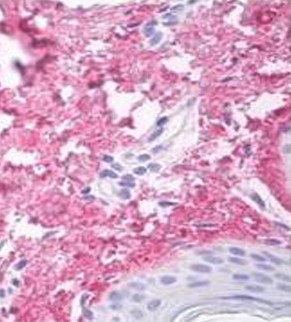 |
| Immunohistochemistry: Formalin-fixed, paraffin-embedded tissue, heat-induced antigen retrieval. Use at 1-10ug/ml. Staining of human skin with #9077. |
FAQ & Publications
Frequently Asked Questions
What are the recommended dilutions for using the mouse anti-Collagen V α-1 Chain (NC2 domain) monoclonal antibody in Western blot and immunohistochemistry?
For Western blot applications, it is recommended to use the antibody at a concentration of 1-5 µg/mL. For immunohistochemistry on formalin-fixed, paraffin-embedded tissue with heat-induced antigen retrieval, a concentration of 1-10 µg/mL is suggested. Users should optimize these concentrations for their specific experimental conditions.
How should the mouse anti-Collagen V α-1 Chain (NC2 domain) monoclonal antibody be stored to maintain its stability?
The lyophilized antibody is stable for at least one year when stored at temperatures between -20°C and -70°C. After reconstitution, it should be aliquoted appropriately to avoid repeated freeze-thaw cycles, which can degrade antibody quality.
Publications
| pmid | title | authors | citation |
|---|---|---|---|
| We haven't added any publications to our database yet. | |||
Published literature highly relevant to the biological target of this product and referencing this antibody or clone are retrieved from the PubMed database provided by the United States National Library of Medicine at the National Institutes of Health.
Protocols
| relevant to this product |
|---|
| Western blot IHC |
Documents
| Batch Number | QC File | SDS |
|---|---|---|
| To view batch-specific Safety Datasheets and Quality Certificates associated with your account, please Log In. | ||
Only logged in customers who have purchased this product may leave a review.


Reviews
There are no reviews yet.