| Weight | 1 lbs |
|---|---|
| Dimensions | 9 × 5 × 2 in |
| host | mouse |
| isotype | IgG1 |
| clonality | monoclonal |
| concentration | 1 mg/mL |
| applications | ICC/IF, WB |
| reactivity | Cholera Toxin β Subunit |
| available sizes | 200 µg |

mouse anti-Cholera toxin beta subunit monoclonal antibody (3D11) 9168
$314.00
Antibody summary
- Mouse monoclonal to Cholera toxin beta subunit
- Suitable for: ELISA,IHC
- Isotype: IgG1
- 200 µg
mouse anti-Cholera toxin beta subunit monoclonal antibody (3D11) 9168
| antibody |
|---|
| Tested applications IHC,IHC,ELISA |
| Recommended dilutions This antibody may be used for detection of cholera toxin in ELISA. Not all applications have been investigated. |
| Immunogen Purified beta subunit of cholera toxin. |
| Size and concentration 200µg and lot specific |
| Form liquid |
| Storage Instructions These antibodies are stable for at least one (1) year at -20°C to -70°C. Store product in appropriate aliquots to avoid multiple freeze-thaw cycles. |
| Storage buffer PBS containing 0.1% NaN3 |
| Purity protein affinity purification |
| Clonality monoclonal |
| Isotype IgG1 |
| Compatible secondaries goat anti-mouse IgG, H&L chain specific, peroxidase conjugated polyclonal antibody 5486 goat anti-mouse IgG, H&L chain specific, biotin conjugated, Conjugate polyclonal antibody 2685 goat anti-mouse IgG, H&L chain specific, FITC conjugated polyclonal antibody 7854 goat anti-mouse IgG, H&L chain specific, peroxidase conjugated polyclonal antibody, crossabsorbed 1706 goat anti-mouse IgG, H&L chain specific, biotin conjugated polyclonal antibody, crossabsorbed 1716 goat anti-mouse IgG, H&L chain specific, FITC conjugated polyclonal antibody, crossabsorbed 1721 |
| Isotype control Mouse monocolonal IgG1 - Isotype Control |
| target relevance |
|---|
| Vibrio cholerae serotype O1 (strain ATCC 39315 / El Tor Inaba N16961) CTXB Cholera enterotoxin subunit B |
| Protein names Cholera enterotoxin subunit B |
| Alternative names Cholera enterotoxin B chain, Cholera enterotoxin gamma chain, Choleragenoid |
| Gene names ctxB |
| Function The B subunit pentameric ring directs the A subunit to its target by binding to the GM1 gangliosides present on the surface of the intestinal epithelial cells. It can bind five GM1 gangliosides. It has no toxic activity by itself |
| Subcellular location Secreted, Host cell membrane |
| Structure The holotoxin (choleragen) consists of a pentameric ring of B subunits whose central pore is occupied by the A subunit. The A subunit contains two chains, A1 and A2, linked by a disulfide bridge |
| Keywords 3D-structure, Direct protein sequencing, Disulfide bond, Enterotoxin, Host cell membrane, Host membrane, Membrane, Reference proteome, Secreted, Signal, Toxin, Virulence |
| Sequence MIKLKFGVFFTVLLSSAYAHGTPQNITDLCAEYHNTQIYTLNDKIFSYTESLAGKREMAI ITFKNGAIFQVEVPGSQHIDSQKKAIERMKDTLRIAYLTEAKVEKLCVWNNKTPHAIAAI SMAN |
| UniProt accession: P01556 |
Data
| No results found |
FAQ & Publications
Frequently Asked Questions
What applications has the mouse anti-Cholera toxin beta subunit monoclonal antibody (3D11) been validated for?
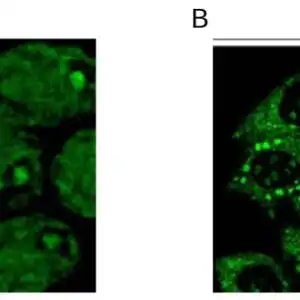
This monoclonal antibody has been tested and is suitable for use in ELISA and immunohistochemistry (IHC) applications. It may also be used in immunocytochemistry/immunofluorescence (ICC/IF) and Western blot (WB), although not all applications have been fully investigated.
How should the mouse anti-Cholera toxin beta subunit monoclonal antibody (3D11) be stored to maintain stability?
The antibody should be stored at temperatures between -20°C and -70°C. It is recommended to aliquot the product appropriately to avoid multiple freeze-thaw cycles, which can compromise antibody stability. Under these conditions, the antibody remains stable for at least one year.
What is the immunogen used to generate the mouse anti-Cholera toxin beta subunit monoclonal antibody (3D11)?
The immunogen for this monoclonal antibody is the purified beta subunit of cholera toxin.
Publications
| pmid | title | authors | citation |
|---|---|---|---|
| We haven't added any publications to our database yet. | |||
Published literature highly relevant to the biological target of this product and referencing this antibody or clone are retrieved from the PubMed database provided by the United States National Library of Medicine at the National Institutes of Health.
Protocols
| relevant to this product |
|---|
| Western blot IHC ICC |
Documents
| Batch Number | QC File | SDS |
|---|---|---|
| To view batch-specific Safety Datasheets and Quality Certificates associated with your account, please Log In. | ||
Only logged in customers who have purchased this product may leave a review.


Reviews
There are no reviews yet.