| Weight | 1 lbs |
|---|---|
| Dimensions | 9 × 5 × 2 in |
| host | mouse |
| isotype | IgG2a |
| clonality | monoclonal |
| concentration | 1 mg/mL |
| applications | ICC/IF, WB |
| reactivity | Osteocalcin |
| available sizes | 100 µg |

mouse anti-Bovine Osteocalcin monoclonal antibody (OCG2) 2273
$509.00
Antibody summary
- Mouse monoclonal to Bovine Osteocalcin
- Suitable for: WB,ELISA,IHC
- Isotype: IgG2a
- 100 µg
mouse anti-Bovine Osteocalcin monoclonal antibody (OCG2) 2273
| antibody |
|---|
| Tested applications WB,IHC,IHC,ELISA |
| Recommended dilutions Sandwich ELISA: 1-10ug/ml with immobilized antigen, pair with catalog no. 50116. Immunoblotting: 1-10ug/ml, reducing or non-reducing conditions. Immunohistochemistry: 1-10ug/ml, frozen or paraffin-embedded tissue after proteinase K (0.4m/ml) antigen retrieval. Endusers should |
| Immunogen Bovine osteocalcin |
| Size and concentration 100µg and |
| Form lyophilized |
| Storage Instructions Store stock solution (2. 0 mg/ml) in aliquots at -20 for 1 year, or at 4°C for 6 months after adding 0.1% sodium azide. Avoid repeated freeze-thaw cycles. Diluted antibody should not be stor |
| Storage buffer PBS, pH7.4, containing 1.0% bovine serum albumin |
| Purity immunogen affinity purification |
| Clonality monoclonal |
| Isotype IgG2a |
| Compatible secondaries goat anti-mouse IgG, H&L chain specific, peroxidase conjugated polyclonal antibody 5486 goat anti-mouse IgG, H&L chain specific, biotin conjugated, Conjugate polyclonal antibody 2685 goat anti-mouse IgG, H&L chain specific, FITC conjugated polyclonal antibody 7854 goat anti-mouse IgG, H&L chain specific, peroxidase conjugated polyclonal antibody, crossabsorbed 1706 goat anti-mouse IgG, H&L chain specific, biotin conjugated polyclonal antibody, crossabsorbed 1716 goat anti-mouse IgG, H&L chain specific, FITC conjugated polyclonal antibody, crossabsorbed 1721 |
| Isotype control Mouse monocolonal IgG2a - Isotype Control |
| target relevance |
|---|
| Homo sapiens BGLAP Osteocalcin |
| Protein names Osteocalcin |
| Alternative names Bone Gla protein, Gamma-carboxyglutamic acid-containing protein |
| Gene names BGLAP |
| Protein family Belongs to the osteocalcin/matrix Gla protein family |
| Function The carboxylated form is one of the main organic components of the bone matrix, which constitutes 1-2% of the total bone protein (PubMed:3019668, PubMed:6967872). Acts as a negative regulator of bone formation and is required to limit bone formation without impairing bone resorption or mineralization (By similarity). Binds strongly to apatite and calcium upon gamma-carboxylation; this modification is essential for bone metabolism (PubMed:6967872, PubMed:39880952) |
| Subcellular location Secreted |
| Post-translational modification Carboxylated by vitamin K-dependent GGCX to form gamma-carboxyglutamate; these residues are essential for the binding of calcium (PubMed:6967872, PubMed:39880952). Decarboxylation promotes the hormone activity (By similarity) |
| Keywords 3D-structure, Biomineralization, Calcium, Cleavage on pair of basic residues, Direct protein sequencing, Disulfide bond, Gamma-carboxyglutamic acid, Hormone, Metal-binding, Proteomics identification, Reference proteome, Secreted, Signal |
| Sequence MRALTLLALLALAALCIAGQAGAKPSGAESSKGAAFVSKQEGSEVVKRPRRYLYQWLGAP VPYPDPLEPRREVCELNPDCDELADHIGFQEAYRRFYGPV |
| UniProt accession: P02818 |
Data
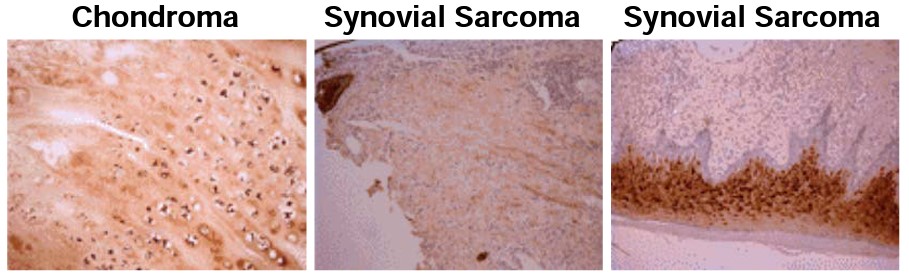 |
| Immunohistochemistry: 1-10ug/ml, frozen or paraffin-embedded tissue after proteinase K (0.4m/ml) antigen retrieval. Chondroma: Human bone tumor. Synovial Sarcoma: human osteosarcoma. |
FAQ & Publications
Frequently Asked Questions
What species does the mouse anti-Bovine Osteocalcin monoclonal antibody (OCG2) specifically react with?
This monoclonal antibody is specific for bovine osteocalcin.
Which applications have been validated for use with this antibody?
The antibody has been tested and is suitable for Western blotting (WB), immunohistochemistry (IHC), and ELISA.
How should the antibody be stored to ensure stability and longevity?
Store the stock solution at -20°C in aliquots for up to 1 year, or at 4°C for 6 months after adding 0.1% sodium azide. Avoid repeated freeze-thaw cycles. Diluted antibody should not be stored.
What is the recommended dilution range for using this antibody in immunohistochemistry on frozen or paraffin-embedded tissues?
For immunohistochemistry, use the antibody at 1-10 µg/mL with antigen retrieval using proteinase K (0.4 mg/mL).
Publications
| pmid | title | authors | citation |
|---|---|---|---|
| We haven't added any publications to our database yet. | |||
Published literature highly relevant to the biological target of this product and referencing this antibody or clone are retrieved from the PubMed database provided by the United States National Library of Medicine at the National Institutes of Health.
Protocols
| relevant to this product |
|---|
| Western blot IHC |
Documents
| Batch Number | QC File | SDS |
|---|---|---|
| To view batch-specific Safety Datasheets and Quality Certificates associated with your account, please Log In. | ||
Only logged in customers who have purchased this product may leave a review.


Reviews
There are no reviews yet.