B. burgdorferi sensu stricto, B. garinii, B. afzelii, B. spielmanii and B. bavariensis
applications
Lateral flow (dipstick)
assay type
Indirect & qualitative
available sizes
20 test kits
Human Borrelia IgM Lateral flow dipstick kit 4273
kit
Assay type Sandwich assay, lateral flow (dipstick)
Research area Infectious Disease
Sample type Serum, plasma, whole blood
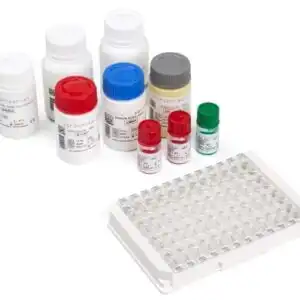
Components
10X Wash Buffer
100 mL
TMB Substrate
40 mL
Milk Powder
5 g
Instructions for Use
1 Each
Evaluation Form
1 Each
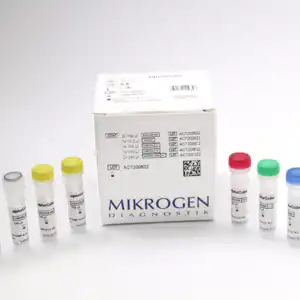
Test Strips
2 kits of [2 Vials x 10 Each]
Anti-Human IgG Conjugate
500 µL
Positive Control
140 µL
Negative Control
140 µL
Storage Store at 2-8°C.
Additional information Mikrogen recomLine Borrelia Tests
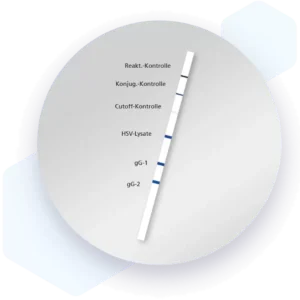
Mikrogen recomLine Borrelia Tests are serological, qualitative in vitro tests with recombinantly produced, highly specific and immunodominant Borrelia antigens. All specific antibodies against all known Lyme disease-causing Borrelia species (B. burgdorferi sensu stricto, B. garinii, B. afzelii, B. spielmanii, and B. bavariensis) can be detected on one test strip.
The recomLine Borrelia tests are used to confirm the results of screening enzyme immunoassays.
Advantages
Optimal imaging without cross-reacting Borrelia proteins.
Identification of early and late infection status through different, typical antigen band patterns.
Standardized serum CSF analysis possible, for detection of antibody index in suspected cases of Lyme neuroborreliosis.
Separate detection of IgG and IgM antibodies.
Simple and clear interpretation due to easy-to-read banding.
Compliant with MiQ Lyme Borreliosis1 and DIN 58969-442.
Partial and full automation, software-based evaluation (recomScan), and integration with laboratory information system possible.
Highest sensitivity and specificity by using recombinant, immunodominant antigens.
Bands
Antigen
Tribe
p100
B. afzelii
VIsE
Different Borrelia genospecies
p58
B. garinii
p41
B. burgdorferi sensu stricto
p39
B. afzelii
OspA
B. afzelii
OspC
B. burgdorferi sensu stricto, B. afzelii, B. garinii, B. spielmanii
p18
B. burgdorferi sensu stricto, B. afzelii, B. garinii, B. spielmanii, B. bavariensis
target relevance
human antibody anti-Borrelia
Borrelia
Description Bacterial genus that causes Lyme disease and relapsing fever
Structure Borrelia is a genus of spiral-shaped bacteria belonging to the family Spirochaetaceae. Members of the genus are Gram-negative, highly motile spirochetes characterized by a flexible helical morphology and periplasmic flagella located between the outer membrane and the peptidoglycan layer. These endoflagella enable corkscrew-like movement through tissues and viscous environments. Borrelia species are maintained in nature through complex transmission cycles involving arthropod vectors such as ticks and lice and a variety of vertebrate reservoir hosts. The genus includes pathogens responsible for Lyme borreliosis, primarily the Borrelia burgdorferi sensu lato complex, and relapsing fever caused by several other Borrelia species.
Diagnosis The diagnosis of Borrelia infection is performed through a combination of clinical assessment, serological testing, and molecular methods. For Lyme disease, laboratory diagnosis typically involves a two-tier testing strategy consisting of an ELISA or immunoassay followed by a confirmatory immunoblot when appropriate. Detection of Borrelia-specific IgM and IgG antibodies can support the diagnosis, although antibody responses may not be detectable during the earliest stages of infection. Polymerase chain reaction (PCR) assays may be used to detect Borrelia DNA in selected clinical specimens, particularly synovial fluid, cerebrospinal fluid, or skin biopsies. Culture of Borrelia organisms is possible but technically demanding and not routinely performed in clinical laboratories.
Symptoms Borrelia infections present with a wide spectrum of clinical manifestations depending on the infecting species and stage of disease. Lyme borreliosis commonly begins with erythema migrans, an expanding skin lesion that develops days to weeks after a tick bite and may be accompanied by fever, fatigue, headache, myalgia, and arthralgia. Untreated infection can progress to involve the nervous system, heart, and joints, resulting in neuroborreliosis, carditis, or Lyme arthritis. Relapsing fever Borrelia species cause recurrent episodes of high fever, chills, headache, muscle pain, and malaise separated by symptom-free intervals. Severe complications may occur if infections are left untreated.
Data
FAQ & Publications
Frequently Asked Questions
What types of samples can be used with the Human Borrelia IgM Lateral Flow Dipstick Kit 4273?
The kit is compatible with serum, plasma, and whole blood samples for the detection of human Borrelia IgM antibodies.
Which Borrelia species does this IgM lateral flow dipstick kit detect?
This kit detects antibodies against Borrelia burgdorferi sensu stricto, B. garinii, B. afzelii, B. spielmanii, and B. bavariensis species.
How should the Human Borrelia IgM Lateral Flow Dipstick Kit 4273 be stored to maintain its stability?
The kit should be stored refrigerated at 2-8°C to ensure proper stability and performance.
Publications
pmid
title
authors
citation
We haven't added any publications to our database yet.
Published literature highly relevant to the biological target of this product and referencing this antibody or clone are retrieved from the PubMed database provided by the United States National Library of Medicine at the National Institutes of Health.
Protocols
relevant to this product
This product has moved to a digital protocol. Please use the URL provided on the product packaging to access the electronic Instructions for Use (eIFU). 4273 protocol











Reviews
There are no reviews yet.