| Weight | 1 lbs |
|---|---|
| Dimensions | 9 × 5 × 2 in |
| target | Rubella Spike Ectodomain (E1-E2) |
| species reactivity | Rubella Virus |
| applications | ELISA |
| assay type | Indirect & quantitative |
| available size | 1 mg |

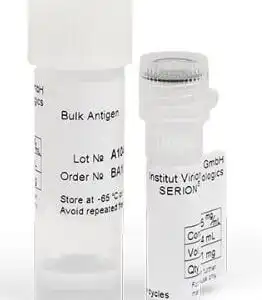
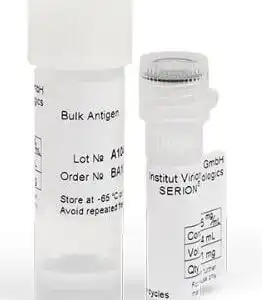
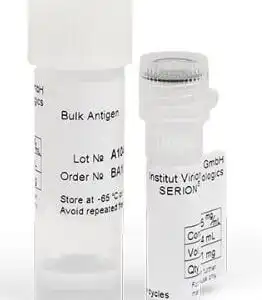
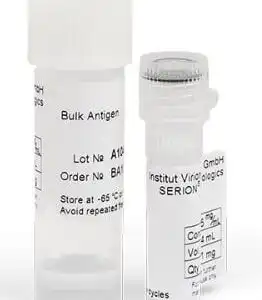
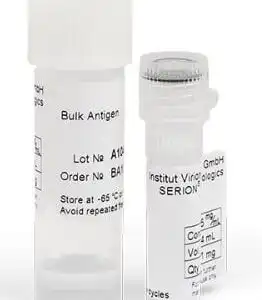
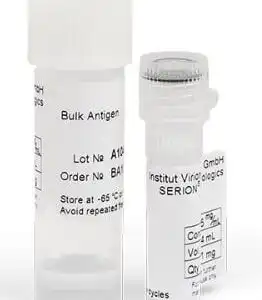
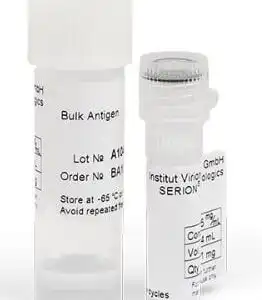
Rubella Spike Ectodomain (E1-E2) Antigen BA129R01
$1,152.00
Summary
- Virion/Serion Immunologics Antigen for research use (RUO)
- Rubella Spike Ectodomain (E1-E2) Antigen, recombinant
- Suitable for detection of IgA, IgG & IgM antibodies in ELISA
- Lot specific concentration, specified in mg/mL
- 1 mg
Rubella Spike Ectodomain (E1-E2) Antigen BA129R01
| kit |
|---|
| Research area Infectious Disease |
| Storage Store -65°C or below. Avoid repeated freeze-thaw cycles. Avoid repeated freeze-thaw cycles. |
| Form liquid |
| Associated products Rubella Virus Avidity Reagent (B129AVID) Rubella Virus Grade 2 Antigen (BA129G2VS) Rubella Spike Ectodomain (E1-E2) Antigen (BA129R01) Rubella Virus IgG Control Serum (BC129G) Rubella Virus IgM Control Serum (BC129M) Rubella Virus IgG ELISA Kit (ESR129G) Rubella Virus IgM ELISA Kit (ESR129M) |
| target relevance |
|---|
| Rubella Virus |
| Description Virus that causes rubella (German measles) and congenital rubella syndrome |
| Structure Rubella virus is an enveloped, positive-sense, single-stranded RNA virus belonging to the genus Rubivirus within the family Matonaviridae. Humans are the only known natural host of the virus. The viral particle contains an icosahedral nucleocapsid surrounded by a lipid envelope bearing glycoproteins that mediate host cell attachment and entry. Rubella virus is transmitted primarily through respiratory droplets and direct contact with respiratory secretions. Following infection, the virus replicates in the upper respiratory tract and regional lymphoid tissues before disseminating throughout the body. Although rubella infection is generally mild in children and adults, infection during pregnancy can result in transplacental transmission and severe fetal abnormalities known as congenital rubella syndrome (CRS). Widespread vaccination programs have dramatically reduced the incidence of rubella in many regions of the world. |
| Diagnosis The diagnosis of rubella virus infection is performed through serological and molecular methods. Detection of rubella-specific IgM antibodies by ELISA is commonly used to diagnose recent infection, while measurement of IgG antibodies can determine immune status or previous exposure. IgG avidity testing may help distinguish recent primary infection from past infection or vaccination. Molecular methods such as reverse transcription polymerase chain reaction (RT-PCR) can detect viral RNA in respiratory specimens, blood, amniotic fluid, or other clinical samples and are particularly valuable in cases of congenital infection. Laboratory confirmation is especially important in pregnant women because of the significant risk of fetal complications associated with maternal infection. |
| Symptoms Rubella virus infection typically develops following an incubation period of approximately fourteen to twenty-one days. The disease is often mild and may be asymptomatic, particularly in children. Common symptoms include low-grade fever, malaise, headache, lymphadenopathy, and a characteristic fine pink maculopapular rash that usually begins on the face and spreads to the trunk and extremities. Swelling of the posterior auricular, occipital, and cervical lymph nodes is a characteristic clinical feature. Adults, particularly women, may experience arthralgia or arthritis. The most serious consequence of rubella infection occurs during pregnancy, especially during the first trimester, when fetal infection can result in congenital rubella syndrome characterized by hearing impairment, cataracts, congenital heart defects, developmental delay, growth restriction, and fetal loss. |
Data
FAQ & Publications
Frequently Asked Questions
What is the primary application of the Rubella Spike Ectodomain (E1-E2) Antigen BA129R01?
The Rubella Spike Ectodomain (E1-E2) Antigen BA129R01 is primarily used for detecting IgA, IgG, and IgM antibodies against Rubella Virus in ELISA assays.
How should the Rubella Spike Ectodomain (E1-E2) Antigen be stored to maintain its stability?
This antigen should be stored at -65°C or below, and repeated freeze-thaw cycles should be avoided to preserve its integrity.
Is this antigen suitable for indirect and quantitative ELISA assay types?
Yes, the Rubella Spike Ectodomain (E1-E2) Antigen BA129R01 is designed for use in indirect and quantitative ELISA assays.
Which species' reactivity is confirmed for the Rubella Spike Ectodomain (E1-E2) Antigen BA129R01?
The antigen is reactive with Rubella Virus, and is suitable for research involving this species.
What is the typical product size and concentration provided for the Rubella Spike Ectodomain (E1-E2) Antigen?
The product is available in a 1 mg size, with the lot-specific concentration specified in mg/mL on the product datasheet.
Publications
| pmid | title | authors | citation |
|---|---|---|---|
| We haven't added any publications to our database yet. | |||
Published literature highly relevant to the biological target of this product and referencing this antibody or clone are retrieved from the PubMed database provided by the United States National Library of Medicine at the National Institutes of Health.
Protocols
| relevant to this product |
|---|
Only logged in customers who have purchased this product may leave a review.


Reviews
There are no reviews yet.