| Weight | 1 lbs |
|---|---|
| Dimensions | 9 × 5 × 2 in |
| host | mouse |
| isotype | IgG |
| clonality | monoclonal |
| concentration | concentrate, predilute |
| applications | IHC |
| reactivity | human |
| available size | 0.1 mL, 0.5 mL, 1 mL concentrated, 7 mL prediluted |

rabbit anti-DOG-1 monoclonal antibody (ZR146) 6161
Price range: $160.00 through $528.00
Antibody summary
- Rabbit monoclonal to DOG-1
- Suitable for: Immunohistochemistry (formalin-fixed, paraffin-embedded tissues)
- Reacts with: Human
- Isotype:IgG
- Control: Breast carcinomas
- Visualization: Cell membrane
- 0.1, 0.5, 1.0 mL concentrated, 7 mL prediluted
rabbit anti-DOG-1 monoclonal antibody ZR146 6161
| target relevance |
|---|
| Homo sapiens ANO1 Anoctamin-1 |
| Protein names Anoctamin-1 |
| Alternative names Discovered on gastrointestinal stromal tumors protein 1, Oral cancer overexpressed protein 2, Transmembrane protein 16A, Tumor-amplified and overexpressed sequence 2 |
| Gene names ANO1 |
| Protein family Belongs to the anoctamin family |
| Function Calcium-activated chloride channel (CaCC) (PubMed:20056604, PubMed:22178883, PubMed:22946059, PubMed:32487539). Plays a role in transepithelial anion transport and smooth muscle contraction. Required for the normal functioning of the interstitial cells of Cajal (ICCs) which generate electrical pacemaker activity in gastrointestinal smooth muscles. Acts as a major contributor to basal and stimulated chloride conductance in airway epithelial cells and plays an important role in tracheal cartilage development. Required for CFTR activation by enhancing endoplasmic reticulum Ca(2+) store release and is also required for CFTR membrane expression (PubMed:28963502). Required for basal and ATP-dependent mucus secretion in airways and intestine, probably by controlling exocytosis of mucus-filled granules by providing Ca(2+) to an apical signaling compartment (By similarity). Contributes to airway mucus expression induced by interleukins IL3 and IL8 and by the asthma-associated protein CLCA1 and is required for expression of mucin MUC5AC (PubMed:33026825). However, was shown in another study not to be required for MUC5AC expression (PubMed:31732694). Plays a role in the propagation of Ca(2+) waves in Kolliker's organ in the cochlea and contributes to the refinement of auditory brainstem circuitries prior to hearing onset (By similarity). In vomeronasal sensory neurons, modulates spontaneous firing patterns in the absence of stimuli as well as the firing pattern of pheromone-evoked activity (By similarity). Responsible for calcium-activated chloride channel activity in type I taste cells of the vallate papillae (By similarity). Acts as a heat sensor in nociceptive neurons (By similarity). In dorsal root ganglion neurons, plays a role in mediating non-histaminergic Mas-related G-protein coupled receptor (MRGPR)-dependent itching, acting as a downstream effector of MRGPRs (By similarity). In the developing brain, required for the Ca(2+)-dependent process extension of radial glial cells (By similarity) |
| Catalytic activity chloride(in) = chloride(out) |
| Subcellular location Apical cell membrane, Presynapse |
| Structure Homodimer (PubMed:21056985, PubMed:28559167). Interacts with CFTR (PubMed:22178883, PubMed:28963502). Interacts with TRPV4 (By similarity) |
| Involvement in disease Intestinal dysmotility syndrome An autosomal recessive disorder characterized by impaired intestinal peristalsis, recurrent episodes of haemorrhagic diarrhea, and distention of intestinal loops. Intestinal and hepatic portal venous gas, dysmorphic features, and developmental delay may also be present. Moyamoya disease 7 A form of Moyamoya disease, a progressive cerebral angiopathy characterized by bilateral intracranial carotid artery stenosis and telangiectatic vessels in the region of the basal ganglia. The abnormal vessels resemble a 'puff of smoke' (moyamoya) on cerebral angiogram. Affected individuals can develop transient ischemic attacks and/or cerebral infarction, and rupture of the collateral vessels can cause intracranial hemorrhage. Hemiplegia of sudden onset and epileptic seizures constitute the prevailing presentation in childhood, while subarachnoid bleeding occurs more frequently in adults. MYMY7 inheritance can be autosomal dominant or autosomal recessive. |
| Keywords Alternative splicing, Calcium, Cell membrane, Cell projection, Chloride, Chloride channel, Developmental protein, Disease variant, Disulfide bond, Glycoprotein, Ion channel, Ion transport, Membrane, Metal-binding, Phosphoprotein, Proteomics identification, Reference proteome, Synapse, Transmembrane, Transmembrane helix, Transport |
| Sequence MRVNEKYSTLPAEDRSVHIINICAIEDIGYLPSEGTLLNSLSVDPDAECKYGLYFRDGRR KVDYILVYHHKRPSGNRTLVRRVQHSDTPSGARSVKQDHPLPGKGASLDAGSGEPPMDYH EDDKRFRREEYEGNLLEAGLELERDEDTKIHGVGFVKIHAPWNVLCREAEFLKLKMPTKK MYHINETRGLLKKINSVLQKITDPIQPKVAEHRPQTMKRLSYPFSREKQHLFDLSDKDSF FDSKTRSTIVYEILKRTTCTKAKYSMGITSLLANGVYAAAYPLHDGDYNGENVEFNDRKL LYEEWARYGVFYKYQPIDLVRKYFGEKIGLYFAWLGVYTQMLIPASIVGIIVFLYGCATM DENIPSMEMCDQRHNITMCPLCDKTCSYWKMSSACATARASHLFDNPATVFFSVFMALWA ATFMEHWKRKQMRLNYRWDLTGFEEEEEAVKDHPRAEYEARVLEKSLKKESRNKEKRRHI PEESTNKWKQRVKTAMAGVKLTDKVKLTWRDRFPAYLTNLVSIIFMIAVTFAIVLGVIIY RISMAAALAMNSSPSVRSNIRVTVTATAVIINLVVIILLDEVYGCIARWLTKIEVPKTEK SFEERLIFKAFLLKFVNSYTPIFYVAFFKGRFVGRPGDYVYIFRSFRMEECAPGGCLMEL CIQLSIIMLGKQLIQNNLFEIGIPKMKKLIRYLKLKQQSPPDHEECVKRKQRYEVDYNLE PFAGLTPEYMEMIIQFGFVTLFVASFPLAPLFALLNNIIEIRLDAKKFVTELRRPVAVRA KDIGIWYNILRGIGKLAVIINAFVISFTSDFIPRLVYLYMYSKNGTMHGFVNHTLSSFNV SDFQNGTAPNDPLDLGYEVQICRYKDYREPPWSENKYDISKDFWAVLAARLAFVIVFQNL VMFMSDFVDWVIPDIPKDISQQIHKEKVLMVELFMREEQDKQQLLETWMEKERQKDEPPC NHHNTKACPDSLGSPAPSHAYHGGVL |
| UniProt accession: Q5XXA6 |
Data
 |
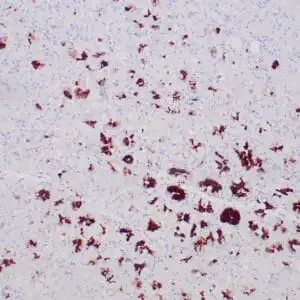
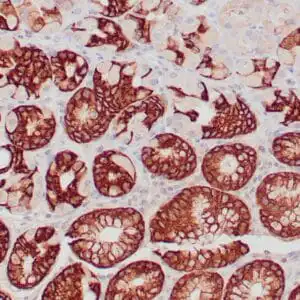
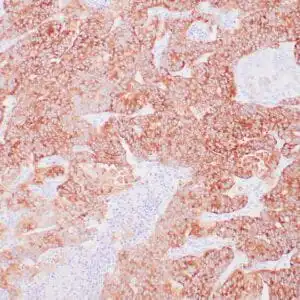
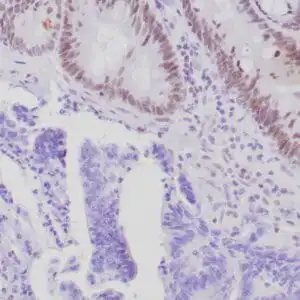
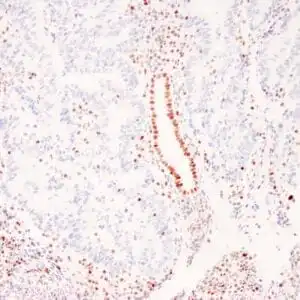
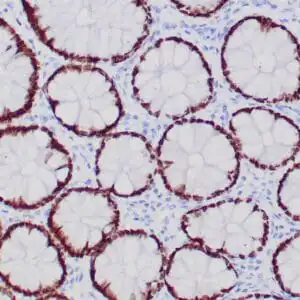
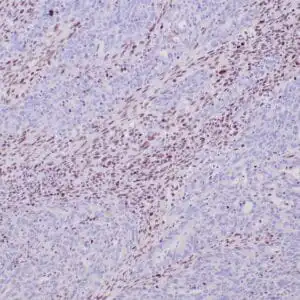
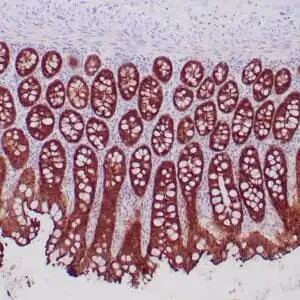
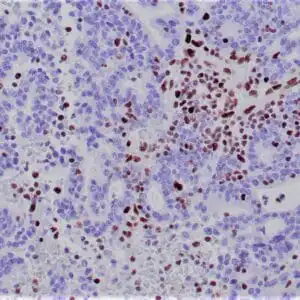
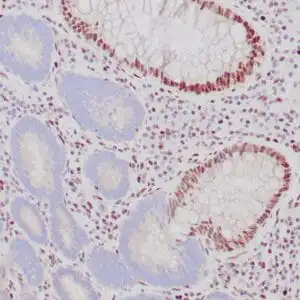
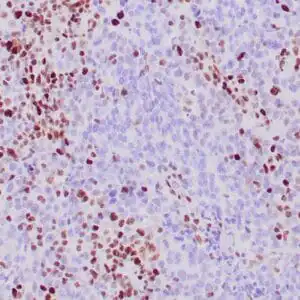
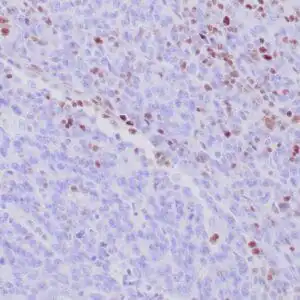
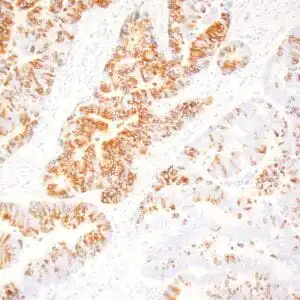
| Formalin-fixed, paraffin-embedded GIST stained with ZR146 antibody using peroxidase-conjugate and DAB chromogen. Note the strong cytoplasmic staining of tumor cells |
FAQ & Publications
Frequently Asked Questions
What species does the rabbit anti-DOG-1 monoclonal antibody (ZR146) specifically react with?
This rabbit monoclonal antibody specifically reacts with human DOG-1 protein, making it suitable for studies involving human tissue samples.
How should the rabbit anti-DOG-1 monoclonal antibody (ZR146) be stored to maintain its stability?
The antibody should be stored at 2-8°C for short-term use and at -20°C for long-term storage. It is important to avoid freeze/thaw cycles to preserve antibody integrity.
Publications
| pmid | title | authors | citation |
|---|---|---|---|
| We haven't added any publications to our database yet. | |||
Published literature highly relevant to the biological target of this product and referencing this antibody or clone are retrieved from the PubMed database provided by the United States National Library of Medicine at the National Institutes of Health.
Protocols
| relevant to this product |
|---|
| IHC |
Documents
| Batch Number | QC File | SDS |
|---|---|---|
| To view batch-specific Safety Datasheets and Quality Certificates associated with your account, please Log In. | ||
Only logged in customers who have purchased this product may leave a review.

Reviews
There are no reviews yet.