| Weight | 1 lbs |
|---|---|
| Dimensions | 9 × 5 × 2 in |
| host | mouse |
| isotype | IgG |
| clonality | monoclonal |
| concentration | concentrate, predilute |
| applications | IHC |
| reactivity | human |
| available size | 0.1 mL, 0.5 mL, 1 mL concentrated, 7 mL prediluted |

rabbit anti-Cytokeratin 20 monoclonal antibody (ZR429) 6144
Price range: $160.00 through $528.00
Antibody summary
- Rabbit monoclonal to Cytokeratin 20
- Suitable for: Immunohistochemistry (formalin-fixed, paraffin-embedded tissues)
- Reacts with: Human
- Isotype:IgG
- Control: Colon carcinoma
- Visualization: Cytoplasmic
- 0.1, 0.5, 1.0 mL concentrated, 7 mL prediluted
rabbit anti-Cytokeratin 20 monoclonal antibody ZR429 6144
| target relevance |
|---|
| Protein names Keratin, type I cytoskeletal 20 (Cytokeratin-20) (CK-20) (Keratin-20) (K20) (Protein IT) |
| Gene names KRT20,KRT20 |
| Protein family Intermediate filament family |
| Mass 48487Da |
| Function FUNCTION: Plays a significant role in maintaining keratin filament organization in intestinal epithelia. When phosphorylated, plays a role in the secretion of mucin in the small intestine (By similarity). {ECO:0000250, ECO:0000269|PubMed:12857878, ECO:0000269|PubMed:16608857}. |
| Subellular location SUBCELLULAR LOCATION: Cytoplasm {ECO:0000269|PubMed:10973561, ECO:0000269|PubMed:1696264}. |
| Tissues TISSUE SPECIFICITY: Expressed predominantly in the intestinal epithelium. Expressed in luminal cells of colonic mucosa. Also expressed in the Merkel cells of keratinized oral mucosa; specifically at the tips of some rete ridges of the gingival mucosa, in the basal layer of the palatal mucosa and in the taste buds of lingual mucosa. {ECO:0000269|PubMed:10973561, ECO:0000269|PubMed:1696264}. |
| Structure SUBUNIT: Heterotetramer of two type I and two type II keratins. Associates with KRT8. |
| Post-translational modification PTM: Hyperphosphorylation at Ser-13 occurs during the early stages of apoptosis but becomes less prominent during the later stages. Phosphorylation at Ser-13 also increases in response to stress brought on by cell injury (By similarity). {ECO:0000250}.; PTM: Proteolytically cleaved by caspases during apoptosis. Cleavage occurs at Asp-228. {ECO:0000269|PubMed:16608857}. |
| Target Relevance information above includes information from UniProt accession: P35900 |
| The UniProt Consortium |
Data
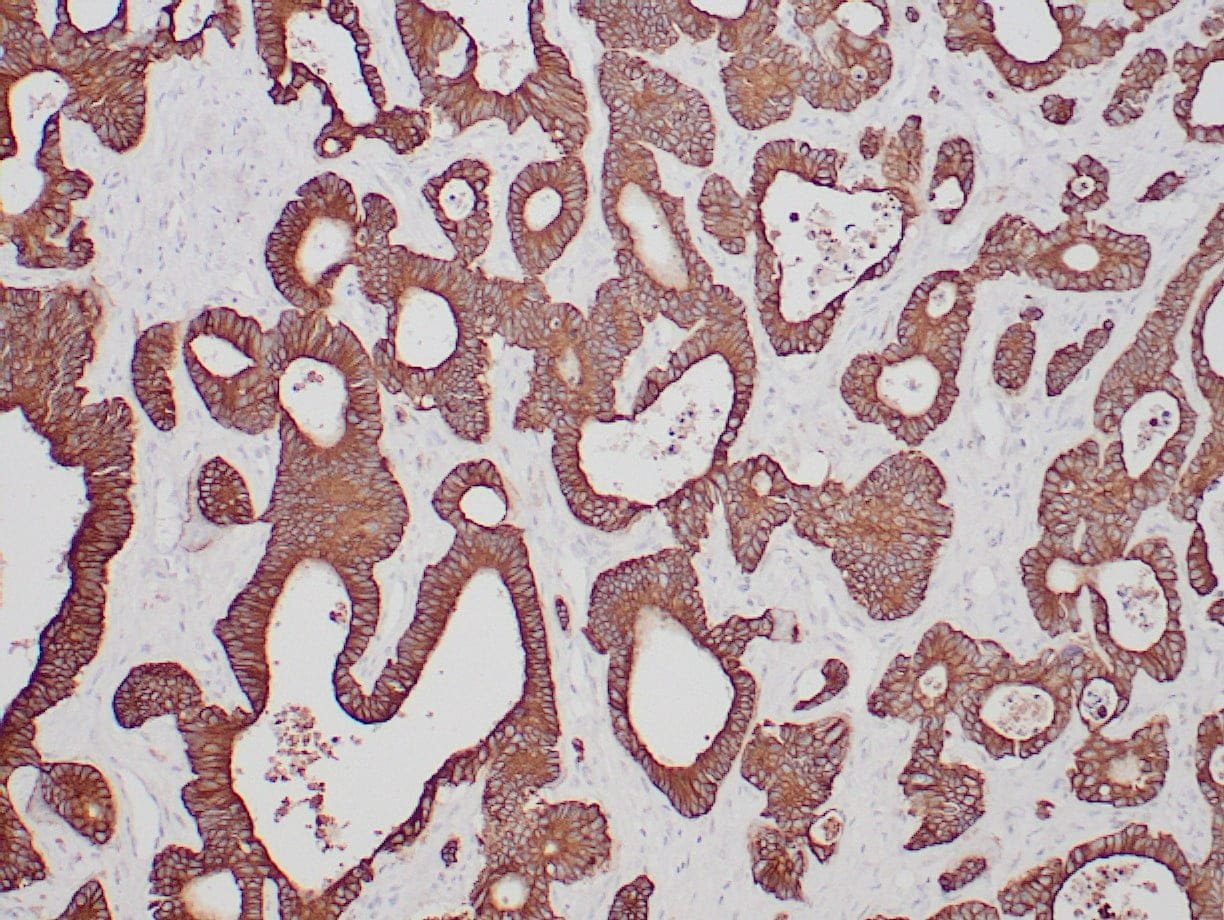 |
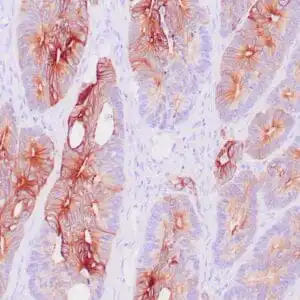
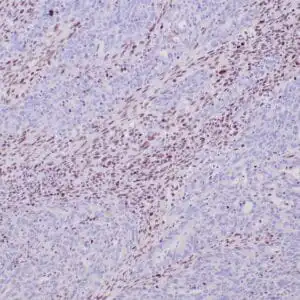
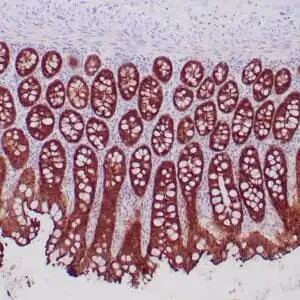
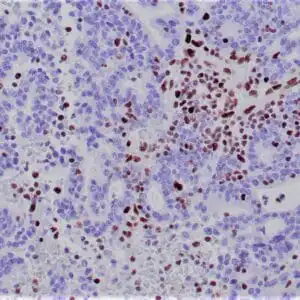
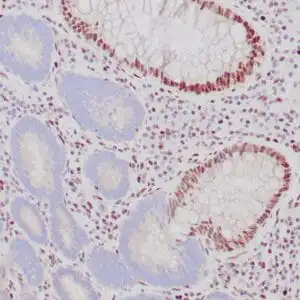
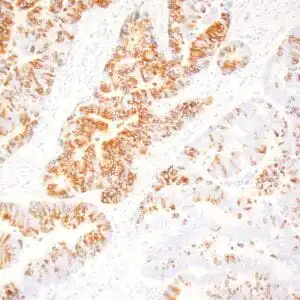
| Human colon carcinoma stained with anti-keratin 20 antibody using peroxidase-conjugate and DAB chromogen. Note the cytoplasmic staining of carcinoma glands. |
FAQ & Publications
Frequently Asked Questions
What species is the rabbit anti-Cytokeratin 20 monoclonal antibody (ZR429) reactive with?
This antibody is reactive with human tissues, making it suitable for studies involving human samples.
How should the rabbit anti-Cytokeratin 20 monoclonal antibody (ZR429) be stored to maintain stability?
For short-term storage, keep the antibody at 2-8°C. For longer-term preservation, store it at -20°C and avoid repeated freeze/thaw cycles to maintain antibody integrity.
Publications
| pmid | title | authors | citation |
|---|---|---|---|
| We haven't added any publications to our database yet. | |||
Published literature highly relevant to the biological target of this product and referencing this antibody or clone are retrieved from the PubMed database provided by the United States National Library of Medicine at the National Institutes of Health.
Protocols
| relevant to this product |
|---|
| IHC |
Documents
| Batch Number | QC File | SDS |
|---|---|---|
| To view batch-specific Safety Datasheets and Quality Certificates associated with your account, please Log In. | ||
Only logged in customers who have purchased this product may leave a review.
Reviews
There are no reviews yet.