| Weight | 1 lbs |
|---|---|
| Dimensions | 9 × 5 × 2 in |
| host | mouse |
| isotype | IgG2b |
| clonality | monoclonal |
| concentration | concentrate, predilute |
| applications | IHC |
| reactivity | human |
| available size | 0.1 mL, 0.5 mL, 1 mL concentrated, 7 mL prediluted |

mouse anti-NGFR monoclonal antibody (ZM55) 6288
Price range: $160.00 through $528.00
Antibody summary
- Mouse monoclonal to NGFR
- Suitable for: Immunohistochemistry (formalin-fixed, paraffin-embedded tissues)
- Reacts with: Human
- Isotype:IgG2b
- Control: Breast tissue
- Visualization: Cytoplasmic
- 0.1, 0.5, 1.0 mL concentrated, 7 mL prediluted
mouse anti-NGFR monoclonal antibody ZM55 6288
| target relevance |
|---|
| Homo sapiens NGFR Tumor necrosis factor receptor superfamily member 16 |
| Protein names Tumor necrosis factor receptor superfamily member 16 |
| Alternative names Gp80-LNGFR, Low affinity neurotrophin receptor p75NTR, Low-affinity nerve growth factor receptor, Low-affinity nerve growth factor receptor p75NGFR, Low-affinity nerve growth factor receptor p75NGR, p75 ICD |
| Gene names NGFR |
| Function Low affinity receptor which can bind to NGF, BDNF, NTF3, and NTF4. Forms a heterodimeric receptor with SORCS2 that binds the precursor forms of NGF, BDNF and NTF3 with high affinity, and has much lower affinity for mature NGF and BDNF (PubMed:24908487). Plays an important role in differentiation and survival of specific neuronal populations during development (By similarity). Can mediate cell survival as well as cell death of neural cells. Plays a role in the inactivation of RHOA (PubMed:26646181). Plays a role in the regulation of the translocation of GLUT4 to the cell surface in adipocytes and skeletal muscle cells in response to insulin, probably by regulating RAB31 activity, and thereby contributes to the regulation of insulin-dependent glucose uptake (By similarity). Necessary for the circadian oscillation of the clock genes BMAL1, PER1, PER2 and NR1D1 in the suprachiasmatic nucleus (SCmgetaN) of the brain and in liver and of the genes involved in glucose and lipid metabolism in the liver (PubMed:23785138). Together with BFAR negatively regulates NF-kappa-B and JNK-related signaling pathways (PubMed:22566094) |
| Subcellular location Cell membrane, Cytoplasm, Perikaryon, Cell projection, growth cone, Cell projection, dendritic spine |
| Structure Homodimer; disulfide-linked (By similarity). Heterodimer with SORCS2. The extracellular domains of the heterodimer bind NGF (PubMed:22155786, PubMed:24908487). The cytoplasmic region of the heterodimer binds TRIO. NGF binding mediates dissociation of TRIO from the receptor complex (PubMed:22155786). Interacts with RTN4R (PubMed:19052207). Interacts with TRAF2, TRAF4, TRAF6, PTPN13 and RANBP9 (PubMed:10514511, PubMed:10544233, PubMed:12963025, PubMed:9915784). Interacts through TRAF6 with SQSTM1 which bridges NGFR to NTRK1 (PubMed:11244088). Interacts with BEX1 (By similarity). Interacts with BEX3 (By similarity). Interacts with KIDINS220 and NTRK1. Can form a ternary complex with NTRK1 and KIDINS220 and this complex is affected by the expression levels of KIDINS220. An increase in KIDINS220 expression leads to a decreased association of NGFR and NTRK1. Interacts with NTRK2; may regulate the ligand specificity of the NTRK2 receptor (By similarity). Interacts (via death domain) with RAB31 (By similarity). Interacts with LINGO1 (PubMed:14966521). Interacts with NRADD (By similarity). Interacts with MAGED1; the interaction antagonizes the association NGFR:NTRK1 (By similarity). Interacts (via death domain) with ARHGDIA and RIPK2 (PubMed:26646181). Interacts with BFAR (PubMed:22566094) |
| Post-translational modification N- and O-glycosylated O-linked glycans consist of Gal(1-3)GalNAc core elongated by 1 or 2 NeuNAc Phosphorylated on serine residues |
| Keywords 3D-structure, Alternative splicing, Apoptosis, Biological rhythms, Cell membrane, Cell projection, Cytoplasm, Developmental protein, Differentiation, Disulfide bond, Glycoprotein, Membrane, Neurogenesis, Phosphoprotein, Proteomics identification, Receptor, Reference proteome, Repeat, Signal, Synapse, Transmembrane, Transmembrane helix |
| Sequence MGAGATGRAMDGPRLLLLLLLGVSLGGAKEACPTGLYTHSGECCKACNLGEGVAQPCGAN QTVCEPCLDSVTFSDVVSATEPCKPCTECVGLQSMSAPCVEADDAVCRCAYGYYQDETTG RCEACRVCEAGSGLVFSCQDKQNTVCEECPDGTYSDEANHVDPCLPCTVCEDTERQLREC TRWADAECEEIPGRWITRSTPPEGSDSTAPSTQEPEAPPEQDLIASTVAGVVTTVMGSSQ PVVTRGTTDNLIPVYCSILAAVVVGLVAYIAFKRWNSCKQNKQGANSRPVNQTPPPEGEK LHSDSGISVDSQSLHDQQPHTQTASGQALKGDGGLYSSLPPAKREEVEKLLNGSAGDTWR HLAGELGYQPEHIDSFTHEACPVRALLASWATQDSATLDALLAALRRIQRADLVESLCSE STATSPV |
| UniProt accession: P08138 |
Data
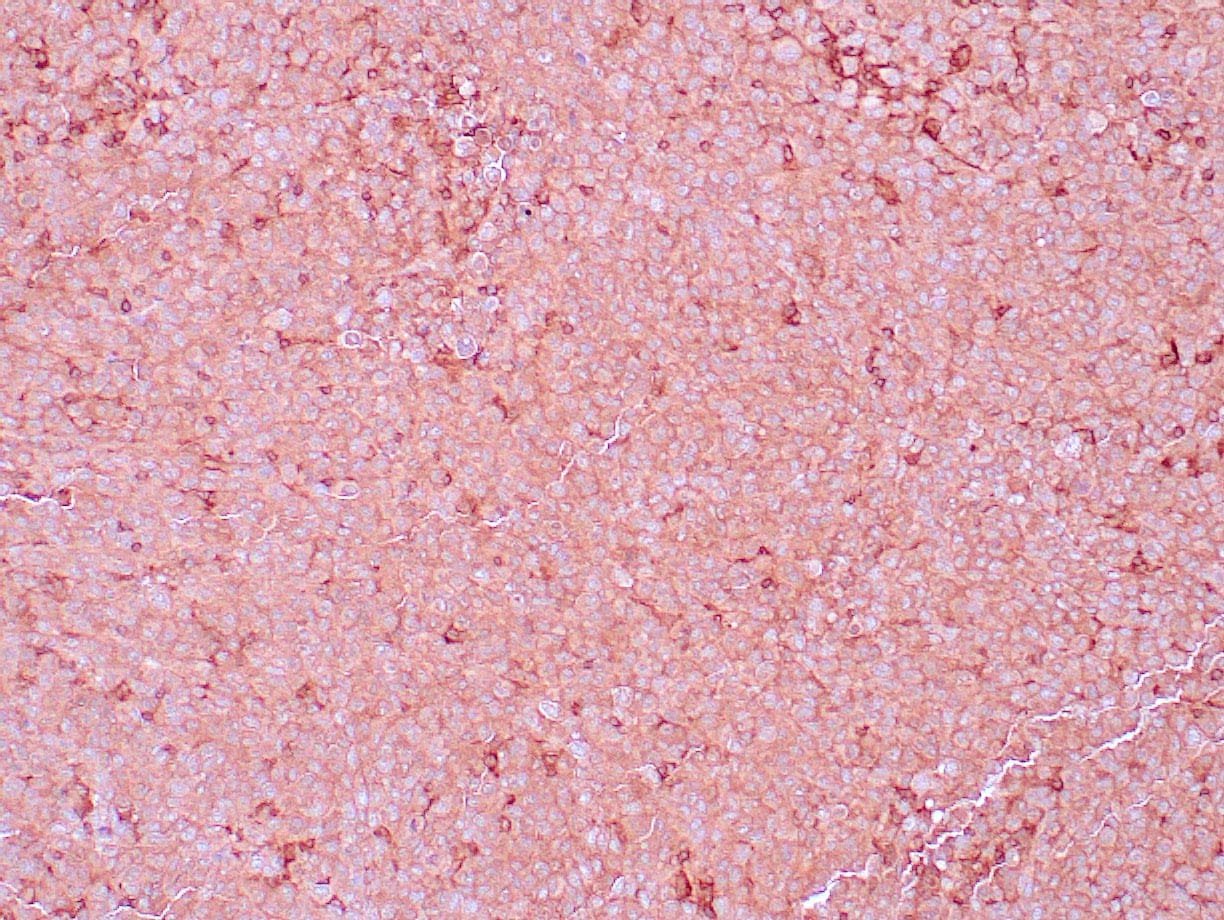 |
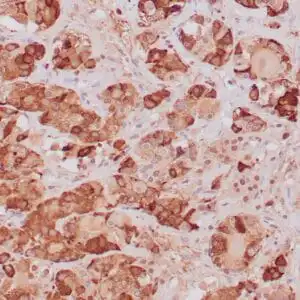
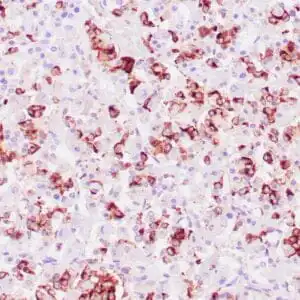
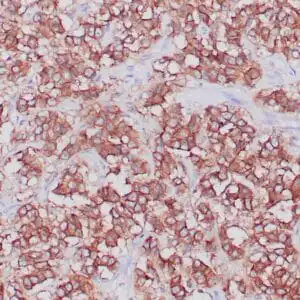
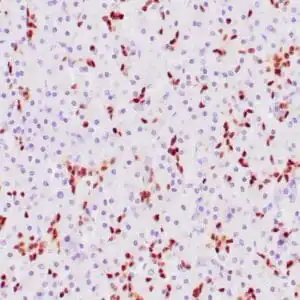
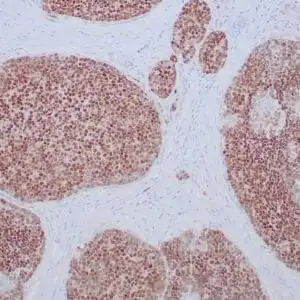
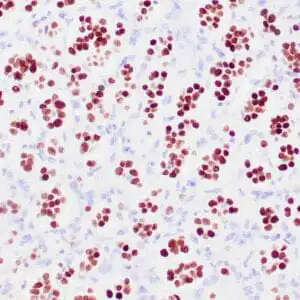
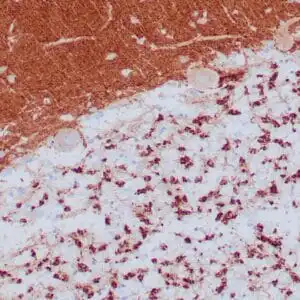
| Human malignant melanoma stained with anti-NGFR antibody using peroxidase-conjugate and DAB chromogen. Note the cytoplasmic staining of tumor cells. |
FAQ & Publications
Frequently Asked Questions
What species reactivity does the mouse anti-NGFR monoclonal antibody (ZM55) 6288 exhibit?
This antibody reacts specifically with human NGFR.
Which applications is this mouse anti-NGFR monoclonal antibody validated for?
The antibody is suitable for immunohistochemistry (IHC) on formalin-fixed, paraffin-embedded tissues.
What are the recommended storage conditions for the mouse anti-NGFR monoclonal antibody (ZM55) 6288?
For short-term storage, keep the antibody at 2-8°C. For long-term storage, it should be kept at -20°C, and freeze/thaw cycles should be avoided.
What is the immunogen used to generate the mouse anti-NGFR monoclonal antibody (ZM55) 6288?
The immunogen is a recombinant human p75 NGFR protein fragment corresponding to amino acids approximately 281-421.
What is the host species and clonality of the anti-NGFR antibody ZM55 6288?
The antibody is a mouse monoclonal antibody of the IgG2b isotype.
Publications
| pmid | title | authors | citation |
|---|---|---|---|
| We haven't added any publications to our database yet. | |||
Published literature highly relevant to the biological target of this product and referencing this antibody or clone are retrieved from the PubMed database provided by the United States National Library of Medicine at the National Institutes of Health.
Protocols
| relevant to this product |
|---|
| IHC |
Documents
| Batch Number | QC File | SDS |
|---|---|---|
| To view batch-specific Safety Datasheets and Quality Certificates associated with your account, please Log In. | ||
Only logged in customers who have purchased this product may leave a review.


Reviews
There are no reviews yet.