| Weight | 1 lbs |
|---|---|
| Dimensions | 9 × 5 × 2 in |
| host | mouse |
| isotype | IgG1 |
| clonality | monoclonal |
| concentration | concentrate, predilute |
| applications | IHC |
| reactivity | human |
| available size | 0.1 mL, 0.5 mL, 1 mL concentrated, 7 mL prediluted |

mouse anti-Gastrin monoclonal antibody (ZM359) 6189
Price range: $160.00 through $528.00
Antibody summary
- Mouse monoclonal to Gastrin
- Suitable for: Immunohistochemistry (formalin-fixed, paraffin-embedded tissues)
- Reacts with: Human
- Isotype:IgG1
- Control: Normal gastric mucosa
- Visualization: Cytoplasmic
- 0.1, 0.5, 1.0 mL concentrated, 7 mL prediluted
mouse anti-Gastrin monoclonal antibody ZM359 6189
| target relevance |
|---|
| Homo sapiens GAST Gastrin |
| Protein names Gastrin |
| Gene names GAST |
| Protein family Belongs to the gastrin/cholecystokinin family |
| Function Gastrin stimulates the stomach mucosa to produce and secrete hydrochloric acid and the pancreas to secrete its digestive enzymes. It also stimulates smooth muscle contraction and increases blood circulation and water secretion in the stomach and intestine |
| Subcellular location Secreted |
| Post-translational modification Two different processing pathways probably exist in antral G-cells. In the dominant pathway progastrin is cleaved at three sites resulting in two major bioactive gastrins, gastrin-34 and gastrin-17. In the putative alternative pathway, progastrin may be processed only at the most C-terminal dibasic site resulting in the synthesis of gastrin-71 Sulfation enhances proteolytic processing, and blocks peptide degradation. Levels of sulfation differ between proteolytically-cleaved gastrins. Thus, gastrin-6 is almost 73% sulfated, whereas the larger gastrins are less than 50% sulfated. Sulfation levels are also tissue-specific |
| Keywords 3D-structure, Amidation, Cleavage on pair of basic residues, Direct protein sequencing, Hormone, Phosphoprotein, Proteomics identification, Pyrrolidone carboxylic acid, Reference proteome, Secreted, Signal, Sulfation |
| Sequence MQRLCVYVLIFALALAAFSEASWKPRSQQPDAPLGTGANRDLELPWLEQQGPASHHRRQL GPQGPPHLVADPSKKQGPWLEEEEEAYGWMDFGRRSAEDEN |
| UniProt accession: P01350 |
Data
 |
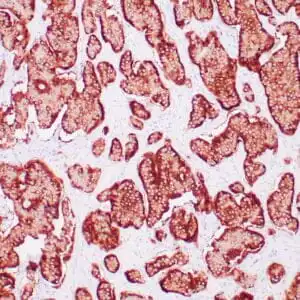
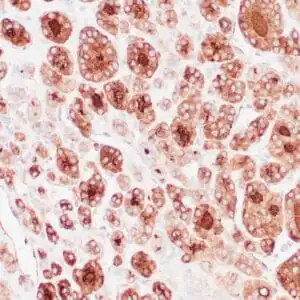
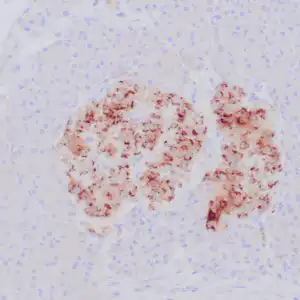
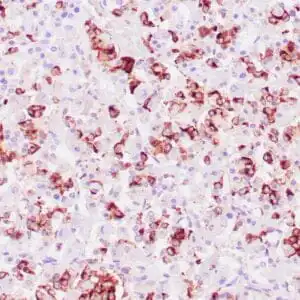
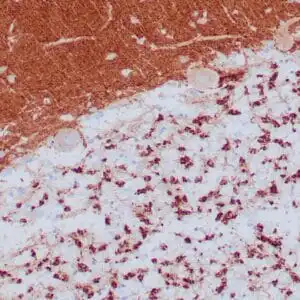
| Formalin-fixed, paraffin-embedded human gastric antral mucosa stained with anti-gastrin antibody using peroxidase-conjugate and DAB chromogen. Note the cytoplasmic staining of few G-cells |
FAQ & Publications
Frequently Asked Questions
What species does the mouse anti-Gastrin monoclonal antibody (ZM359) specifically react with?
This antibody is reactive with human Gastrin protein.
Which applications and sample types is this mouse anti-Gastrin antibody validated for?
It is suitable for Immunohistochemistry (IHC) on formalin-fixed, paraffin-embedded tissues.
What are the recommended storage conditions for preserving the integrity of this antibody?
For short-term storage, keep the antibody at 2-8°C. For long-term storage, store at -20°C and avoid repeated freeze/thaw cycles.
Publications
| pmid | title | authors | citation |
|---|---|---|---|
| We haven't added any publications to our database yet. | |||
Published literature highly relevant to the biological target of this product and referencing this antibody or clone are retrieved from the PubMed database provided by the United States National Library of Medicine at the National Institutes of Health.
Protocols
| relevant to this product |
|---|
| IHC |
Documents
| Batch Number | QC File | SDS |
|---|---|---|
| To view batch-specific Safety Datasheets and Quality Certificates associated with your account, please Log In. | ||
Only logged in customers who have purchased this product may leave a review.


Reviews
There are no reviews yet.