| Weight | 1 lbs |
|---|---|
| Dimensions | 9 × 5 × 2 in |
| host | mouse |
| isotype | IgG1 |
| clonality | monoclonal |
| concentration | concentrate, predilute |
| applications | IHC |
| reactivity | human |
| available size | 0.1 mL, 0.5 mL, 1 mL concentrated, 7 mL prediluted |

mouse anti-MLH-1 monoclonal antibody (G168-728) 6257
Price range: $160.00 through $528.00
Antibody summary
- Mouse monoclonal to MLH-1
- Suitable for: Immunohistochemistry (formalin-fixed, paraffin-embedded tissues)
- Reacts with: Human
- Isotype:IgG1
- Control: Colon carcinoma
- Visualization: Nuclear
- 0.1, 0.5, 1.0 mL concentrated, 7 mL prediluted
mouse anti-MLH-1 monoclonal antibody G168-728 6257
| target relevance |
|---|
| Homo sapiens MLH1 DNA mismatch repair protein Mlh1 |
| Protein names DNA mismatch repair protein Mlh1 |
| Alternative names MutL protein homolog 1 |
| Gene names MLH1 |
| Protein family Belongs to the DNA mismatch repair MutL/HexB family |
| Function Heterodimerizes with PMS2 to form MutL alpha, a component of the post-replicative DNA mismatch repair system (MMR). DNA repair is initiated by MutS alpha (MSH2-MSH6) or MutS beta (MSH2-MSH3) binding to a dsDNA mismatch, then MutL alpha is recruited to the heteroduplex. Assembly of the MutL-MutS-heteroduplex ternary complex in presence of RFC and PCNA is sufficient to activate endonuclease activity of PMS2. It introduces single-strand breaks near the mismatch and thus generates new entry points for the exonuclease EXO1 to degrade the strand containing the mismatch. DNA methylation would prevent cleavage and therefore assure that only the newly mutated DNA strand is going to be corrected. MutL alpha (MLH1-PMS2) interacts physically with the clamp loader subunits of DNA polymerase III, suggesting that it may play a role to recruit the DNA polymerase III to the site of the MMR. Also implicated in DNA damage signaling, a process which induces cell cycle arrest and can lead to apoptosis in case of major DNA damages. Heterodimerizes with MLH3 to form MutL gamma which plays a role in meiosis |
| Subcellular location Nucleus, Chromosome |
| Structure Component of the DNA mismatch repair (MMR) complex composed at least of MSH2, MSH3, MSH6, PMS1 and MLH1 (PubMed:26300262). Heterodimer of MLH1 and PMS2 (MutL alpha), MLH1 and PMS1 (MutL beta) or MLH1 and MLH3 (MutL gamma). Forms a ternary complex with MutS alpha (MSH2-MSH6) or MutS beta (MSH2-MSH3). Part of the BRCA1-associated genome surveillance complex (BASC), which contains BRCA1, MSH2, MSH6, MLH1, ATM, BLM, PMS2 and the RAD50-MRE11-NBS1 protein complex (PubMed:10783165). This association could be a dynamic process changing throughout the cell cycle and within subnuclear domains (PubMed:10097147). Interacts with MCM9; the interaction recruits MLH1 to chromatin (PubMed:26300262). Interacts with MCM8 (PubMed:26300262). Interacts with PMS2; this interaction promotes MLH1 stability (PubMed:11427529, PubMed:22753075, PubMed:39032648). Interacts with MBD4 (PubMed:10097147). Interacts with EXO1 (PubMed:11427529, PubMed:11429708, PubMed:12414623, PubMed:14676842, PubMed:22753075). Interacts with MTMR15/FAN1 (PubMed:20603073) |
| Post-translational modification Acetylated (PubMed:30770470). Deacetylated by HDAC6 which prevents the MutL alpha complex, formed by the MLH1-PMS2 heterodimer, from being recruited to the MutS alpha complex, formed by the MSH2-MSH6 heterodimer, leading to tolerance of DNA damage (PubMed:30770470) Ubiquitinated by UBR4; leading to proteasomal degradation. This ubiquitination is counteracted by the deubiquitinase USP5 |
| Involvement in disease Lynch syndrome 2 A form of Lynch syndrome, an autosomal dominant disease associated with marked increase in cancer susceptibility. It is characterized by a familial predisposition to early-onset colorectal carcinoma (CRC) and extra-colonic tumors of the gastrointestinal, urological and female reproductive tracts. Lynch syndrome is reported to be the most common form of inherited colorectal cancer in the Western world. Clinically, it is often divided into two subgroups. Type I is characterized by hereditary predisposition to colorectal cancer, a young age of onset, and carcinoma observed in the proximal colon. Type II is characterized by increased risk for cancers in certain tissues such as the uterus, ovary, breast, stomach, small intestine, skin, and larynx in addition to the colon. Diagnosis of classical Lynch syndrome is based on the Amsterdam criteria: 3 or more relatives affected by colorectal cancer, one a first degree relative of the other two; 2 or more generation affected; 1 or more colorectal cancers presenting before 50 years of age; exclusion of hereditary polyposis syndromes. The term 'suspected Lynch syndrome' or 'incomplete Lynch syndrome' can be used to describe families who do not or only partially fulfill the Amsterdam criteria, but in whom a genetic basis for colon cancer is strongly suspected. Mismatch repair cancer syndrome 1 An autosomal recessive form of mismatch repair cancer syndrome, a childhood cancer predisposition syndrome encompassing a broad tumor spectrum. This includes hematological malignancies, central nervous system tumors, Lynch syndrome-associated malignancies such as colorectal tumors as well as multiple intestinal polyps, embryonic tumors and rhabdomyosarcoma. Multiple cafe-au-lait macules, a feature reminiscent of neurofibromatosis type 1, are often found as first manifestation of the underlying cancer. Muir-Torre syndrome Rare autosomal dominant disorder characterized by sebaceous neoplasms and visceral malignancy. Endometrial cancer A malignancy of endometrium, the mucous lining of the uterus. Most endometrial cancers are adenocarcinomas, cancers that begin in cells that make and release mucus and other fluids. Colorectal cancer A complex disease characterized by malignant lesions arising from the inner wall of the large intestine (the colon) and the rectum. Genetic alterations are often associated with progression from premalignant lesion (adenoma) to invasive adenocarcinoma. Risk factors for cancer of the colon and rectum include colon polyps, long-standing ulcerative colitis, and genetic family history. |
| Keywords 3D-structure, Acetylation, Alternative splicing, ATP-binding, Cell cycle, Chromosome, Disease variant, DNA damage, DNA repair, Hereditary nonpolyposis colorectal cancer, Nucleotide-binding, Nucleus, Phosphoprotein, Proteomics identification, Reference proteome, Tumor suppressor, Ubl conjugation |
| Sequence MSFVAGVIRRLDETVVNRIAAGEVIQRPANAIKEMIENCLDAKSTSIQVIVKEGGLKLIQ IQDNGTGIRKEDLDIVCERFTTSKLQSFEDLASISTYGFRGEALASISHVAHVTITTKTA DGKCAYRASYSDGKLKAPPKPCAGNQGTQITVEDLFYNIATRRKALKNPSEEYGKILEVV GRYSVHNAGISFSVKKQGETVADVRTLPNASTVDNIRSIFGNAVSRELIEIGCEDKTLAF KMNGYISNANYSVKKCIFLLFINHRLVESTSLRKAIETVYAAYLPKNTHPFLYLSLEISP QNVDVNVHPTKHEVHFLHEESILERVQQHIESKLLGSNSSRMYFTQTLLPGLAGPSGEMV KSTTSLTSSSTSGSSDKVYAHQMVRTDSREQKLDAFLQPLSKPLSSQPQAIVTEDKTDIS SGRARQQDEEMLELPAPAEVAAKNQSLEGDTTKGTSEMSEKRGPTSSNPRKRHREDSDVE MVEDDSRKEMTAACTPRRRIINLTSVLSLQEEINEQGHEVLREMLHNHSFVGCVNPQWAL AQHQTKLYLLNTTKLSEELFYQILIYDFANFGVLRLSEPAPLFDLAMLALDSPESGWTEE DGPKEGLAEYIVEFLKKKAEMLADYFSLEIDEEGNLIGLPLLIDNYVPPLEGLPIFILRL ATEVNWDEEKECFESLSKECAMFYSIRKQYISEESTLSGQQSEVPGSIPNSWKWTVEHIV YKALRSHILPPKHFTEDGNILQLANLPDLYKVFERC |
| UniProt accession: P40692 |
Data
 |
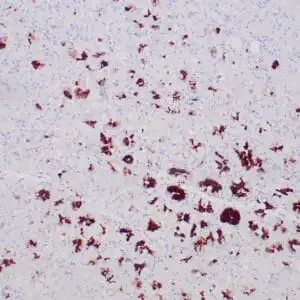
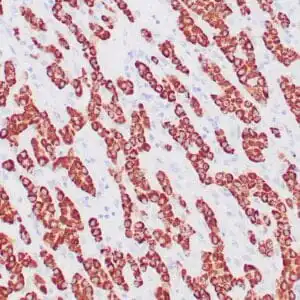
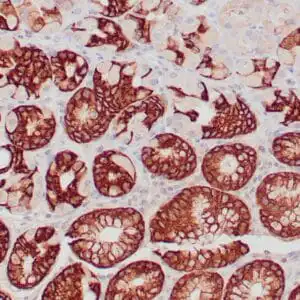
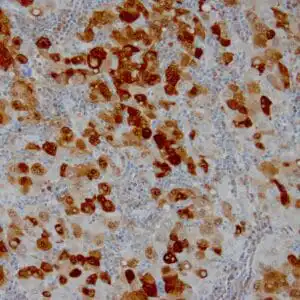
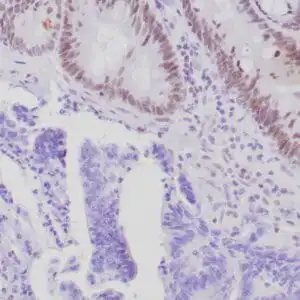
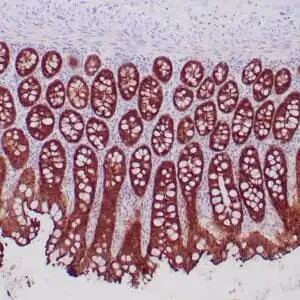
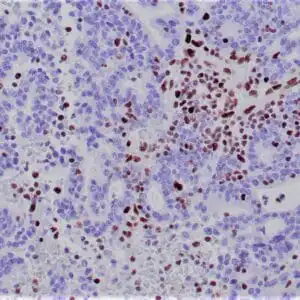
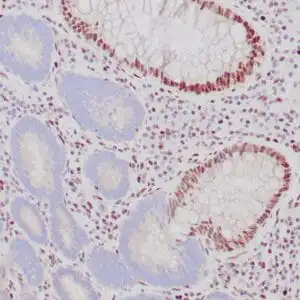
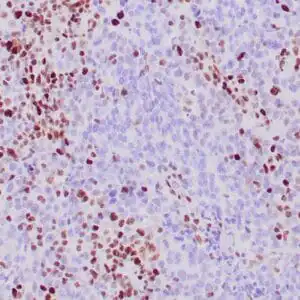
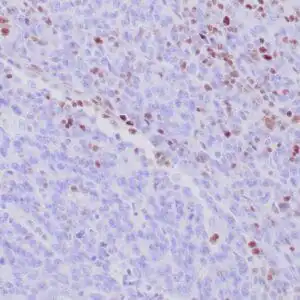
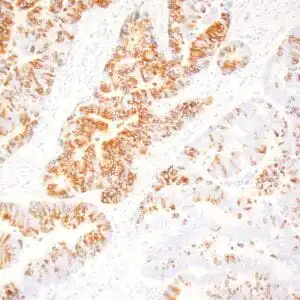
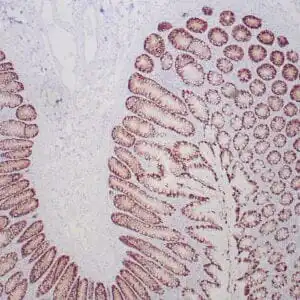
| Human colon adenocarcinoma with Lynch syndrome stained with anti-MLH-1 antibody using peroxidase-conjugate and DAB chromogen. Note absence of nuclear staining of tumor cells whereas the background non tumor cells are positive. |
FAQ & Publications
Frequently Asked Questions
What species does the mouse anti-MLH-1 monoclonal antibody (G168-728) specifically react with?
This antibody specifically reacts with human MLH-1 protein.
What are the recommended storage conditions for the mouse anti-MLH-1 monoclonal antibody to maintain its stability?
Store the antibody at 2-8°C for short term use and at -20°C for longer term storage, avoiding freeze/thaw cycles.
For which application is this mouse anti-MLH-1 monoclonal antibody (G168-728) validated, and what is the suggested dilution range for the concentrated form?
This antibody is validated for immunohistochemistry on formalin-fixed, paraffin-embedded tissues, with a recommended dilution range of 1:25 to 1:100 for the concentrated antibody.
Publications
| pmid | title | authors | citation |
|---|---|---|---|
| We haven't added any publications to our database yet. | |||
Published literature highly relevant to the biological target of this product and referencing this antibody or clone are retrieved from the PubMed database provided by the United States National Library of Medicine at the National Institutes of Health.
Protocols
| relevant to this product |
|---|
| IHC |
Documents
| Batch Number | QC File | SDS |
|---|---|---|
| To view batch-specific Safety Datasheets and Quality Certificates associated with your account, please Log In. | ||
Only logged in customers who have purchased this product may leave a review.
Reviews
There are no reviews yet.