| Weight | 1 lbs |
|---|---|
| Dimensions | 9 × 5 × 2 in |
| host | mouse |
| isotype | IgG2b/κ |
| clonality | monoclonal |
| concentration | concentrate, predilute |
| applications | IHC |
| reactivity | human |
| available size | 0.1 mL, 0.5 mL, 1 mL concentrated, 7 mL prediluted |

mouse anti-Glutamine synthetase monoclonal antibody (ZM377) 6198
Price range: $160.00 through $528.00
Antibody summary
- Mouse monoclonal to Glutamine synthetase
- Suitable for: Immunohistochemistry (formalin-fixed, paraffin-embedded tissues)
- Reacts with: Human
- Isotype:IgG2b/κ
- Control: Normal liver
- Visualization: Cytoplasmic
- 0.1, 0.5, 1.0 mL concentrated, 7 mL prediluted
mouse anti-Glutamine synthetase monoclonal antibody ZM377 6198
| target relevance |
|---|
| Homo sapiens GLUL Glutamine synthetase |
| Protein names Glutamine synthetase |
| Alternative names Glutamate--ammonia ligase, Palmitoyltransferase GLUL |
| Gene names GLUL |
| Protein family Belongs to the glutamine synthetase family |
| Function Glutamine synthetase that catalyzes the ATP-dependent conversion of glutamate and ammonia to glutamine (PubMed:16267323, PubMed:30158707, PubMed:36289327). Its role depends on tissue localization: in the brain, it regulates the levels of toxic ammonia and converts neurotoxic glutamate to harmless glutamine, whereas in the liver, it is one of the enzymes responsible for the removal of ammonia (By similarity). Plays a key role in ammonium detoxification during erythropoiesis: the glutamine synthetase activity is required to remove ammonium generated by porphobilinogen deaminase (HMBS) during heme biosynthesis to prevent ammonium accumulation and oxidative stress (By similarity). Essential for proliferation of fetal skin fibroblasts (PubMed:18662667). Independently of its glutamine synthetase activity, required for endothelial cell migration during vascular development: acts by regulating membrane localization and activation of the GTPase RHOJ, possibly by promoting RHOJ palmitoylation (PubMed:30158707). May act as a palmitoyltransferase for RHOJ: able to autopalmitoylate and then transfer the palmitoyl group to RHOJ (PubMed:30158707). Plays a role in ribosomal 40S subunit biogenesis (PubMed:26711351). Through the interaction with BEST2, inhibits BEST2 channel activity by affecting the gating at the aperture in the absence of intracellular L-glutamate, but sensitizes BEST2 to intracellular L-glutamate, which promotes the opening of BEST2 and thus relieves its inhibitory effect on BEST2 (PubMed:36289327) |
| Catalytic activity L-glutamate + NH4(+) + ATP = L-glutamine + ADP + phosphate + H(+) L-cysteinyl-[protein] + hexadecanoyl-CoA = S-hexadecanoyl-L-cysteinyl-[protein] + CoA |
| Subcellular location Cytoplasm, cytosol, Microsome, Mitochondrion, Cell membrane |
| Structure Decamer; composed of two pentamers (PubMed:18005987). Interacts with PALMD (By similarity). Interacts with RHOJ (PubMed:30158707). Interacts with BEST2; this interaction tethers a fraction of GLUL to the membrane, causing a decrease of cytosolic glutamine synthase (GS) activity and inhibits the chloride channel activity of BEST2 by affecting the gating at the aperture in the absence of intracellular glutamate (PubMed:36289327) |
| Post-translational modification Acetylated by EP300/p300; acetylation is stimulated by increased glutamine levels and promotes ubiquitin-mediated proteasomal degradation Palmitoylated; undergoes autopalmitoylation Ubiquitinated by ZNRF1 (By similarity). Ubiquitinated by the DCX (DDB1-CUL4-X-box) E3 ubiquitin-protein ligase complex called CRL4(CRBN), leading to proteasomal degradation (PubMed:26990986) |
| Involvement in disease Glutamine deficiency, congenital An autosomal recessive disorder characterized by variable brain malformations, encephalopathy, severe developmental delay, seizures, and decreased glutamine levels in bodily fluids. Death in early infancy may occur. Developmental and epileptic encephalopathy 116 A form of epileptic encephalopathy, a heterogeneous group of early-onset epilepsies characterized by refractory seizures, neurodevelopmental impairment, and poor prognosis. Development is normal prior to seizure onset, after which cognitive and motor delays become apparent. DEE116 is autosomal dominant form characterized by severe developmental delay, seizures, and white matter abnormalities. |
| Keywords 3D-structure, Acetylation, Angiogenesis, ATP-binding, Cell membrane, Cytoplasm, Disease variant, Endoplasmic reticulum, Epilepsy, Intellectual disability, Ligase, Lipoprotein, Magnesium, Manganese, Membrane, Metal-binding, Microsome, Mitochondrion, Nucleotide-binding, Palmitate, Phosphoprotein, Proteomics identification, Reference proteome, Transferase, Ubl conjugation |
| Sequence MTTSASSHLNKGIKQVYMSLPQGEKVQAMYIWIDGTGEGLRCKTRTLDSEPKCVEELPEW NFDGSSTLQSEGSNSDMYLVPAAMFRDPFRKDPNKLVLCEVFKYNRRPAETNLRHTCKRI MDMVSNQHPWFGMEQEYTLMGTDGHPFGWPSNGFPGPQGPYYCGVGADRAYGRDIVEAHY RACLYAGVKIAGTNAEVMPAQWEFQIGPCEGISMGDHLWVARFILHRVCEDFGVIATFDP KPIPGNWNGAGCHTNFSTKAMREENGLKYIEEAIEKLSKRHQYHIRAYDPKGGLDNARRL TGFHETSNINDFSAGVANRSASIRIPRTVGQEKKGYFEDRRPSANCDPFSVTEALIRTCL LNETGDEPFQYKN |
| UniProt accession: P15104 |
Data
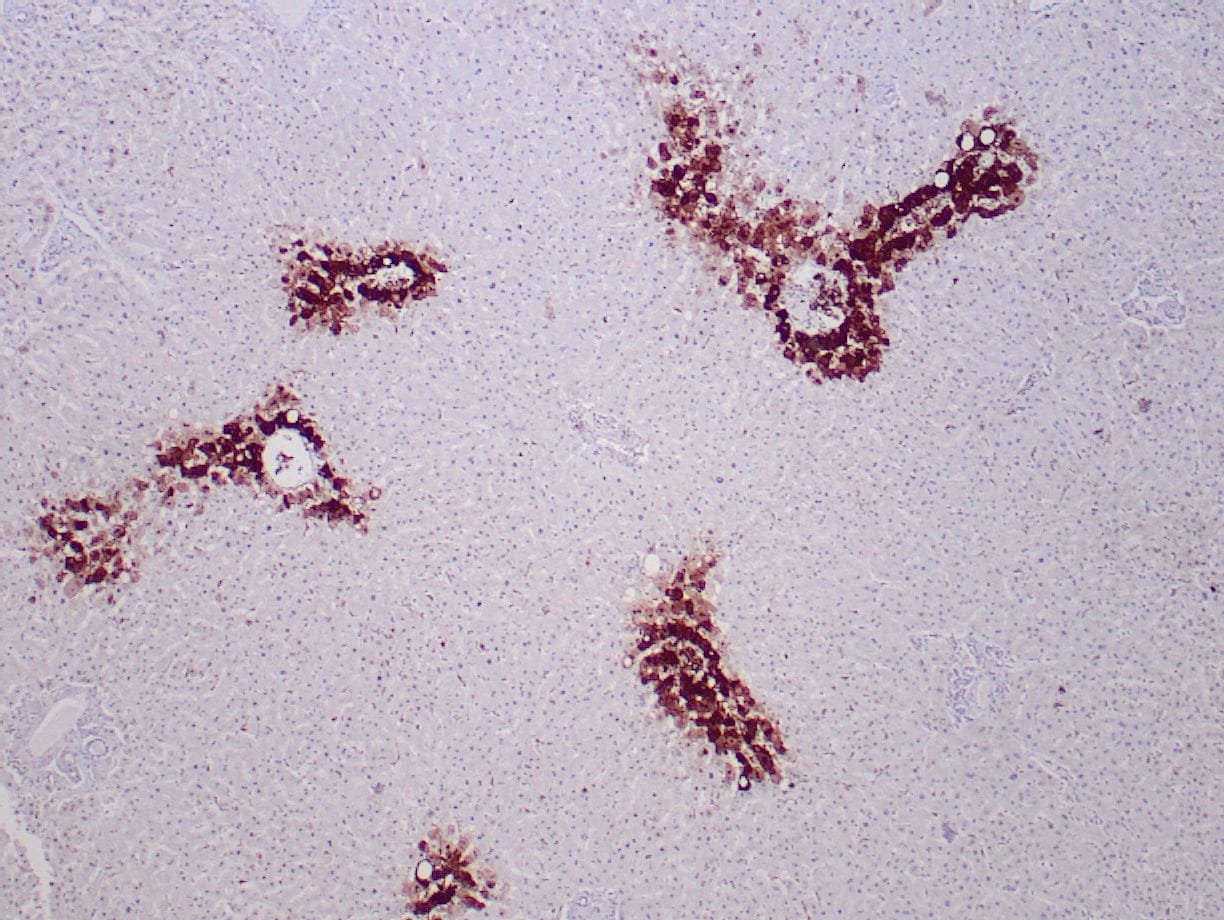 |
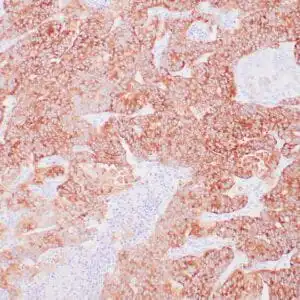
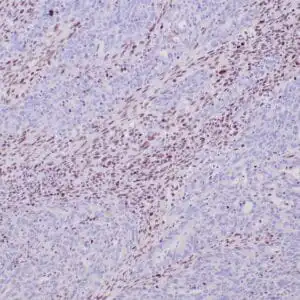
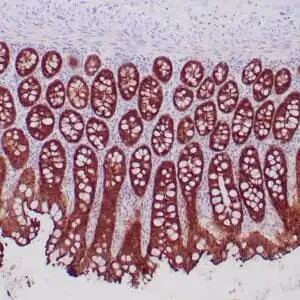
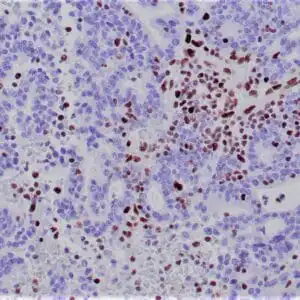
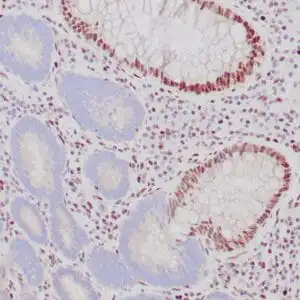
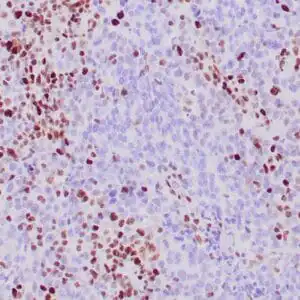
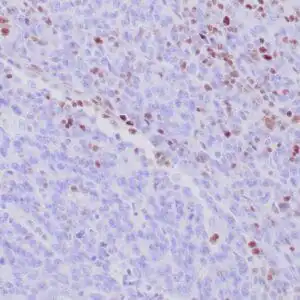
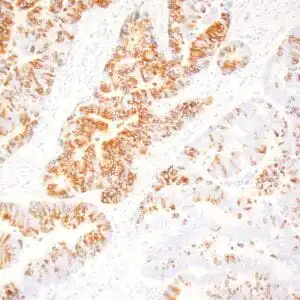
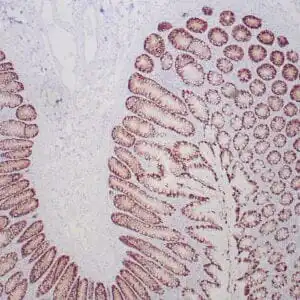
| Formalin-fixed, paraffin-embedded human liver stained with anti-glutamine synthetase antibody using peroxidase-conjugate and DAB chromogen. Note the cytoplasmic staining of hepatocytes around a central vein. |
FAQ & Publications
Frequently Asked Questions
What applications is the mouse anti-Glutamine synthetase monoclonal antibody (ZM377) suitable for?
This antibody is suitable for immunohistochemistry (IHC) on formalin-fixed, paraffin-embedded human tissues.
What are the recommended storage conditions for the mouse anti-Glutamine synthetase monoclonal antibody?
For short-term storage, keep the antibody at 2-8°C. For long-term storage, it should be kept at -20°C, and freeze/thaw cycles should be avoided.
Which species does the mouse anti-Glutamine synthetase monoclonal antibody (ZM377) react with?
This antibody specifically reacts with human Glutamine synthetase.
Publications
| pmid | title | authors | citation |
|---|---|---|---|
| We haven't added any publications to our database yet. | |||
Published literature highly relevant to the biological target of this product and referencing this antibody or clone are retrieved from the PubMed database provided by the United States National Library of Medicine at the National Institutes of Health.
Protocols
| relevant to this product |
|---|
| IHC |
Documents
| Batch Number | QC File | SDS |
|---|---|---|
| To view batch-specific Safety Datasheets and Quality Certificates associated with your account, please Log In. | ||
Only logged in customers who have purchased this product may leave a review.
Reviews
There are no reviews yet.