| Weight | 1 lbs |
|---|---|
| Dimensions | 9 × 5 × 2 in |
| host | mouse |
| isotype | IgG1 |
| clonality | monoclonal |
| concentration | concentrate, predilute |
| applications | IHC |
| reactivity | human |
| available size | 0.1 mL, 0.5 mL, 1 mL concentrated, 7 mL prediluted |

mouse anti-CD31 monoclonal antibody (JC70A) 6086
Price range: $160.00 through $528.00
Antibody summary
- Mouse monoclonal to CD31
- Suitable for: Immunohistochemistry (formalin-fixed, paraffin-embedded tissues)
- Reacts with: Human
- Isotype:IgG1
- Control: Placenta
- Visualization: Cell membrane
- 0.1, 0.5, 1.0 mL concentrated, 7 mL prediluted
mouse anti-CD31 monoclonal antibody JC70A 6086
| target relevance |
|---|
| Homo sapiens PECAM1 Platelet endothelial cell adhesion molecule |
| Protein names Platelet endothelial cell adhesion molecule |
| Alternative names EndoCAM, GPIIA', PECA1 |
| Gene names PECAM1 |
| Function Cell adhesion molecule which is required for leukocyte transendothelial migration (TEM) under most inflammatory conditions (PubMed:17580308, PubMed:19342684). Tyr-690 plays a critical role in TEM and is required for efficient trafficking of PECAM1 to and from the lateral border recycling compartment (LBRC) and is also essential for the LBRC membrane to be targeted around migrating leukocytes (PubMed:19342684). Trans-homophilic interaction may play a role in endothelial cell-cell adhesion via cell junctions (PubMed:27958302). Heterophilic interaction with CD177 plays a role in transendothelial migration of neutrophils (PubMed:17580308). Homophilic ligation of PECAM1 prevents macrophage-mediated phagocytosis of neighboring viable leukocytes by transmitting a detachment signal (PubMed:12110892). Promotes macrophage-mediated phagocytosis of apoptotic leukocytes by tethering them to the phagocytic cells; PECAM1-mediated detachment signal appears to be disabled in apoptotic leukocytes (PubMed:12110892). Modulates bradykinin receptor BDKRB2 activation (PubMed:18672896). Regulates bradykinin- and hyperosmotic shock-induced ERK1/2 activation in endothelial cells (PubMed:18672896). Induces susceptibility to atherosclerosis (By similarity) |
| Subcellular location Cell junction |
| Structure Trans-homodimer (via Ig-like C2-type 1 and Ig-like C2-type 2 domains); trans-homodimerization is required for cell-cell interaction (PubMed:26702061, PubMed:27958302). Forms a complex with BDKRB2 and GNAQ (PubMed:18672896). Interacts with BDKRB2 and GNAQ (PubMed:18672896). Interacts with PTPN11; Tyr-713 is critical for PTPN11 recruitment (PubMed:18388311, PubMed:19342684). Interacts with FER (By similarity). Interacts (via Ig-like C2-type domain 6) with CD177; the interaction is Ca(2+)-dependent; the interaction is direct (PubMed:17580308) |
| Post-translational modification Phosphorylated on Ser and Tyr residues after cellular activation by src kinases (PubMed:18710921, PubMed:19342684, PubMed:21464369, PubMed:9298995). Upon activation, phosphorylated on Ser-729 which probably initiates the dissociation of the membrane-interaction segment (residues 709-729) from the cell membrane allowing the sequential phosphorylation of Tyr-713 and Tyr-690 (PubMed:21464369). Constitutively phosphorylated on Ser-734 in resting platelets (PubMed:21464369). Phosphorylated on tyrosine residues by FER and FES in response to FCER1 activation (By similarity). In endothelial cells Fyn mediates mechanical-force (stretch or pull) induced tyrosine phosphorylation (PubMed:18710921) Palmitoylation by ZDHHC21 is necessary for cell surface expression in endothelial cells and enrichment in membrane rafts |
| Keywords 3D-structure, Alternative splicing, Cell adhesion, Cell junction, Cell membrane, Disulfide bond, Glycoprotein, Immunoglobulin domain, Lipoprotein, Membrane, Palmitate, Phagocytosis, Phosphoprotein, Proteomics identification, Reference proteome, Repeat, Signal, Transmembrane, Transmembrane helix |
| Sequence MQPRWAQGATMWLGVLLTLLLCSSLEGQENSFTINSVDMKSLPDWTVQNGKNLTLQCFAD VSTTSHVKPQHQMLFYKDDVLFYNISSMKSTESYFIPEVRIYDSGTYKCTVIVNNKEKTT AEYQVLVEGVPSPRVTLDKKEAIQGGIVRVNCSVPEEKAPIHFTIEKLELNEKMVKLKRE KNSRDQNFVILEFPVEEQDRVLSFRCQARIISGIHMQTSESTKSELVTVTESFSTPKFHI SPTGMIMEGAQLHIKCTIQVTHLAQEFPEIIIQKDKAIVAHNRHGNKAVYSVMAMVEHSG NYTCKVESSRISKVSSIVVNITELFSKPELESSFTHLDQGERLNLSCSIPGAPPANFTIQ KEDTIVSQTQDFTKIASKSDSGTYICTAGIDKVVKKSNTVQIVVCEMLSQPRISYDAQFE VIKGQTIEVRCESISGTLPISYQLLKTSKVLENSTKNSNDPAVFKDNPTEDVEYQCVADN CHSHAKMLSEVLRVKVIAPVDEVQISILSSKVVESGEDIVLQCAVNEGSGPITYKFYREK EGKPFYQMTSNATQAFWTKQKASKEQEGEYYCTAFNRANHASSVPRSKILTVRVILAPWK KGLIAVVIIGVIIALLIIAAKCYFLRKAKAKQMPVEMSRPAVPLLNSNNEKMSDPNMEAN SHYGHNDDVRNHAMKPINDNKEPLNSDVQYTEVQVSSAESHKDLGKKDTETVYSEVRKAV PDAVESRYSRTEGSLDGT |
| UniProt accession: P16284 |
Data
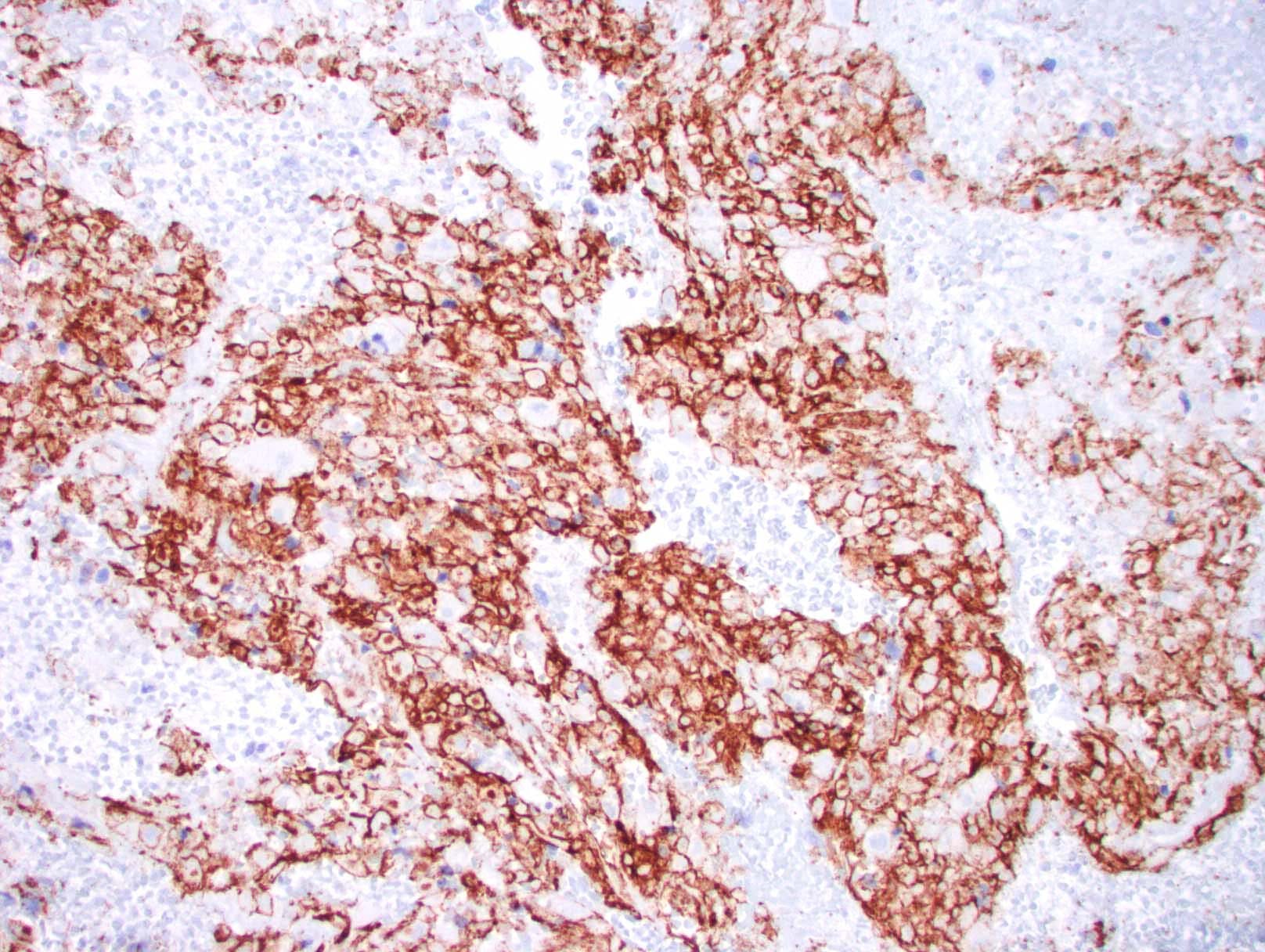 |
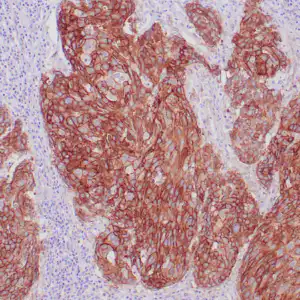
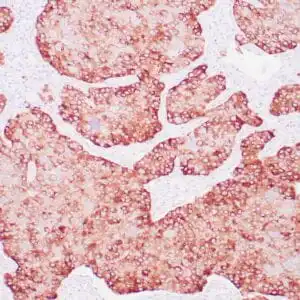
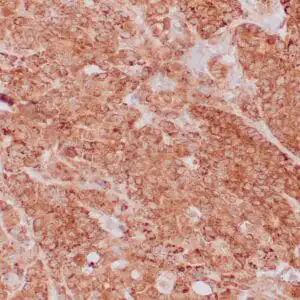
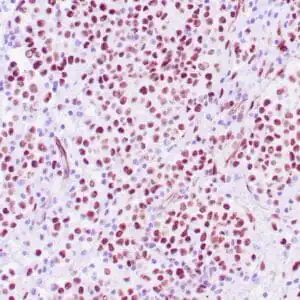
| Human angiosarcoma stained with anti-CD31 antibody using peroxidase-conjugate and DAB chromogen. Note cytoplasmic staining of tumor cells. |
FAQ & Publications
Frequently Asked Questions
What applications is the mouse anti-CD31 monoclonal antibody (JC70A) suitable for?
This antibody is suitable for immunohistochemistry (IHC) on formalin-fixed, paraffin-embedded human tissue samples.
How should the mouse anti-CD31 monoclonal antibody (JC70A) be stored to maintain stability?
For short-term storage, keep the antibody at 2-8°C. For long-term storage, it should be kept at -20°C, and freeze/thaw cycles should be avoided to preserve antibody integrity.
Publications
| pmid | title | authors | citation |
|---|---|---|---|
| We haven't added any publications to our database yet. | |||
Published literature highly relevant to the biological target of this product and referencing this antibody or clone are retrieved from the PubMed database provided by the United States National Library of Medicine at the National Institutes of Health.
Protocols
| relevant to this product |
|---|
| IHC |
Documents
| Batch Number | QC File | SDS |
|---|---|---|
| To view batch-specific Safety Datasheets and Quality Certificates associated with your account, please Log In. | ||
Only logged in customers who have purchased this product may leave a review.

Reviews
There are no reviews yet.