| Weight | 1 lbs |
|---|---|
| Dimensions | 9 × 5 × 2 in |
| host | goat |
| isotype | IgG |
| clonality | polyclonal |
| concentration | 1 mg/mL |
| applications | ICC/IF, WB |
| reactivity | VSV-G |
| available sizes | 1 mg |

goat anti-VSV-G HRP polyclonal antibody 1734
$3,142.00
Antibody summary
- Goat polyclonal to VSV-G , HRP conjugate
- Suitable for: ELISA,ICC,IHC,WB
- Isotype: Whole IgG
- 1 mg
goat anti-VSV-G HRP polyclonal antibody 1734
| antibody |
|---|
| Tested applications WB,IHC,IHC,ICC/IF,ELISA |
| Recommended dilutions Immunoblotting: use at a dilution of 1:1,000- 1:30,000. Immunocytochemistry: use at a dilution of 1:200-1:500 ELISA: use at a dilution of 1:10,000- 1:100,000 These are recommended dilutions. Endusers should determine optimal dilutions for their applications. |
| Immunogen Synthetic peptide YTDIEMNRLGK conjugated to KLH. |
| Size and concentration 1mg and 1 mg/mL |
| Form liquid |
| Storage Instructions This antibody is stable for at least one (1) year at 2-8°C. |
| Storage buffer Phosphate Buffered Saline (PBS) containing 0.09 |
| Purity peptide affinity purification |
| Clonality polyclonal |
| Isotype IgG |
| Compatible secondaries donkey anti-goat IgG, H&L chain specific, peroxidase conjugated polyclonal antibody 1689 donkey anti-goat IgG, H&L chain specific, biotin conjugated polyclonal antibody 1699 donkey anti-goat IgG, H&L chain specific, FITC conjugated polyclonal antibody 1704 donkey anti-goat IgG, H&L chain specific, peroxidase conjugated polyclonal antibody, crossabsorbed 1709 donkey anti-goat IgG, H&L chain specific, FITC conjugated polyclonal antibody, crossabsorbed 1705 |
| Isotype control Goat polyclonal - Isotype Control |
| target relevance |
|---|
| Protein names Vesicular stomatitis virus glycoprotein tag, VSV-G epitope |
| Biotechnology The VSV-G tag has become a valuable and versatile tool in scientific research, particularly in molecular biology, cell biology, and virology studies. The VSV-G tag is derived from the glycoprotein of the Vesicular Stomatitis Virus (VSV), a virus that infects animals and does not replicate in mammalian cells. This feature makes the VSV-G tag highly useful for pseudotyping viral particles and creating viral vectors for gene delivery and expression studies. Researchers frequently use the VSV-G tag to replace the native envelope protein of viral vectors, enabling efficient and broad transduction of target cells, including difficult-to-transfect cell types. Furthermore, the VSV-G tag is often employed as a fusion tag for protein expression and purification, as it is well-tolerated and effectively trafficked to the plasma membrane. The VSV-G tag can be readily detected using specific antibodies in a variety of experimental assays, such as Western blotting and immunofluorescence, facilitating the visualization and quantification of tagged proteins. The widespread application of the VSV-G tag in research can be attributed to its utility in viral vector design, as well as its compatibility with multiple expression systems, making it a valuable tool for investigating cellular processes, gene function, and protein dynamics in diverse biological contexts. |
Data
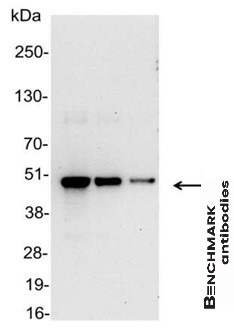 |
| Detection of VSV-G-tagged fusion protein in 200, 100, and 50ng of E. coli lysate with #1734 diluted 1:25,000. |
FAQ & Publications
Frequently Asked Questions
What applications has the goat anti-VSV-G HRP polyclonal antibody 1734 been validated for?
This antibody has been tested and validated for use in Western blotting (WB), immunohistochemistry (IHC), immunocytochemistry/immunofluorescence (ICC/IF), and ELISA assays.
What are the recommended dilutions for using this antibody in ELISA and immunoblotting?
For ELISA, the recommended dilution range is 1:10,000 to 1:100,000. For immunoblotting (Western blot), use a dilution range of 1:1,000 to 1:30,000. Optimal dilutions should be determined by the end user for specific applications.
How should the goat anti-VSV-G HRP polyclonal antibody be stored to maintain stability?
The antibody should be stored in liquid form at 2-8°C. It is stable for at least one year under these conditions.
What is the host species and clonality of this anti-VSV-G antibody?
The antibody is a goat polyclonal IgG, generated against the VSV-G epitope.
What immunogen was used to produce this goat anti-VSV-G antibody?
The immunogen is a synthetic peptide with the sequence YTDIEMNRLGK conjugated to keyhole limpet hemocyanin (KLH).
Publications
| pmid | title | authors | citation |
|---|---|---|---|
| We haven't added any publications to our database yet. | |||
Published literature highly relevant to the biological target of this product and referencing this antibody or clone are retrieved from the PubMed database provided by the United States National Library of Medicine at the National Institutes of Health.
Protocols
| relevant to this product |
|---|
| Western blot IHC ICC |
Documents
| Batch Number | QC File | SDS |
|---|---|---|
| To view batch-specific Safety Datasheets and Quality Certificates associated with your account, please Log In. | ||
Only logged in customers who have purchased this product may leave a review.


Reviews
There are no reviews yet.