| Weight | 1 lbs |
|---|---|
| Dimensions | 9 × 5 × 2 in |
| host | goat |
| isotype | IgG |
| clonality | polyclonal |
| concentration | 1 mg/mL |
| applications | ICC/IF, WB |
| reactivity | BRD2 |
| available sizes | 100 µg |

goat anti-BRD2 polyclonal antibody 8339
$518.00
Antibody summary
- Goat polyclonal to BRD2
- Suitable for: WB,IP
- Isotype: Whole IgG
- 100 µg
goat anti-BRD2 polyclonal antibody 8339
| antibody |
|---|
| Tested applications WB,IP |
| Recommended dilutions Immunoblotting: 0.025 - 0.1 ug/mL.Detection of human BRD2 in RIPA extract (10ug) of HeLa cells untreated (-) or treated (+) with calf intestinal phosphatase with #13020 at 0.05ug/mL. |
| Immunogen Synthetic peptide representing a portion of the protein between the putative nuclear localization signal and the ET domain |
| Size and concentration 100µg and 1 mg/mL |
| Form liquid |
| Storage Instructions This product is stable at 2 -8°C for 1 year. |
| Storage buffer Tris-citrate/phosphate buffer, pH 7 to 8 contai |
| Purity immunogen affinity purification |
| Clonality polyclonal |
| Isotype IgG |
| Compatible secondaries donkey anti-goat IgG, H&L chain specific, peroxidase conjugated polyclonal antibody 1689 donkey anti-goat IgG, H&L chain specific, biotin conjugated polyclonal antibody 1699 donkey anti-goat IgG, H&L chain specific, FITC conjugated polyclonal antibody 1704 donkey anti-goat IgG, H&L chain specific, peroxidase conjugated polyclonal antibody, crossabsorbed 1709 donkey anti-goat IgG, H&L chain specific, FITC conjugated polyclonal antibody, crossabsorbed 1705 |
| Isotype control Goat polyclonal - Isotype Control |
| target relevance |
|---|
| Homo sapiens BRD2 Bromodomain-containing protein 2 |
| Protein names Bromodomain-containing protein 2 |
| Alternative names O27.1.1 |
| Gene names BRD2 |
| Protein family Belongs to the BET family |
| Function Chromatin reader protein that specifically recognizes and binds histone H4 acetylated at 'Lys-5' and 'Lys-12' (H4K5ac and H4K12ac, respectively), thereby controlling gene expression and remodeling chromatin structures (PubMed:17148447, PubMed:17848202, PubMed:18406326, PubMed:20048151, PubMed:20709061, PubMed:20871596). Recruits transcription factors and coactivators to target gene sites, and activates RNA polymerase II machinery for transcriptional elongation (PubMed:28262505). Plays a key role in genome compartmentalization via its association with CTCF and cohesin: recruited to chromatin by CTCF and promotes formation of topologically associating domains (TADs) via its ability to bind acetylated histones, contributing to CTCF boundary formation and enhancer insulation (PubMed:35410381). Also recognizes and binds acetylated non-histone proteins, such as STAT3 (PubMed:28262505). Involved in inflammatory response by regulating differentiation of naive CD4(+) T-cells into T-helper Th17: recognizes and binds STAT3 acetylated at 'Lys-87', promoting STAT3 recruitment to chromatin (PubMed:28262505). In addition to acetylated lysines, also recognizes and binds lysine residues on histones that are both methylated and acetylated on the same side chain to form N6-acetyl-N6-methyllysine (Kacme), an epigenetic mark of active chromatin associated with increased transcriptional initiation (PubMed:37731000). Specifically binds histone H4 acetyl-methylated at 'Lys-5' and 'Lys-12' (H4K5acme and H4K12acme, respectively) (PubMed:37731000) |
| Subcellular location Nucleus, Chromosome |
| Structure (Microbial infection) Interacts with herpes virus 8 protein LANA1 |
| Keywords 3D-structure, Acetylation, Alternative splicing, Bromodomain, Chromatin regulator, Chromosome, Host-virus interaction, Nucleus, Phosphoprotein, Proteomics identification, Reference proteome, Repeat, Transcription, Transcription regulation |
| Sequence MLQNVTPHNKLPGEGNAGLLGLGPEAAAPGKRIRKPSLLYEGFESPTMASVPALQLTPAN PPPPEVSNPKKPGRVTNQLQYLHKVVMKALWKHQFAWPFRQPVDAVKLGLPDYHKIIKQP MDMGTIKRRLENNYYWAASECMQDFNTMFTNCYIYNKPTDDIVLMAQTLEKIFLQKVASM PQEEQELVVTIPKNSHKKGAKLAALQGSVTSAHQVPAVSSVSHTALYTPPPEIPTTVLNI PHPSVISSPLLKSLHSAGPPLLAVTAAPPAQPLAKKKGVKRKADTTTPTPTAILAPGSPA SPPGSLEPKAARLPPMRRESGRPIKPPRKDLPDSQQQHQSSKKGKLSEQLKHCNGILKEL LSKKHAAYAWPFYKPVDASALGLHDYHDIIKHPMDLSTVKRKMENRDYRDAQEFAADVRL MFSNCYKYNPPDHDVVAMARKLQDVFEFRYAKMPDEPLEPGPLPVSTAMPPGLAKSSSES SSEESSSESSSEEEEEEDEEDEEEEESESSDSEEERAHRLAELQEQLRAVHEQLAALSQG PISKPKRKREKKEKKKKRKAEKHRGRAGADEDDKGPRAPRPPQPKKSKKASGSGGGSAAL GPSGFGPSGGSGTKLPKKATKTAPPALPTGYDSEEEEESRPMSYDEKRQLSLDINKLPGE KLGRVVHIIQAREPSLRDSNPEEIEIDFETLKPSTLRELERYVLSCLRKKPRKPYTIKKP VGKTKEELALEKKRELEKRLQDVSGQLNSTKKPPKKANEKTESSSAQQVAVSRLSASSSS SDSSSSSSSSSSSDTSDSDSG |
| UniProt accession: P25440 |
Data
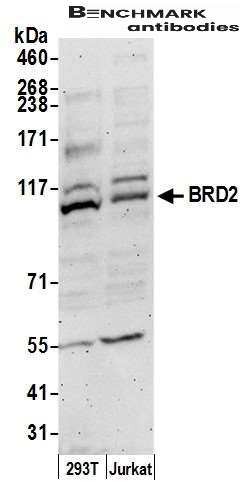 |
| Detection of human BRD2 by western blot. Samples: Whole cell lysate (50 µg ) from HEK293T and Jurkat cells prepared using NETN lysis buffer. Antibody: Affinity purified goat anti-BRD2 antibody 8339 (lot 8339-2) used for WB at 0.1 µg /ml. Detection: Chemiluminescence with an exposure time of 3 minutes. |
FAQ & Publications
Frequently Asked Questions
What species does the goat anti-BRD2 polyclonal antibody 8339 specifically react with, and what are its validated applications?
The goat anti-BRD2 polyclonal antibody 8339 specifically reacts with human BRD2 and is validated for use in Western blotting (WB) and immunoprecipitation (IP) applications. It is also suitable for immunocytochemistry/immunofluorescence (ICC/IF).
How should the goat anti-BRD2 polyclonal antibody 8339 be stored to maintain its stability, and what is its concentration and form?
The goat anti-BRD2 polyclonal antibody 8339 is supplied as a liquid at a concentration of 1 mg/mL. It should be stored at 2–8°C for up to 1 year to maintain stability. The storage buffer is a Tris-citrate/phosphate buffer with a pH between 7 and 8.
Publications
| pmid | title | authors | citation |
|---|---|---|---|
| We haven't added any publications to our database yet. | |||
Published literature highly relevant to the biological target of this product and referencing this antibody or clone are retrieved from the PubMed database provided by the United States National Library of Medicine at the National Institutes of Health.
Protocols
| relevant to this product |
|---|
| Western blot |
Documents
| Batch Number | QC File | SDS |
|---|---|---|
| To view batch-specific Safety Datasheets and Quality Certificates associated with your account, please Log In. | ||
Only logged in customers who have purchased this product may leave a review.


Reviews
There are no reviews yet.