| Weight | 1 lbs |
|---|---|
| Dimensions | 9 × 5 × 2 in |
| target | Chikungunya Glycoprotein E1 (A226V) |
| species reactivity | Chikungunya virus |
| applications | ELISA |
| assay type | Indirect & quantitative |
| available size | 1 mg |

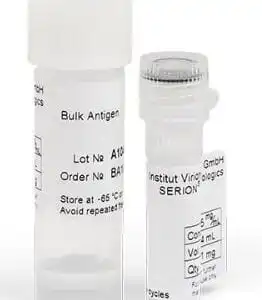
Chikungunya Glycoprotein E1 (A226V) Antigen BA148R3
$1,243.00
Summary
- Virion/Serion Immunologics Antigen for research use (RUO)
- Chikungunya Glycoprotein E1 (A226V) Antigen, recombinant
- Suitable for detection of IgA, IgG & IgM antibodies in ELISA
- Lot specific concentration, specified in mg/mL
- 1 mg
Chikungunya Glycoprotein E1 (A226V) Antigen BA148R3
| kit |
|---|
| Research area Infectious Disease |
| Storage Store -65°C or below. Avoid repeated freeze-thaw cycles. Avoid repeated freeze-thaw cycles. |
| Form liquid |
| Associated products Chikungunya Glycoprotein E2 Antigen (BA148R1) Chikungunya Glycoprotein E1 Antigen (BA148R2) Chikungunya Glycoprotein E1 (A226V) Antigen (BA148R3) Chikungunya Virus Human IgG Assay Control (BC148G) Chikungunya Virus Human IgM Assay Control (BC148M) Chikungunya Virus IgG ELISA Kit (ESR148G) Chikungunya Virus IgM ELISA Kit (ESR148M) |
| target relevance |
|---|
| Chikungunyavirus |
| Description Chikungunya virus - Virus that causes chikungunya fever |
| Structure Chikungunya virus (CHIKV) is an enveloped, positive-sense, single-stranded RNA virus belonging to the genus Alphavirus within the family Togaviridae. The virus is transmitted primarily by Aedes mosquitoes, particularly Aedes aegypti and Aedes albopictus, which are also vectors for dengue and Zika viruses. Chikungunya virus is maintained in transmission cycles involving humans and mosquitoes in urban settings and may also circulate in sylvatic cycles involving non-human primates and other vertebrate hosts. The viral particle contains a lipid envelope with glycoproteins that facilitate attachment and entry into host cells. Since its identification in Tanzania in 1952, chikungunya virus has caused numerous outbreaks across Africa, Asia, Europe, and the Americas. The virus is notable for causing debilitating joint pain that may persist for months or years after acute infection. |
| Diagnosis The diagnosis of chikungunya virus infection is performed through molecular and serological methods. During the acute phase of illness, reverse transcription polymerase chain reaction (RT-PCR) is the preferred diagnostic method because it allows direct detection of viral RNA in blood samples. As viremia declines, serological assays including ELISA and immunofluorescence tests are used to detect chikungunya-specific IgM and IgG antibodies. Virus neutralization assays may be employed for confirmatory testing in specialized laboratories. Laboratory findings often include lymphopenia, thrombocytopenia, and elevated inflammatory markers. Because the clinical presentation overlaps with dengue, Zika, and other arboviral infections, laboratory confirmation is important for accurate diagnosis. |
| Symptoms Chikungunya fever typically develops following an incubation period of approximately two to twelve days after the bite of an infected mosquito. The disease is characterized by sudden onset of high fever, severe joint pain, headache, muscle aches, fatigue, and rash. Joint pain most commonly affects the hands, wrists, ankles, feet, and larger joints and may be severe enough to limit mobility. While the acute illness generally resolves within one to two weeks, many patients experience persistent or recurrent arthralgia, arthritis, and fatigue that can last for months or even years. Severe complications are uncommon but may include neurological disease, myocarditis, hepatitis, ocular inflammation, and, rarely, death, particularly in elderly individuals and patients with underlying medical conditions. |
Data
FAQ & Publications
Frequently Asked Questions
What is the recommended storage condition for the Chikungunya Glycoprotein E1 (A226V) Antigen BA148R3?
The antigen should be stored at -65°C or below, and repeated freeze-thaw cycles should be avoided to maintain stability.
For which antibody types is the Chikungunya Glycoprotein E1 (A226V) Antigen BA148R3 suitable in ELISA applications?
This recombinant antigen is suitable for the detection of IgA, IgG, and IgM antibodies in ELISA assays.
Publications
| pmid | title | authors | citation |
|---|---|---|---|
| We haven't added any publications to our database yet. | |||
Published literature highly relevant to the biological target of this product and referencing this antibody or clone are retrieved from the PubMed database provided by the United States National Library of Medicine at the National Institutes of Health.
Protocols
| relevant to this product |
|---|
Only logged in customers who have purchased this product may leave a review.













Reviews
There are no reviews yet.