|
Protocol - Nivolumab ELISA
Catalog #: 60031
For the quantitative measurement of Nivolumab in serum, plasma, supernatants.
|

|
This ELISA is a solid-phase indirect enzyme-linked immunosorbent assay (ELISA) for the quantitative measurement of Nivolumab in biological samples. This assay is highly specific and sensitive, providing a reliable method for quantitative analysis.
This assay employs an indirect ELISA for the quantitative measurement of Nivolumab. Samples and Standards are added to antigen-coated microplate wells, allowing target-specific binding molecules to bind to the immobilized antigen. After washing, an HRP-labeled secondary antibody is added to detect the bound molecules. Following a final wash, Substrate Solution (TMB) is added, producing a colorimetric reaction proportional to the amount of bound analyte. The reaction is stopped with Stop Solution, and absorbance is measured to calculate concentrations from the Standard Curve.
| Component | Description |
|---|---|
| ELISA Microplate | 96-well (12 strips × 8) coated microplate |
| Lyophilized Standard | 2 vials |
| HRP-Detector Reagent (100X) | 120 µL |
| Sample Dilution Buffer | 20 mL |
| HRP-Detector Dilution Buffer | 10 mL |
| Wash Buffer Concentrate (25X) | 30 mL |
| Substrate Solution (TMB) | 10 mL |
| Stop Solution | 10 mL |
| Plate Sealers | 5 adhesive sealing films |
* Store the unopened kit at 2–8°C. Do not use past the expiration date. Do not combine materials from different lots.
The following are general guidelines. Sample stability has not been fully characterized.
Bring all reagents to room temperature before use. 1X Wash Buffer may be prepared in full at any time. Prepare only the required volume of 1X HRP-Detector Reagent, no more than 30 minutes before use.
Prepare diluted samples and the Standard dilution series. Use all diluted Standards and samples within 2 hours. A second vial of Lyophilized Standard is provided for later experiments.
| 1. | Bring all reagents and samples to room temperature. Prepare Standards, 1X Wash Buffer, 1X HRP-Detector Reagent, and appropriately diluted samples. Place the required number of microplate strips into the plate frame. Duplicate Standard and sample measurements are recommended. Return unused strips to the foil pouch containing the desiccant pack, and reseal. |
| 2. | Add 100 µL of each Standard to the designated wells. Add 100 µL of each sample to the designated wells. Record sample positions. Apply a plate sealer and incubate at 37°C for 90 minutes. |
| 3. | Aspirate the contents of each well and wash three times with 350 µL of 1X Wash Buffer per wash. Ensure complete removal of liquid at each step. After the last wash, remove any remaining Wash Buffer by inverting the plate and blotting it against clean paper towels. |
| 4. | Add 100 µL of 1X HRP-Detector Reagent to all wells. Apply a plate sealer and incubate at 37°C for 60 minutes. |
| 5. | Aspirate the contents of each well and wash five times with 350 µL of 1X Wash Buffer per wash. Wash and blot the plate as described above. |
| 6. | Add 90 µL of Substrate Solution (TMB) to all wells. Incubate at 37°C, protected from direct light, for 10–20 minutes. Monitor color development. The reaction may be stopped when an appreciable color gradient is observed across the Standard dilution series. |
| 7. | Add 50 µL of Stop Solution to each well. The color in the wells should change from blue to yellow. Gently tap the plate to mix the contents of each well. |
| 8. | Measure the Optical Density (OD) of each well within 30 minutes using a microplate reader set to 450 nm. If wavelength correction is available, set correction to 540 nm or 570 nm. |
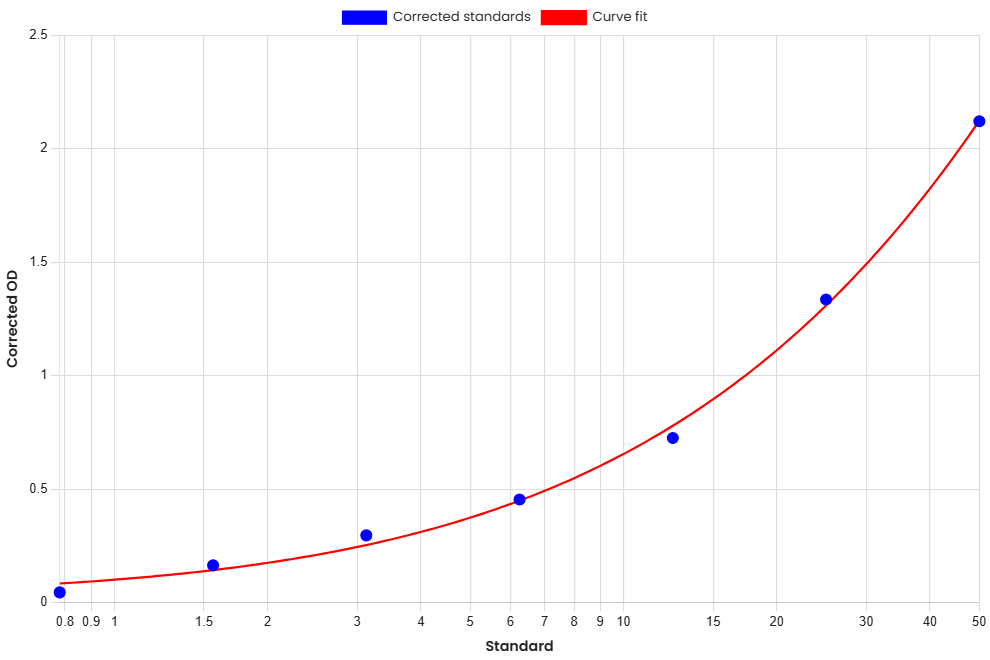
| Standard | Amount [ng/mL] | OD1 | OD2 | Average | Corrected |
|---|---|---|---|---|---|
| Blank #8 | 0 | 0.08 | 0.09 | 0.09 | 0 |
| Standard #7 | 0.78 | 0.13 | 0.13 | 0.13 | 0.05 |
| Standard #6 | 1.56 | 0.25 | 0.25 | 0.25 | 0.17 |
| Standard #5 | 3.13 | 0.38 | 0.39 | 0.38 | 0.3 |
| Standard #4 | 6.25 | 0.53 | 0.55 | 0.54 | 0.46 |
| Standard #3 | 12.5 | 0.8 | 0.82 | 0.81 | 0.73 |
| Standard #2 | 25 | 1.4 | 1.44 | 1.42 | 1.34 |
| Standard #1 | 50 | 2.17 | 2.24 | 2.21 | 2.12 |
| Sample | n | Mean | Standard Deviation | CV (%) |
|---|---|---|---|---|
| Intra Sample 1 | 20 | 1.45 | 0.08 | 5.25 |
| Intra Sample 2 | 20 | 5.92 | 0.31 | 5.23 |
| Intra Sample 3 | 20 | 24.22 | 1.33 | 5.5 |
| Inter Sample 1 | 20 | 1.56 | 0.07 | 4.34 |
| Inter Sample 2 | 20 | 6.13 | 0.33 | 5.46 |
| Inter Sample 3 | 20 | 24.78 | 1.44 | 5.82 |
| Matrix | Recovery Range (%) | Average (%) |
|---|---|---|
| Serum(n=5) | 90-103 | 92 |
| EDTA Plasma(n=5) | 86-105 | 96 |
| HeparinPlasma(n=5) | 85-101 | 91 |
| Sample | 1:2 | 1:4 | 1:8 |
|---|---|---|---|
| Serum(n=5) | 89-100% | 81-86% | 81-93% |
| EDTAPlasma(n=5) | 84-98% | 90-105% | 89-104% |
| Heparin Plasma(n=5) | 85-103% | 83-92% | 91-100% |
| 37°C / 1 Month | 2-8°C / 6 Months | 2-8°C / 12 Months |
|---|---|---|
| 80 | 95-100 | 85-98 |